KS0413 Keyestudio ESP32 Core Board

Description:
This keyestudio ESP32 core board is a Mini development board based on the ESP-WROOM-32 module.
The board has brought out most I/O ports to pin headers of 2.54mm pitch. These provide an easy way of connecting peripherals according to your own needs.
When it comes to developing and debugging with the development board, the both side standard pin headers can make your operation more simple and handy.
 The ESP-WROOM-32 module is the industry’s leading integrated WiFi + Bluetooth solution with less than 10 external components.
It integrates antenna switch, RF balun, power amplifiers, low noise amplifiers, filters and power management modules.
At the same time, it also integrates with TSMC’s low-power 40nm technology, so that power performance and RF performance are safe and reliable, easy to expand to a variety of applications.
Technical Details:
Microcontroller: ESP-WROOM-32 module
USB to Serial Port Chip: CP2102-GMR
Operating Voltage: DC 3.3V
Operating Current: 80mA (average)
Current Supply: 500mA (Minimum)
Operating Temperature Range: -40℃ ~ +85℃
WiFi mode: Station/SoftAP/SoftAP+Station/P2P
WiFi protocol: 802.11 b/g/n/e/i (802.11n, speed up to 150 Mbps
WiFi frequency range: 2.4 GHz ~ 2.5 GHz
Bluetooth protocol: conform to Bluetooth v4.2 BR/EDR and BLE standards
Weight: 9.3g
Dimensions: 55mm*26mm*13mm

Element and Interfaces:
Here is an explanation of what every element and interface of the board has:
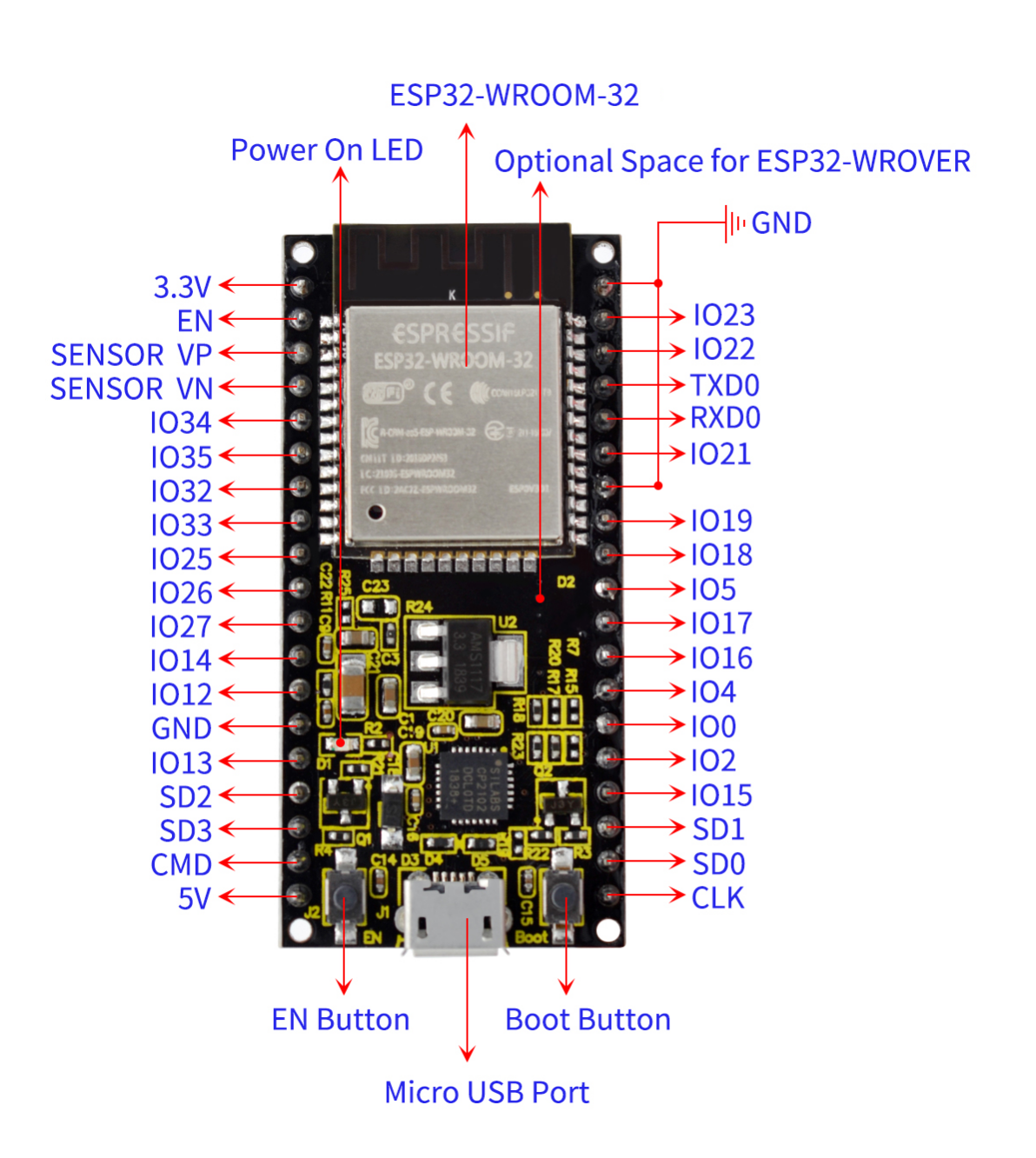
Specialized Functions of Some Pins:
PINS |
EXPLANATIONS |
|---|---|
IO23 |
VSPI MOSI/SPI MOSI |
IO22 |
Wire SCL |
TXD0 |
IO1/Serial TX |
RXD0 |
IO3/Serial RX |
IO21 |
Wire SDA |
IO19 |
VSPI MISO/SPI MISO |
IO18 |
VSPI SCK/SPI SCK |
IO5 |
VSPI SS/SPI SS |
IO4 |
ADC10/TOUCH0 |
IO0 |
ADC11/TOUCH1 |
IO2 |
ADC12/TOUCH2 |
IO15 |
HSPI SS/ADC13/TOUCH3/TDO |
SD1 |
IO8/FLASH D1 |
SD0 |
IO7/FLASH D0 |
CLK |
IO6/FLASH SCK |
CMD |
IO11/FLASH CMD |
SD3 |
IO10/FLASH D3 |
SD2 |
IO9/FLASH D2 |
IO13 |
HSPI MOSI/ADC14/TOUCH4/TCK |
IO12 |
HSPI MISO/ADC15/TOUCH5/TDI |
IO14 |
HSPI SCK/ADC16/TOUCH6/TMS |
IO27 |
ADC17/TOUCH7 |
IO26 |
ADC19/DAC2 |
IO25 |
ADC18/DAC1 |
IO33 |
ADC5/TOUCH8 |
IO32 |
ADC4/TOUCH9 |
IO35 |
ADC7 |
IO34 |
ADC6 |
SENSOR VN |
IO39/ADC3 |
SENSOR VP |
IO36/ADC0 |
EN |
RESET |
Detailed Using Method as follows:
Step1 Install the Arduino IDE
When programming the control board, first you should install the Arduino software and driver.
You can download the different versions for different systems from the link below:
https://www.arduino.cc/en/Main/OldSoftwareReleases#1.5.x
This control board is compatible with the Arduino 1.8.7 or latest version.
So next we will download the Arduino 1.8.7 software to test the keyestudio ESP32 core board.
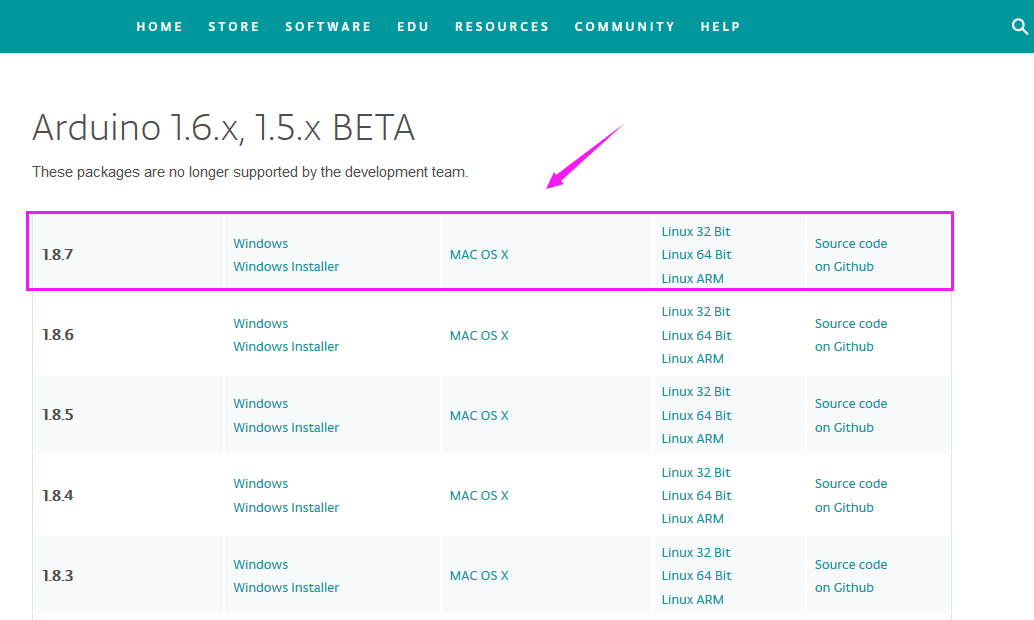
In this Windows system page, there are two options. One is Windows version, the other is Windows Installer.
For Windows Installer, you can download the installation file, this way you need to install the arduino IDE.

For simple Windows version, you can download the software directly, do not need to install, just directly use the software after unzip the package.

Next, we click the Windows, pop up the interface as below.

Click JUST DOWNLOAD.
Downloaded well the arduino-1.8.7-windows.zip package to your computer, you can direct to unzip the package. Open the Arduino-1.8.7 folder, you should get it as follows.
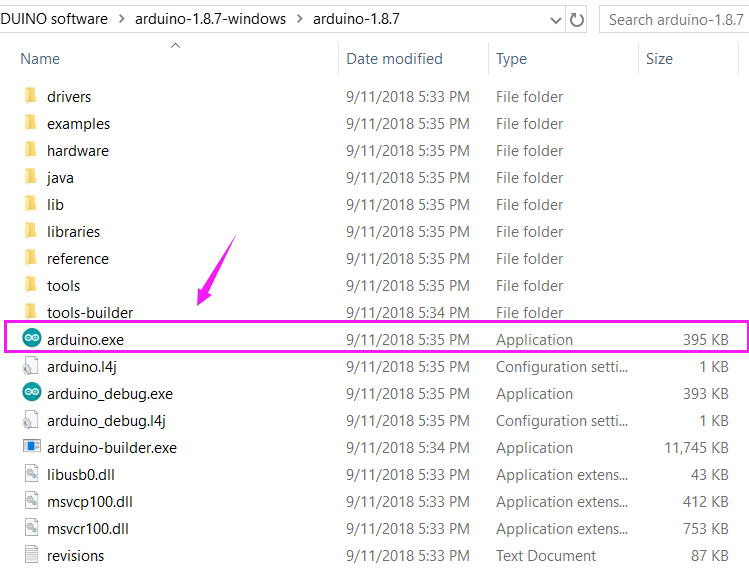
Click the icon of ARDUINO software to open. This is your Arduino.

Step2 Installing the Driver
The USB to serial port chip of this control board is CP2102-GMR. So you need to install the driver for the chip.
You can click the driver tool download link:
https://www.silabs.com/products/development-tools/software/usb-to-uart-bridge-vcp-drivers
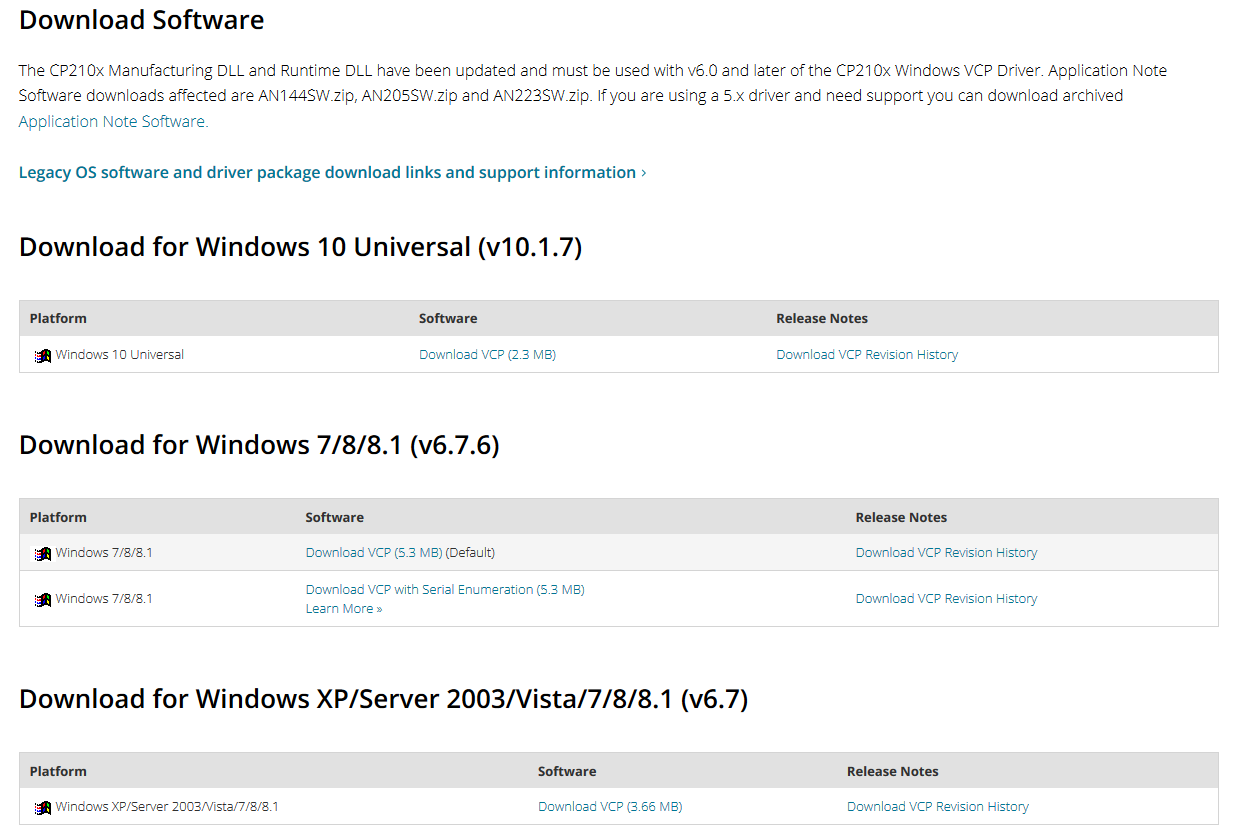
It includes different drivers for different computer’s systems. Download and install the driver according to your computer’s system.
For example, we download the driver for Windows 7. Get the compression package of CP210x_Windows_Drivers

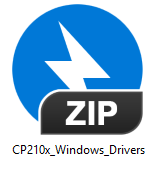
Then extract the compression package; you should see the application to install.
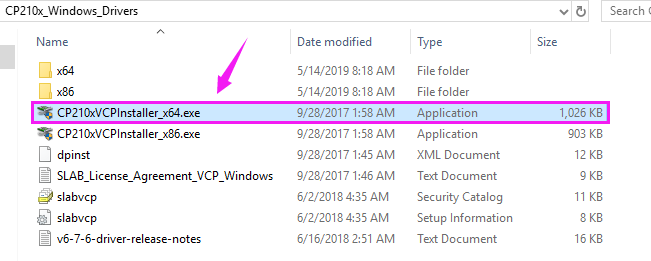
The driver software installation is very simple. Just select the driver application as you like.
Click to .exe package to install the driver. Click “Next”.
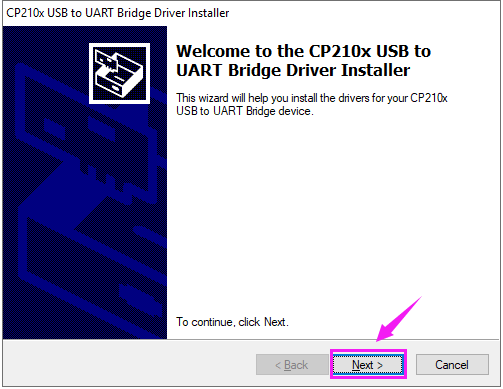
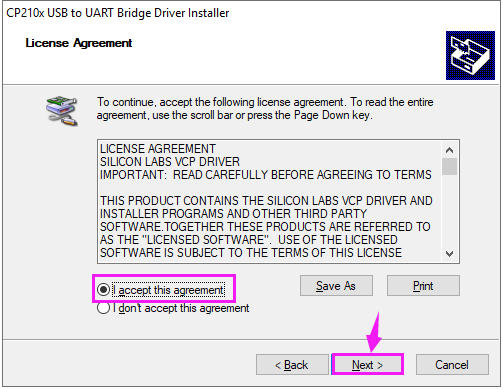
Click to select “I accept this agreement” and click “Next”.
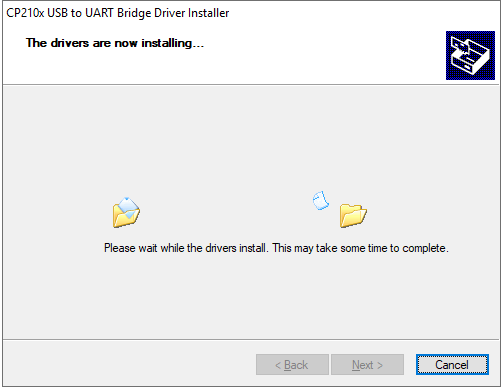
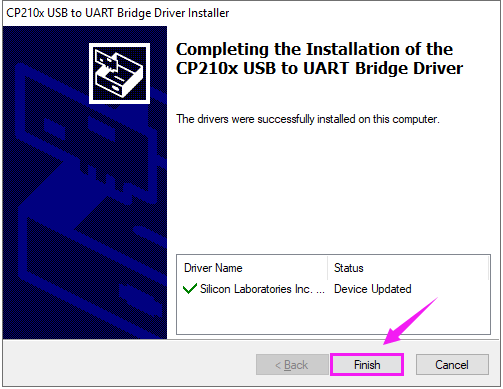
Wait for the installation complete. Finally click “Finish” to close the window.
Step3 Building ESP32 Environment
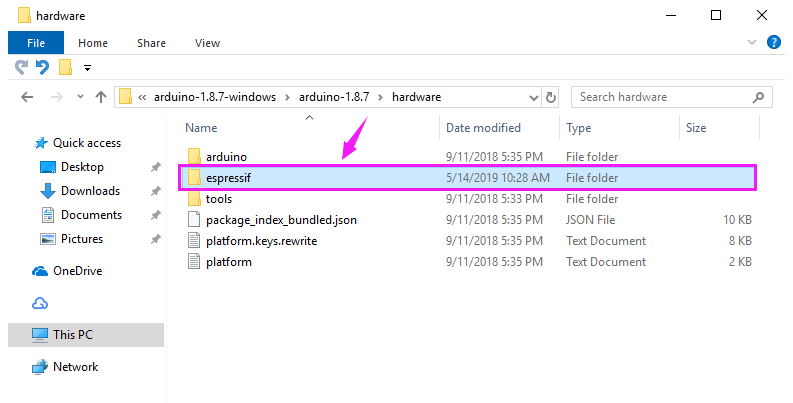
At first, open the Arduino-1.8.7 folder, you will see the hardware folder;
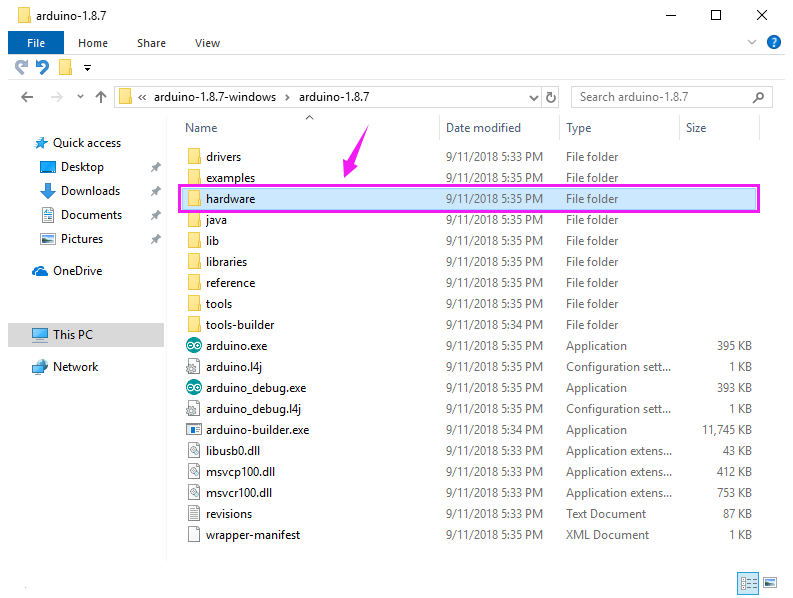
Then open the hardware folder and add a new folder, remember to name it espressif shown below.
After that, unzip the esp32 compression package we provided, and copy to the espressif folder.
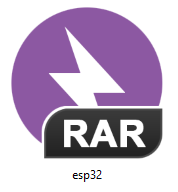
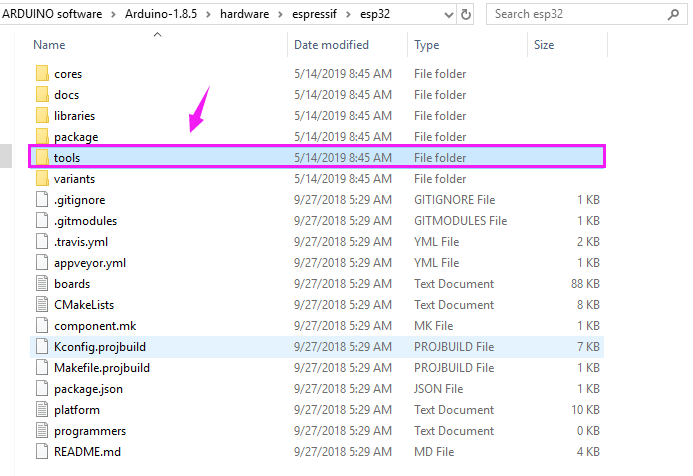
So inside the espressif folder should see the esp32 folder as below. Note that the folder should not name a type.

Now, click to enter the esp32 folder and you can see the tools folder below.
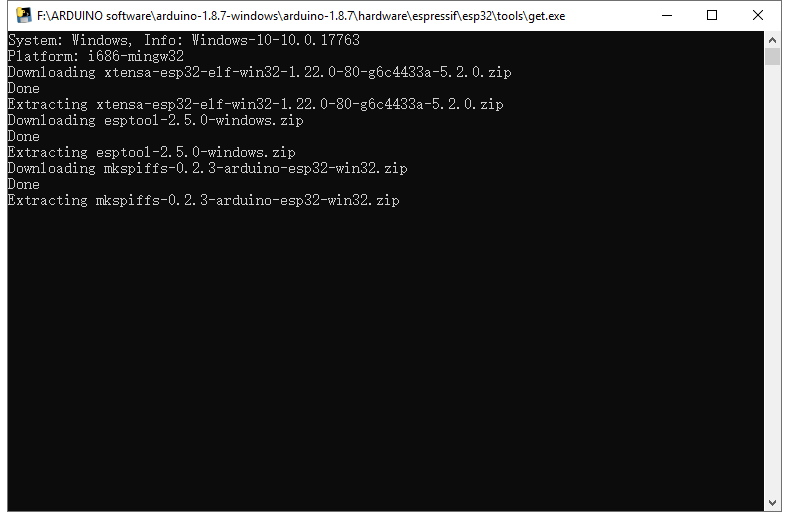
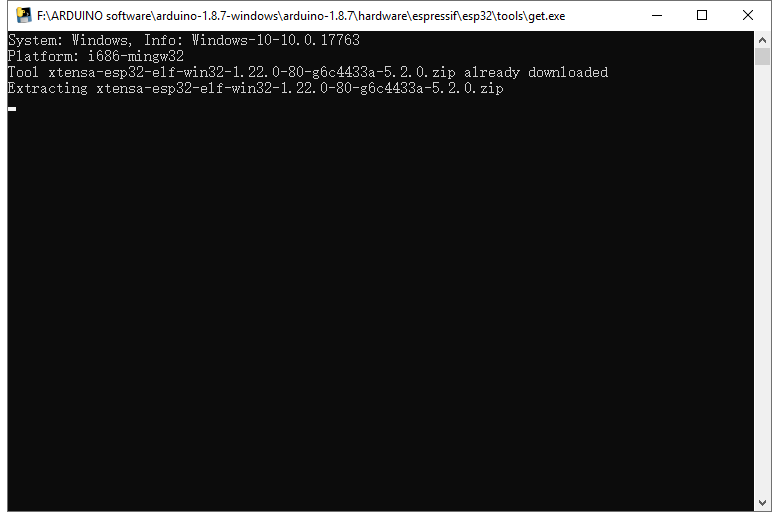
Enter the tools folder and click to run the get.exe application as an administrator. (But the precondition is that you have already installed the Python)
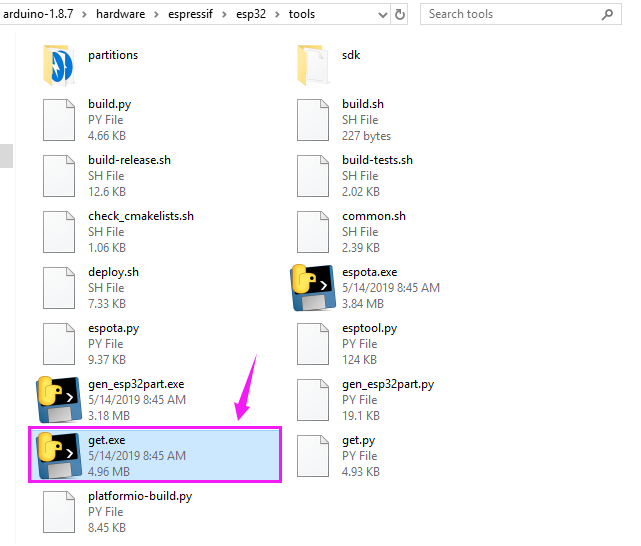
When run the get.exe application, ensure that your network is unblocked and wait for the program download. Done downloading, the following window will automatically close.
Step4 Arduino IDE Setting and Toolbar

Double-click the icon of Arduino software downloaded to open the IDE.
This is your Arduino 1.8.7 interface.
(Note: if the Arduino software loads in the wrong language, you can change it in the preferences dialog. See the environment page for details.)
The functions of each button on the Toolbar are listed below:

|
Check the code for errors |
|
Upload the current Sketch to the Arduino |
|
Create a new blank Sketch |
|
Show a list of Sketches |
|
Save the current Sketch |
|
Display the serial data being sent from the Arduino |
 Verify/Compile
 Upload
 New
New Open
Open Save
Save Serial Monitor
Attach your ESP32 core board to your computer with the USB cable.

Check that the “Board Type”and “Serial Port” are set correctly.
Click to open the “Tools”, for “Board”, scroll to select the ESP32 Dev Module.
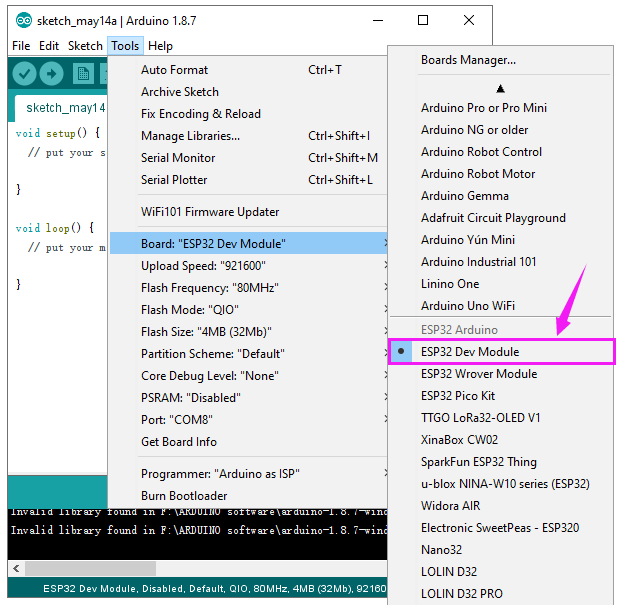
Select well the correct board and then should set the detailed information as shown below.
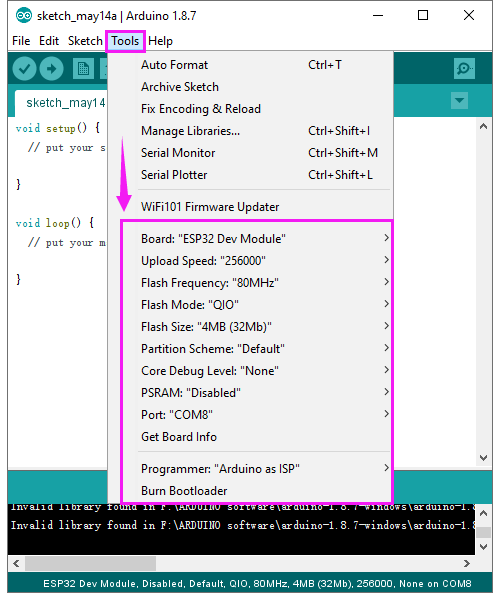
Pay close attention to select the proper COM port. (Arduino driver installed well, you are supposed to see the corresponding port.)
Check out the COM port in the Device Manager of your computer’s control panel.
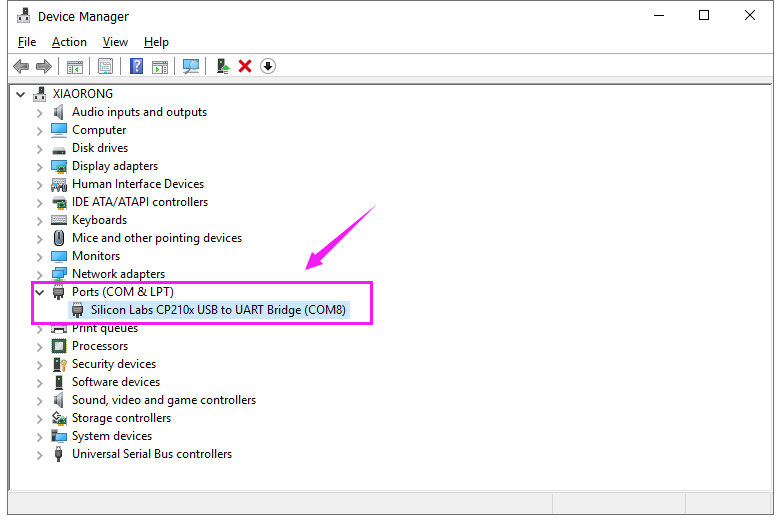
Here we can know the COM port is COM 8. Then select the Port COM 8 in the Arduino Tools.
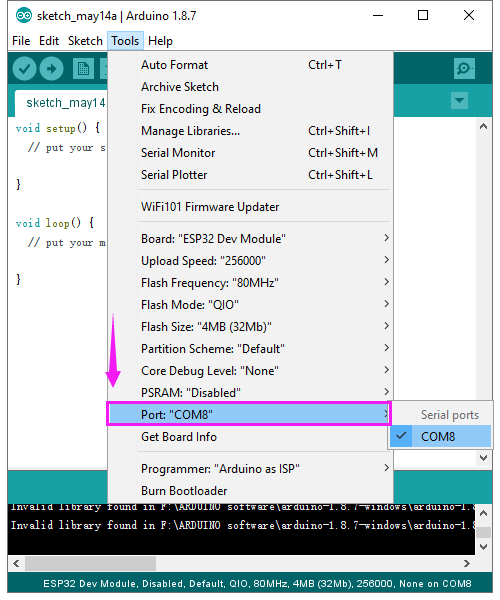
Step5 Upload the Code
Paste and copy the source code below to Arduino IDE.
Special Note: when compile and upload the source code, hold the BOOT button on the ESP32 board until upload well the code.
/*
This sketch demonstrates how to scan WiFi networks.
The API is almost the same as with the WiFi Shield library,
the most obvious difference being the different file you need to include:
*/

#include "WiFi.h"

void setup()
{
Serial.begin(115200);
// Set WiFi to station mode and disconnect from an AP if it was previously connected
WiFi.mode(WIFI_STA);
WiFi.disconnect();
delay(100);
Serial.println("Setup done");
}

void loop()
{
Serial.println("scan start");
// WiFi.scanNetworks will return the number of networks found
int n = WiFi.scanNetworks();
Serial.println("scan done");

if (n == 0)
{
    Serial.println("no networks found");
}
else
{
    Serial.print(n);
    Serial.println(" networks found");
    for (int i = 0; i < n; ++i) {
        // Print SSID and RSSI for each network found
        Serial.print(i + 1);
        Serial.print(": ");
        Serial.print(WiFi.SSID(i));
        Serial.print(" (");
        Serial.print(WiFi.RSSI(i));
        Serial.print(")");
        Serial.println((WiFi.encryptionType(i) == WIFI_AUTH_OPEN)?" ":"*");
        delay(10);
    }
}

Serial.println("");
// Wait a bit before scanning again
delay(5000);
}
Click verify button to check the errors. If compiling successfully, the message “Done compiling.” will appear in the status bar.
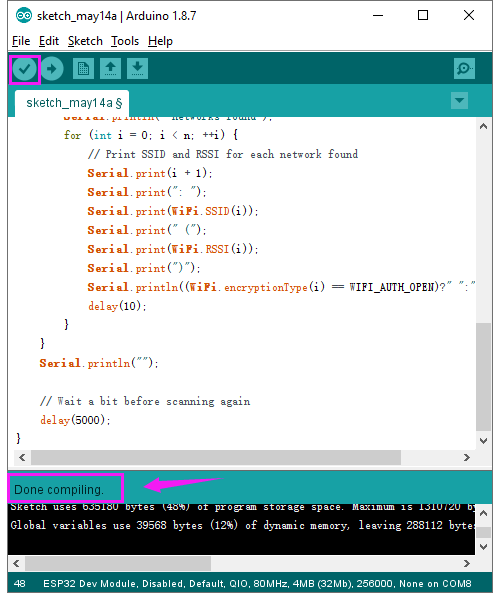
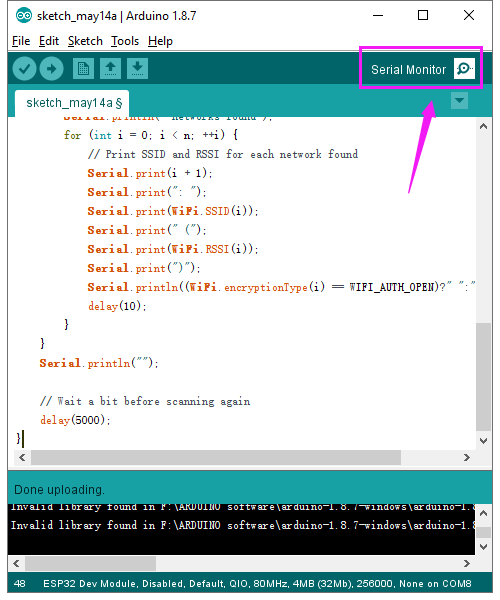
After that, click the “Upload” button to upload the code. If the upload is successful, the message “Done uploading.” will appear in the status bar.
Special Note: if fail to upload, when upload the source code, hold the BOOT button on the ESP32 board until upload well the code.
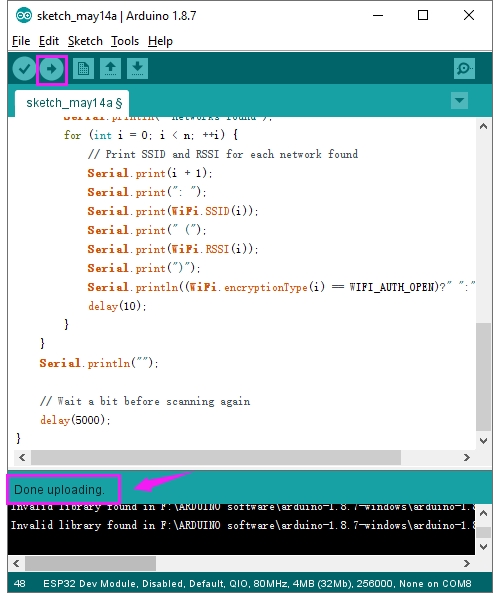
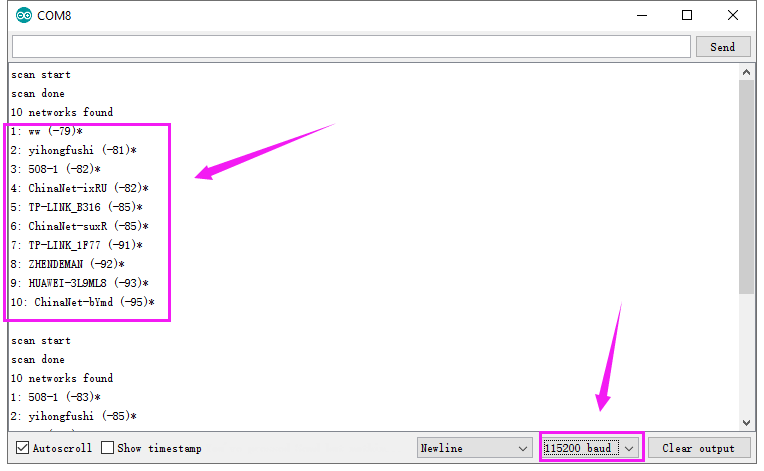
Done uploading the code to your board, open the serial monitor and set the baud rate to 115200. You should be able to see the WIFI information on the pop-up window.
Resource Download:
https://fs.keyestudio.com/KS0413
Download the ARDUINO Software: https://www.arduino.cc/en/Main/OldSoftwareReleases#1.5.x