KS0464 Keyestudio Smart Little Turtle Robot V3

Read me frist
Download the APP, Code and library from the link: https://fs.keyestudio.com/KS0464
1. Introduction
Nowadays, technological education such as VR, kids programming, and artificial intelligence, has become a mainstream in educational industry. Thereby, people attach more importance to STEAM education. Arduino is notably famous for Maker education.
So what is Arduino? Arduino is an open-source electronics platform based on easy-to-use hardware and software. Arduino boards are able to read inputs - light on a sensor, a finger on a button, or a Twitter message - and turn it into an output - activating a motor, turning on an LED, publishing something online. Based on this, Keyestudio team has designed a turtle robot. It has a processor which is programmable using the Arduino IDE, to map its pins to sensors and actuators by a shield that plug in the processor, and it reads sensors and controls the actuators and decides how to operate.
This product boasts 15 learning projects, from simple to complex, which will guide you to make a smart turtle robot all by yourself and introduce the detailed knowledge about sensors and modules.
Moreover, it is the best choice if you intend to obtain a DIY robot for learning programming, entertainment and competition.
2. Features
Multi-purpose function: Multi-purpose function: Obstacle avoidance, following, IR remote control, Bluetooth control, ultrasonic following and facial emoticons display.
Simple assembly: No soldering circuit required, complete assembly easily.
High Tenacity: Aluminum alloy bracket, metal motors, high quality wheels and tracks
High extension: expand other sensors and modules through motor driver shield and sensor shield
Multiple controls: IR remote control, App control(iOS and Android system)
Basic programming: C language code of Arduino IDE.
3. Specification
Working voltage: 5v
Input voltage: 7-12V
Maximum output current: 2A
Maximum power dissipation: 25W (T=75℃)
Motor speed: 5V 63 rpm/min
Motor drive mode: dual H bridge drive
Ultrasonic induction angle: <15 degrees
Ultrasonic detection distance: 2cm-400cm
Infrared remote control distance: 10M (measured)
Bluetooth remote control distance: 50M(measured)
Bluetooth control: support Android and iOS system
4. Kit List

# |
Name |
QTY |
Picture |
|---|---|---|---|
1 |
Keyestudio V4.0 Board (UNO compatible) |
1 |
|
2 |
Keyestudio Quick Connectors Motor Driver Shield |
1 |
|
3 |
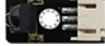
Keyestudio Quick Connectors IR Receiver |
1 |
|
4 |
Keyestudio Quick Connectors Line Tracking Sensor |
1 |
|
5 |
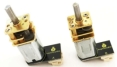
Keyestudio Quick Motor Connector A |
1 |
|
6 |
Keyestudio Quick Motor Connector B |
1 |
|
7 |
Keyestudio 8*8 Dot Matrix Module |
1 |
|
8 |
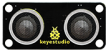
Keyestudio Quick Connectors Ultrasonic Module |
1 |
|
9 |
Keyestudio Bluetooth Module(HC-06) |
1 |
|
10 |
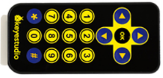
Keyestudio JMFP-4 17 Remote Control(without batteries) |
1 |
|
11 |
15CM 5P 24AWG Wire |
1 |
|
12 |
8CM 4P 24AWG Wire |
1 |
|
13 |
8CM 3P 24AWG Wire |
1 |
|
14 |
160mm 2P 24AW Wire |
2 |
|
15 |
Battery Holder with JST-PH2.0MM-2P Lead |
1 |
|
16 |
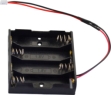
4 Slot AA Battery Holder |
1 |
|
17 |
M2*12MM Round Head Screws |
4 |
|
18 |
M2 Nickel Plated Nuts |
4 |
|
19 |
M3*6MM Round Head Screws |
27 |
|
20 |
M3*6MM Flat Head Screws |
2 |
|
21 |
M3 Nickel Plated Nuts |
5 |
|
22 |
M3*10MM Hexagon Copper Bush |
8 |
|
23 |
M3*40MM Hexagon Copper Bush |
4 |
|
24 |
Keyestudio 9G Servo |
1 |
|
25 |
N20 Motor Wheel |
2 |
|
26 |
N20 Motor U Type Mount |
2 |
|
27 |
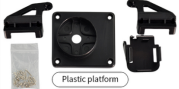
Black Plastic Platform |
1 |
|
28 |
3PI MiniQ Universal Caster |
2 |
|
29 |
3*40MM Black-yellow Screwdriver |
1 |
|
30 |
1m Transparent Blue USB Cable |
1 |
|
31 |
3*100MM Black Ties |
5 |
|
32 |
Turtle Robot Baseboard |
1 |
|
33 |
Turtle Robot Top Board |
1 |
|
34 |
F-F 20CM/40P Dupont Cable |
0.1 |
|
35 |
20cm 3pin F-F Dupont Cable |
1 |
|
36 |
Keyestudio Red LED Module |
1 |
|
37 |
Decorative Board |
1 |
|




















5. Assembly Guide
Note: Peel the plastic film off the board first when installing the smart car.
Step 1: Bottom Motor Wheel
Prepare the parts as follows:
M3*6MM Round Head Screw *2
M3*6MM Flat Head Screw *2
M3 Nickel Plated Nut *2
Bottom PCB*1
Tracking Sensor *1
Universal Caster *2

Step 2: Assemble Parts
Prepare the parts as follows:
M3*6MM Round Head Screw *2
M2 Nut *4
12FN20 Motor *2
U-type Holder* 2
N20 Motor Wheel *2
2P Wire *2
5P Wire *1
M2*12MM Round Head Screw *4
2-cell AA Battery Holder *1
M3*6M Flat Head Screw *2
M3 Nut *2
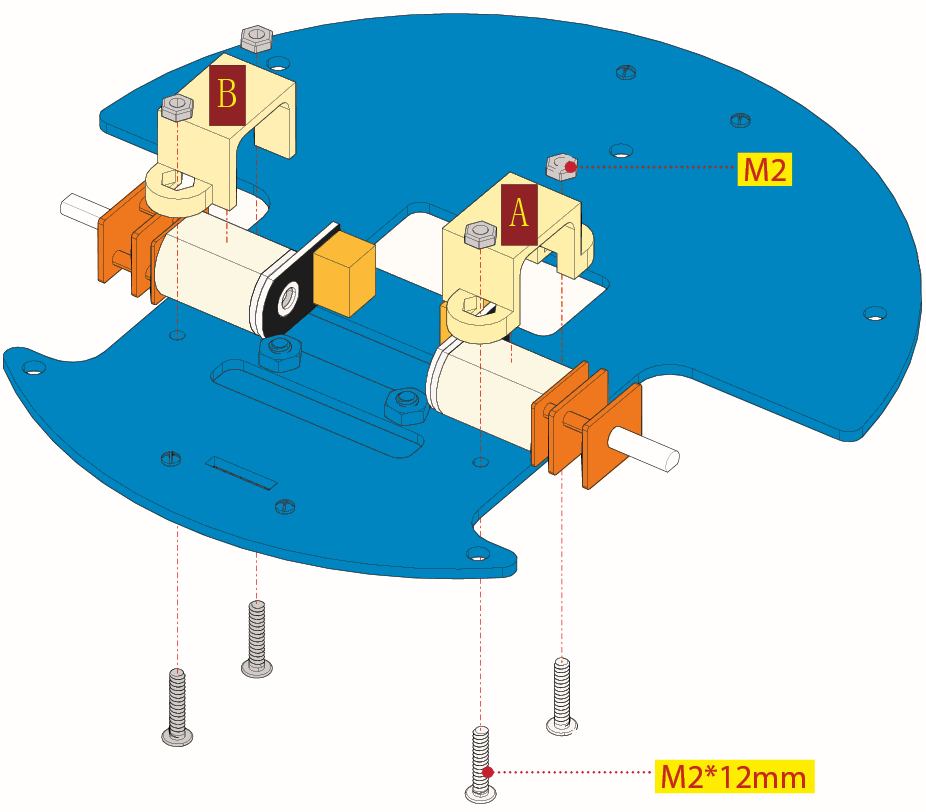

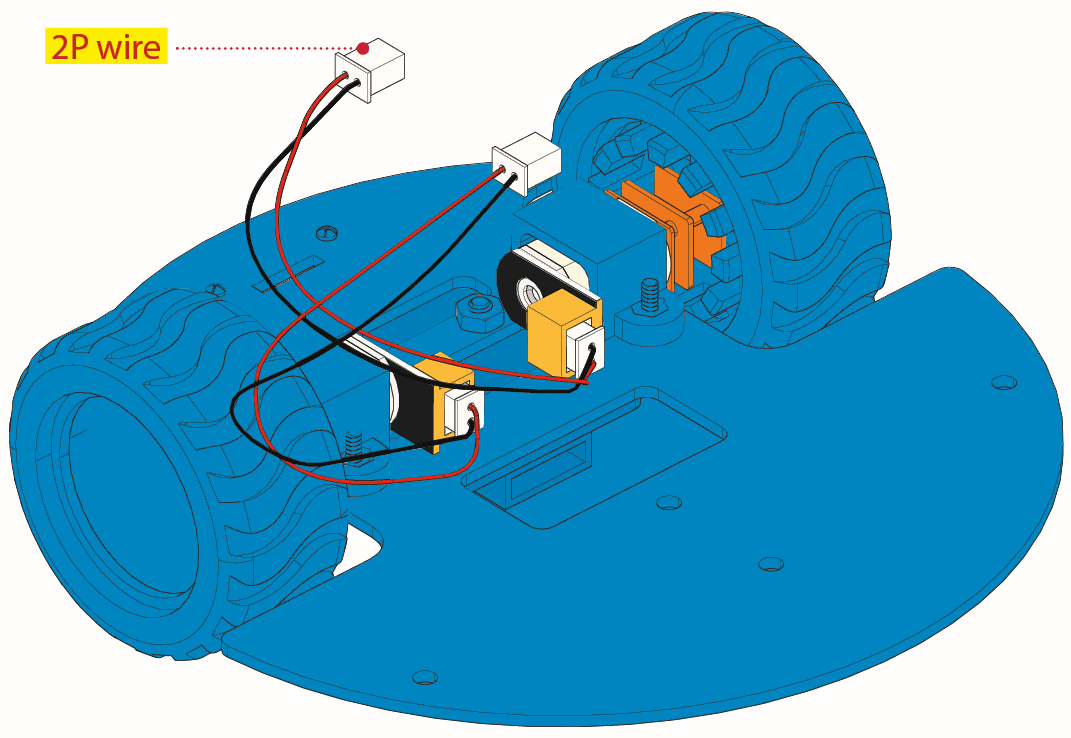


Step 3: Install Top PCB
Prepare the parts as follows:
Top PCB *1
M3 Nut *1
M3*6MM Round Head Screw *9
M3*10MM Hexagon Copper Bush *8
IR Receiver Sensor *1
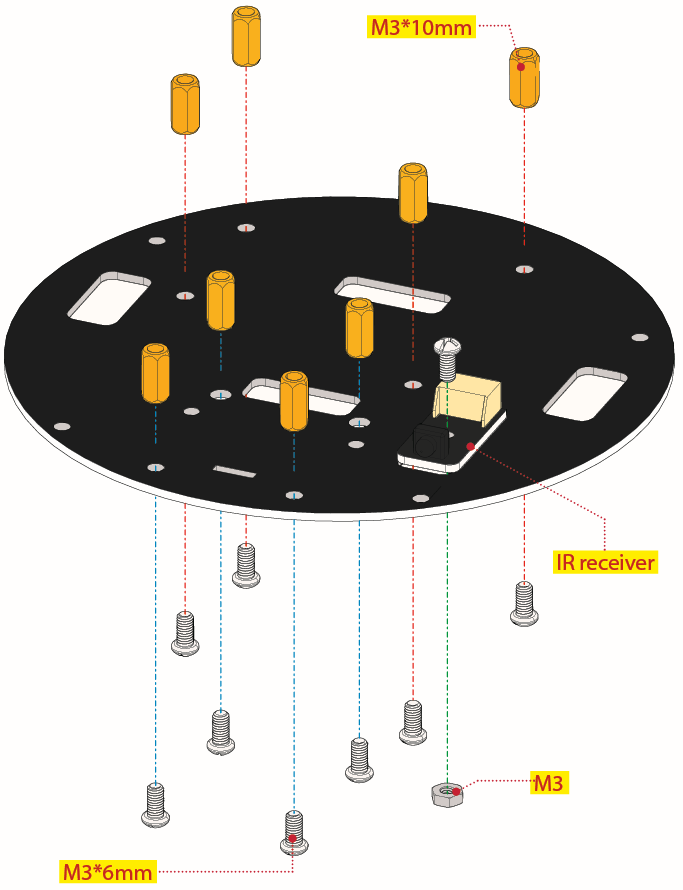
Step 4: Mount Control Board
Prepare the parts as follows:
V4.0 Board*1
Motor Drive Shield V2*1
M3*6MM Round Head Screw *4


Step 5: Servo Plastic Platform
Prepare the parts as follows:
Servo *1
M2*4 Screw *1
Black Tie*2
Ultrasonic Sensor*1
Black Plastic Platform *1
M1.2*4 Tapping Screw *4
M2*8 Tapping Screw *2
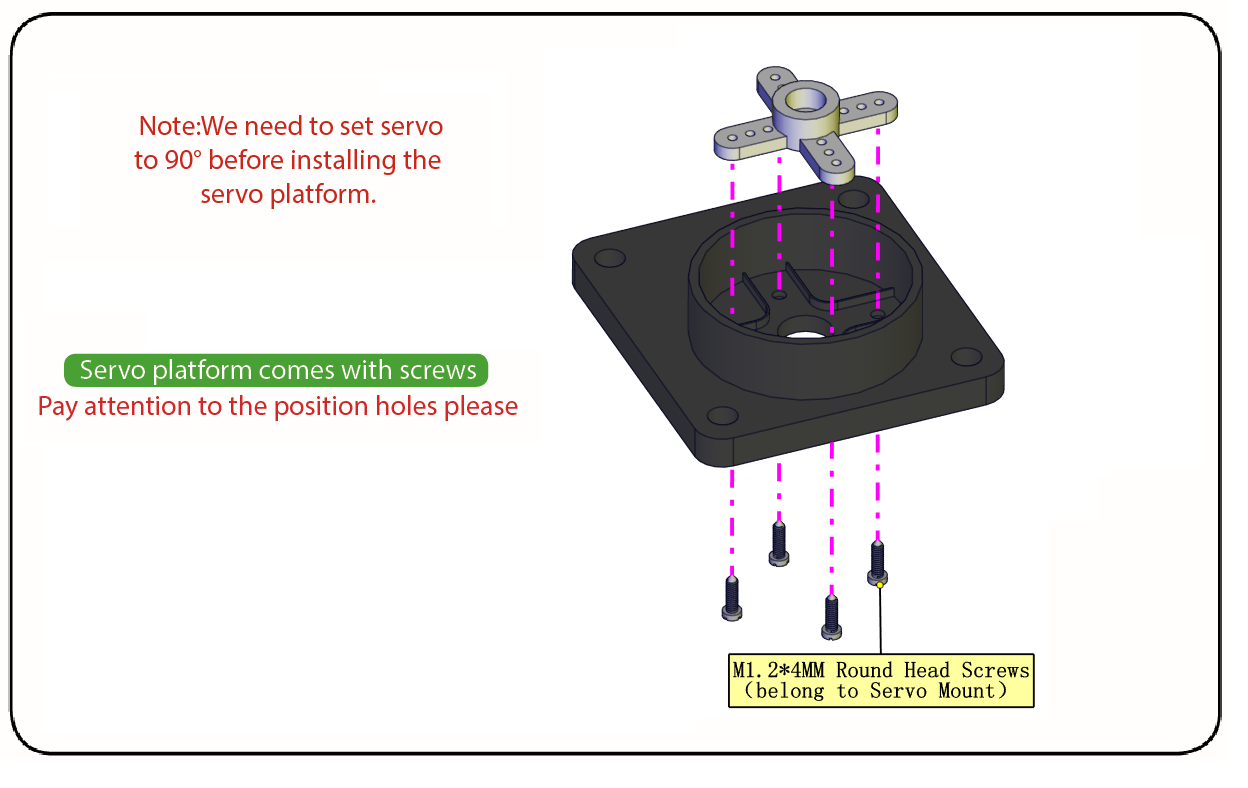

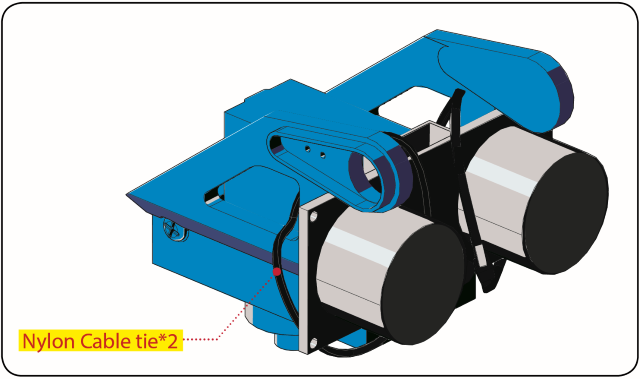
/*
Set the 90-degree code,Copy the code and upload it to the development board. The steering gear connected to port D9 will rotate to 90 °
*/
#define servoPin 9  //servo Pin
int pos; //the angle variable of servo
int pulsewidth; // pulse width variable of servo
void setup() {
  pinMode(servoPin, OUTPUT);  //set servo pin to OUTPUT
  procedure(0); //set the angle of servo to 0°
}
void loop() {

    procedure(90);   // tell servo to go to position in variable 90°

}
// function to control servo
void procedure(int myangle) {
  pulsewidth = myangle * 11 + 500;  //calculate the value of pulse width
  digitalWrite(servoPin,HIGH);
  delayMicroseconds(pulsewidth);   //The duration of high level is pulse width
  digitalWrite(servoPin,LOW);
  delay((20 - pulsewidth / 1000));  // the cycle is 20ms, the low level last for the rest of time
}


Step 6: Final Assembly
Prepare the parts as follows:
M3*6MM Round Head Screw *12
M3*40MM Hexagon Copper Bush *4
8x8 Dot Matrix *1
Jumper Wire *4


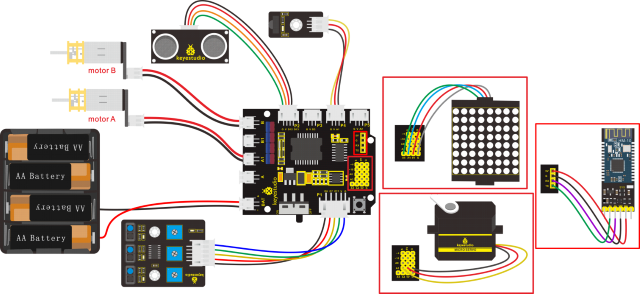
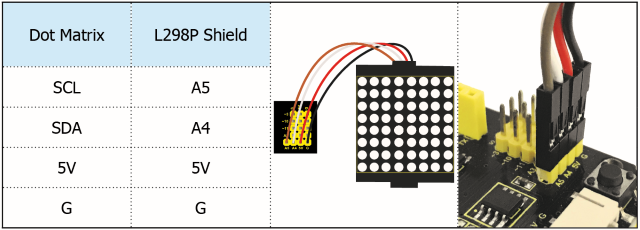
Step 7: Hook-up Guide


6. Getting Started with Arduino
Keyestudio V4.0 Development Board
You need to know that keyestudio V4.0 development board is the core of this smart turtle robot .

Keyestudio V4.0 development board is an Arduino uno -compatible board, which is based on ATmega328P MCU, and with a cp2102 Chip as a UART-to-USB converter.

It has 14 digital input/output pins (of which 6 can be used as PWM outputs), 6 analog inputs, a 16 MHz quartz crystal, a USB connection, a power jack, 2 ICSP headers and a reset button.

It contains everything needed to support the microcontroller; simply connect it to a computer with a USB cable or power it via an external DC power jack (DC 7-12V) or via female headers Vin/ GND(DC 7-12V) to get started.
Microcontroller |
ATmega328P-PU |
|---|---|
Operating Voltage |
5V |
Input Voltage (recommended) |
DC7-12V |
Digital I/O Pins |
14 (D0-D13) (of which 6 provide PWM output) |
PWM Digital I/O Pins |
6 (D3, D5, D6, D9, D10, D11) |
Analog Input Pins |
6 (A0-A5) |
DC Current per I/O Pin |
20 mA |
DC Current for 3.3V Pin |
50 mA |
Flash Memory |
32 KB (ATmega328P-PU) of which 0.5 KB used by bootloader |
SRAM |
2 KB (ATmega328P-PU) |
EEPROM |
1 KB (ATmega328P-PU) |
Clock Speed |
16 MHz |
LED_BUILTIN |
D13 |
Installing Arduino IDE

Click the link to start learning how to download software, install drivers, upload code, and install library files.
7. Projects
The whole project begins with basic programs. Starting from simple to complex, the lessons will guide you to assemble the robot car and absorb the knowledge of electronic and machinery step by step. I reckon that you could hardly sit still and itch to have a go now. Let’s get started.
Note: (G), marked on each sensor and module, is the negative pole and connected to “G”, ”-”or “GND”on the sensor shield or control board ; (V) is the positive pole and linked with V , VCC, + or 5V on the sensor shield or control board.
Project 1: LED Blink
(1)Description
For starters and enthusiasts, LED Blink is a fundamental program. LED, the abbreviation of light emitting diodes, consists of Ga, As, P, N chemical compounds and so on. The LED can flash in diverse color by altering the delay time in the test code. When in control, power on GND and VCC, the LED will be on if S end is in high level; nevertheless, it will go off.
(2)Specification
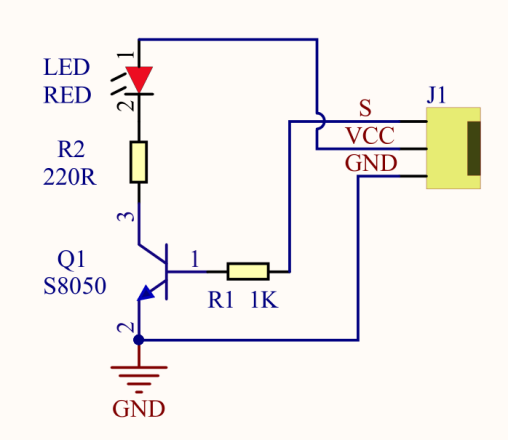

Control interface: digital port
Working voltage: DC 3.3-5V
Pin spacing: 2.54mm
LED display color: red
(3)Components

(4)Wiring Diagram
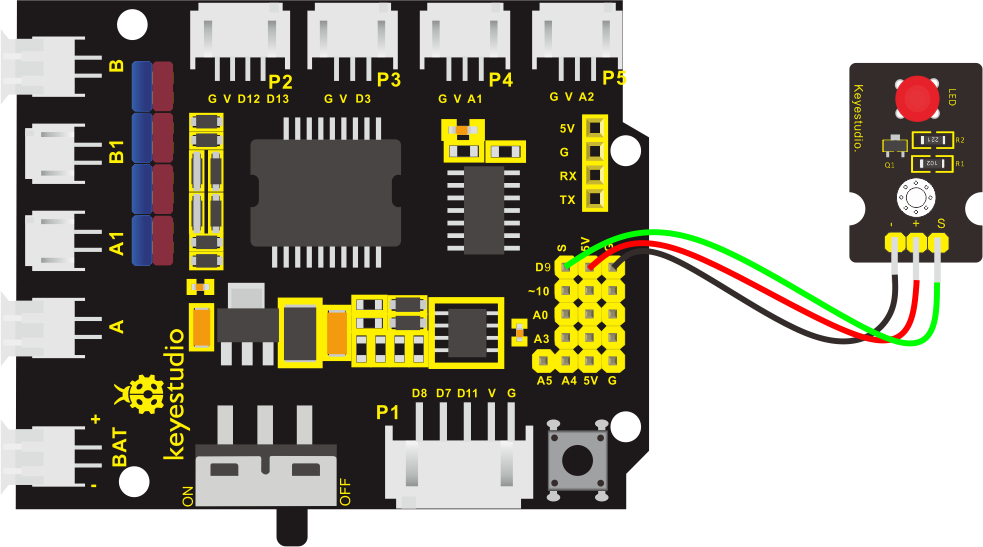
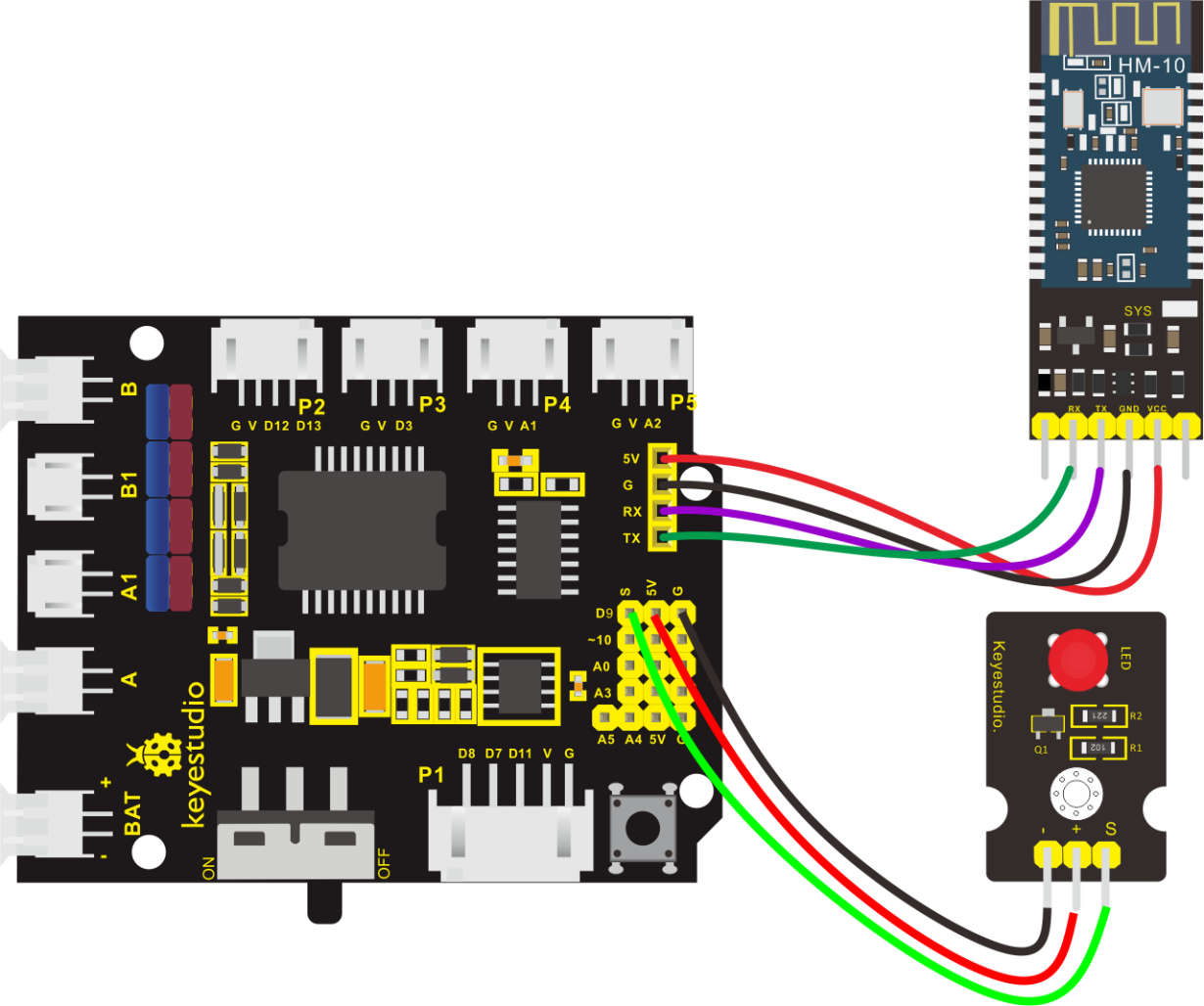
The expansion board is stacked on development board; LED module is connected to G of shield;“+”is linked with 5V and S end is attached to D9.
(5)Test Code
/*
 keyestudio smart turtle robot
 lesson 1.1
 Blink
 http://www.keyestudio.com
*/
#define LED 9

void setup()
{
  pinMode(LED, OUTPUT);// initialize digital pin 9 as an output.
}

void loop() // the loop function runs over and over again forever
{
  digitalWrite(LED, HIGH); // turn the LED on (HIGH is the voltage level)
  delay(1000); // wait for a second
  digitalWrite(LED, LOW); // turn the LED off by making the voltage LOW
  delay(1000); // wait for a second
}
//****************************************************************************
(6)Test Result
Upload the program, then LED flashes at the interval of 1s.
(7)Code Explanation
pinMode(9,OUTPUT) - This function can denote that the pin is INPUT or OUTPUT
digitalWrite(9,HIGH) - When pin is OUTPUT, we can set it to HIGH(output 5V) or LOW(output 0V)
(8)Extension Practice
We have succeeded in blinking LED. Next, let’s observe what will happen to the LED if we modify pins and delay time.
/*
 keyestudio smart turtle robot
 lesson 1.2
 delay
 http://www.keyestudio.com
*/
#define LED 9

void setup()
{
  // initialize digital pin 11 as an output.
  pinMode(LED, OUTPUT);
}
// the loop function runs over and over again forever
void loop()
{
  digitalWrite(LED, HIGH); // turn the LED on (HIGH is the voltage level)
  delay(100); // wait for 0.1 second
  digitalWrite(LED, LOW); // turn the LED off by making the voltage LOW
  delay(100); // wait for 0.1 second
}
//*****************************************************************
The test result shows that the LED flashes faster. Therefore, pins and time delaying affect flash frequency.
Project 2: Adjust LED Brightness
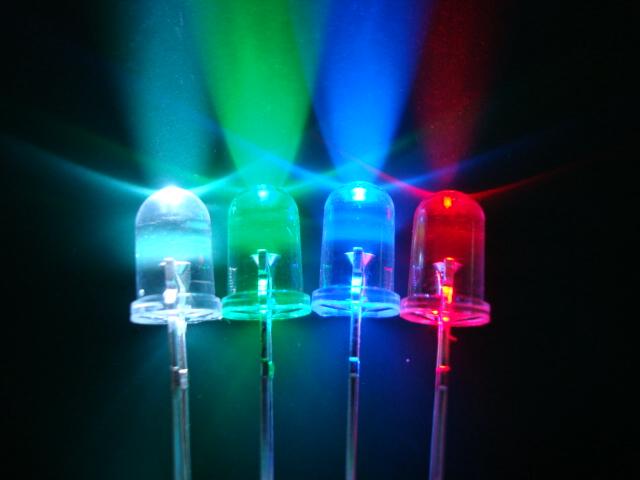
(1) Description
In previous lesson, we control LED on and off and make it blink.
In this project, we will control LED’s brightness through PWM simulating breathing effect. Similarly, you can change the step length and delay time in the code so as to demonstrate different breathing effects.
PWM is a means of controlling the analog output via digital means. Digital control is used to generate square waves with different duty cycles (a signal that constantly switches between high and low levels) to control the analog output.In general, the input voltages of ports are 0V and 5V. What if the 3V is required? Or a switch among 1V, 3V and 3.5V? We cannot change resistors constantly. For this reason, we resort to PWM.
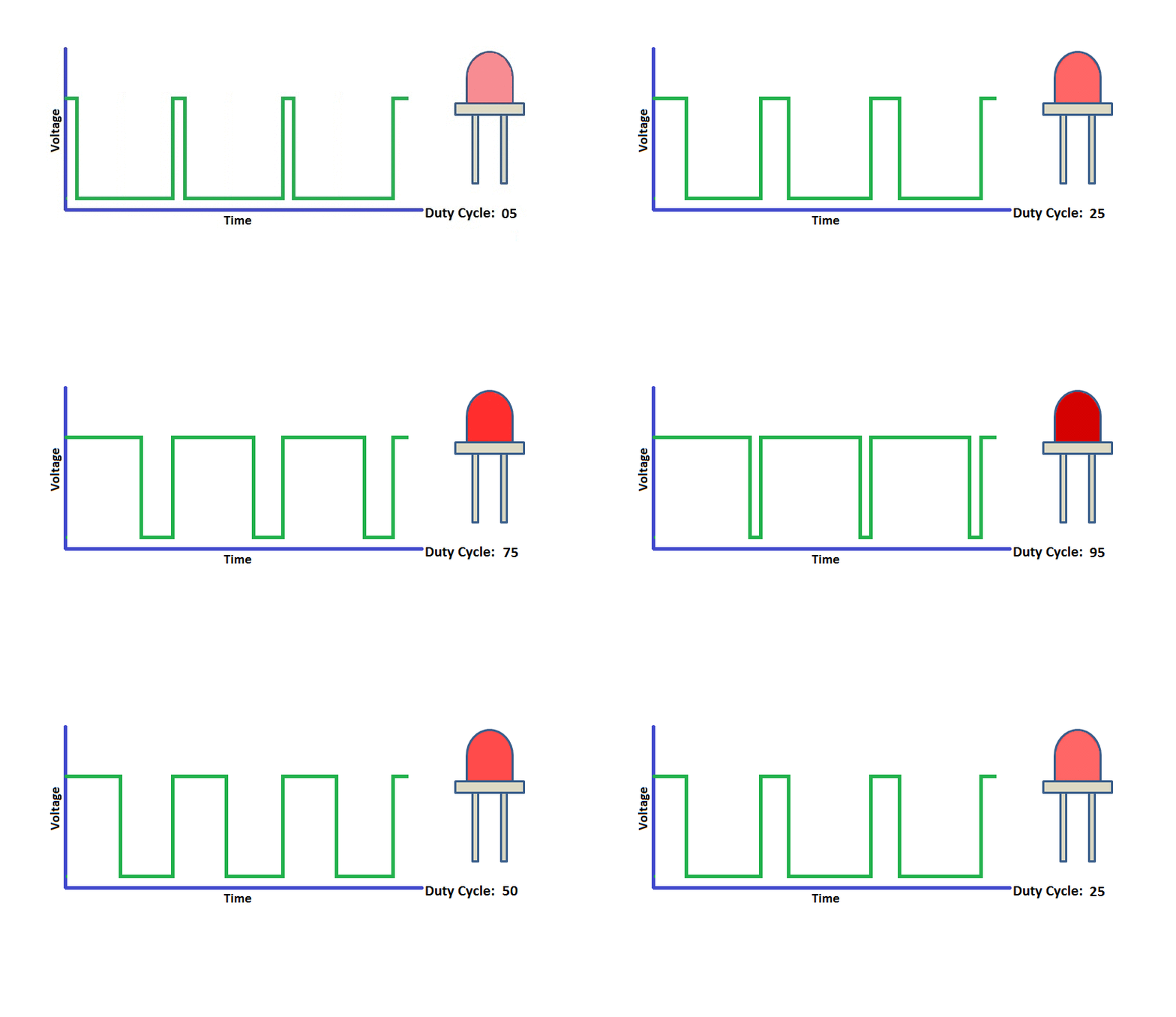
For the Arduino digital port voltage output, there are only LOW and HIGH, which correspond to the voltage output of 0V and 5V. You can define LOW as 0 and HIGH as 1, and let the Arduino output five hundred 0 or 1 signals within 1 second.
If output five hundred 1, that is 5V; if all of which is 1, that is 0V. If output 010101010101 in this way then the output port is 2.5V, which is like showing movie. The movie we watch are not completely continuous. It actually outputs 25 pictures per second. In this case, the human can’t tell it, neither does PWM. If want different voltage, need to control the ratio of 0 and 1. The more 0,1 signals output per unit time, the more accurately control.
(2) Components needed

(3) Wiring Diagram
(4) Test Code:
/*
 keyestudio smart turtle robot
 lesson 2.1
 pwm
 http://www.keyestudio.com
*/
int ledPin = 9; // Define the LED pin at D9
int value;

void setup () {
  pinMode (ledPin, OUTPUT); // initialize ledpin as an output.
}

void loop () {
  for (value = 0; value <255; value = value + 1)
  {
    analogWrite (ledPin, value); // LED lights gradually light up
    delay (5); // delay 5MS
  }
  for (value = 255; value> 0; value = value-1)
  {
    analogWrite (ledPin, value); // LED gradually goes out
    delay (5); // delay 5MS
  }
}
(5) Test Result
Upload test code successfully, LED gradually changes from bright to dark, like human breath, rather than turning on and off immediately.
(6) Code Explanation
To repeat some certain statements, we could use FOR statement.
FOR statement format is shown below:
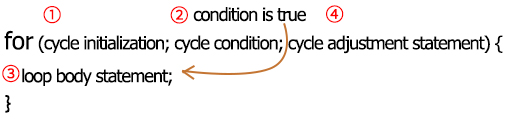
FOR cyclic sequence:
Round 1:1 → 2 → 3 → 4
Round 2:2 → 3 → 4
…
Until number 2 is not established, “for”loop is over,
After knowing this order, go back to code:
for (int value = 0; value < 255; value=value+1){
       }
for (int value = 255; value >0; value=value-1){
       }
The two“for”statements make value increase from 0 to 255, then reduce from 255 to 0, then increase to 255,….infinitely loop
There is a new function in the following —– analogWrite()
We know that digital port only has two state of 0 and 1. So how to send an analog value to a digital value? Here,this function is needed. Let’s observe the Arduino board and find 6 pins marked“~”which can output PWM signals.
Function format as follows:
analogWrite(pin,value)
analogWrite() is used to write an analog value from 0~255 for PWM port, so the value is in the range of 0~255. Attention that you only write the digital pins with PWM function, such as pin 3, 5, 6, 9, 10, 11.
PWM is a technology to obtain analog quantity through digital method. Digital control forms a square wave, and the square wave signal only has two states of turning on and off (that is, high or low levels). By controlling the ratio of the duration of turning on and off, a voltage varying from 0 to 5V can be simulated. The time turning on(academically referred to as high level) is called pulse width, so PWM is also called pulse width modulation.
Through the following five square waves, let’s acknowledge more about PWM.
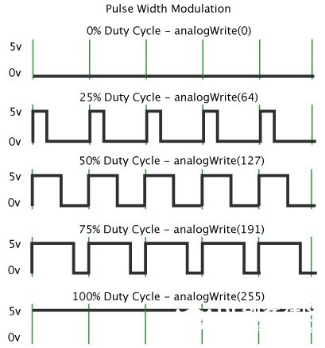
In the above figure, the green line represents a period, and value of analogWrite() corresponds to a percentage which is called Duty Cycle as well. Duty cycle implies that high-level duration is divided by low-level duration in a cycle. From top to bottom, the duty cycle of first square wave is 0% and its corresponding value is 0. The LED brightness is lowest, that is, light off. The more time the high level lasts, the brighter the LED. Therefore, the last duty cycle is 100%, which correspond to 255, and LED is the brightest. And 25% means darker.
PWM mostly is used for adjusting the LED’s brightness or the rotation speed of motors.
It plays a vital role in controlling smart robot cars. I believe that you cannot wait to learn next project.
(7) Extension Practice
Let’s modify the value of delay and remain the pin unchanged, then observe how LED changes.
/*
 keyestudio smart turtle robot
 lesson 2.2
 pwm
 http://www.keyestudio.com
*/
int ledPin = 9; // Define the LED pin at D9
void setup () {
   pinMode(ledPin, OUTPUT); // initialize ledpin as an output.
}

void loop () {
   for (int value = 0; value <255; value = value + 1) {
     analogWrite (ledPin, value); // LED lights gradually light up
     delay (30); // delay 50MS
   }
   for (int value = 255; value> 0; value = value-1) {
     analogWrite (ledPin, value); // LED gradually goes out
     delay (30); // delay 50MS
   }
}
Upload the code to development board, then LED blinks more slowly.
Project 3 : Line Tracking Sensor
Description

The tracking sensor is actually an infrared sensor. The component used here is the TCRT5000 infrared tube.
Its working principle is to use different reflectivity of infrared light to colors, then convert the strength of the reflected signal into a current signal.
During the process of detection, black is active at HIGH level while white is active at LOW level. The detection height is 0-3 cm.
Keyestudio 3-channel line tracking module has integrated 3 sets of TCRT5000 infrared tube on a single board, which is more convenient for wiring and control.
By rotating the adjustable potentiometer on the sensor, it can adjust the detection sensitivity of the sensor.
Specification
Operating Voltage: 3.3-5V (DC)
Interface: 5PIN
Output Signal: Digital signal
Detection Height: 0-3 cm
Special note: before testing, rotate the potentiometer on the sensor to adjust the detection sensitivity. When adjust the LED at the threshold between ON and OFF, the sensitivity is the best.
Components


Connection Diagram

Test Code
/*
keyestudio smart turtle robot
lesson 3.1
 Line Track sensor
 http://www.keyestudio.com
*/
int L_pin = 11;  //pins of  left line tracking sensor
int M_pin = 7;  //pins of  middle line tracking sensor
int R_pin = 8;  //pins of  right  line tracking sensor
int val_L,val_R,val_M;// define the variable value of three sensors

void setup()
{
  Serial.begin(9600); // initialize serial communication at 9600 bits per second
  pinMode(L_pin,INPUT); // make the L_pin as an input
  pinMode(M_pin,INPUT); // make the M_pin as an input
  pinMode(R_pin,INPUT); // make the R_pin as an input
}

void loop()
{
  val_L = digitalRead(L_pin);//read the L_pin:
  val_R = digitalRead(R_pin);//read the R_pin:
  val_M = digitalRead(M_pin);//read the M_pin:
  Serial.print("left:");
  Serial.print(val_L);
  Serial.print(" middle:");
  Serial.print(val_M);
  Serial.print(" right:");
  Serial.println(val_R);
  delay(500);// delay in between reads for stability
}
Test Result:
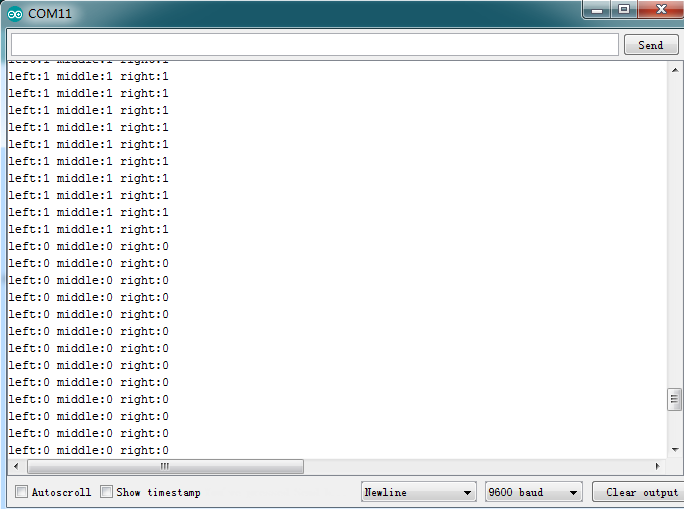
Upload the code on development board, and open serial monitor. The displayed value is 1(high level) when no signal is received. The value shifts into 0 when the sensor is covered with paper.
Code Explanation
Serial.begin(9600)- Initialize serial port, set baud rate to 9600
pinMode- Define the pin as input or output mode
**digitalRead-**Read the state of pin, which are generally HIGH and LOW level
Extension Practice
After knowing its working principle, you can connect an LED to D9 so as to control LED by it.

Test Code
/*
keyestudio smart turtle robot
lesson 3.2
 Line Track sensor
 http://www.keyestudio.com
*/
int L_pin = 11;  //pins of  left line tracking sensor
int M_pin = 7;  //pins of  middle line tracking sensor
int R_pin = 8;  //pins of  right line tracking sensor
int val_L,val_R,val_M;// define the variables of three sensors

void setup()
{
  Serial.begin(9600); // initialize serial communication at 9600 bits per second
  pinMode(L_pin,INPUT); // make the L_pin as an input
  pinMode(M_pin,INPUT); // make the M_pin as an input
  pinMode(R_pin,INPUT); // make the R_pin as an input
  pinMode(3, OUTPUT);
}

void loop()
{
  val_L = digitalRead(L_pin);//read the L_pin:
  val_R = digitalRead(R_pin);//read the R_pin:
  val_M = digitalRead(M_pin);//read the M_pin:
  Serial.print("left:");
  Serial.print(val_L);
  Serial.print(" middle:");
  Serial.print(val_M);
  Serial.print(" right:");
  Serial.println(val_R);
  delay(500);// delay in between reads for stability
  if ((val_L == LOW) || (val_M == LOW) || (val_R == LOW))//if left line tracking sensor detects signals
  {
    Serial.println("HIGH");
    digitalWrite(3, HIGH);//LED is off
  }
  else//if left line tracking sensor doesn’t detect signals
  {
    Serial.println("LOW");
    digitalWrite(3, LOW);//LED is off
  }
 }
Upload the code to development board, then we could find LED light up when covering the line tracking sensor by hand
Project 4: Servo Control
Description
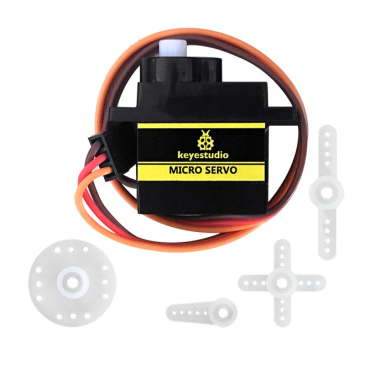
Servo motor is a position control rotary actuator. It mainly consists of a housing, a circuit board, a core-less motor, a gear and a position sensor. Its working principle is that the servo receives the signal sent by MCUs or receivers and produces a reference signal with a period of 20ms and width of 1.5ms, then compares the acquired DC bias voltage to the voltage of the potentiometer and obtain the voltage difference output.
When the motor speed is constant, the potentiometer is driven to rotate through the cascade reduction gear, which leads that the voltage difference is 0, and the motor stops rotating. Generally, the angle range of servo rotation is 0° –180 °
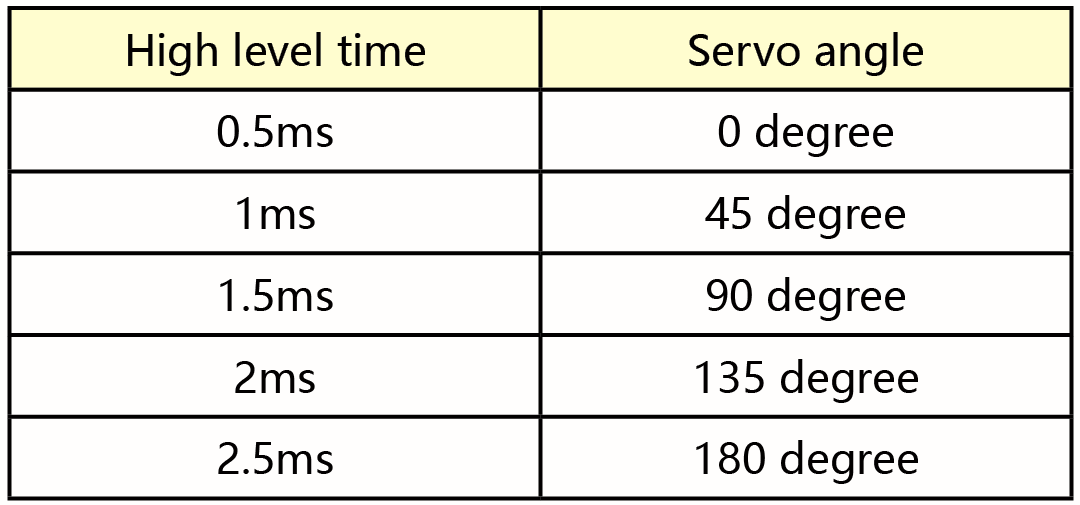
The rotation angle of servo motor is controlled by regulating the duty cycle of PWM (Pulse-Width Modulation) signal. The standard cycle of PWM signal is 20ms (50Hz). Theoretically, the width is distributed between 1ms-2ms, but in fact, it’s between 0.5ms-2.5ms. The width corresponds the rotation angle from 0° to 180°. But note that for different brand motor, the same signal may have different rotation angle.
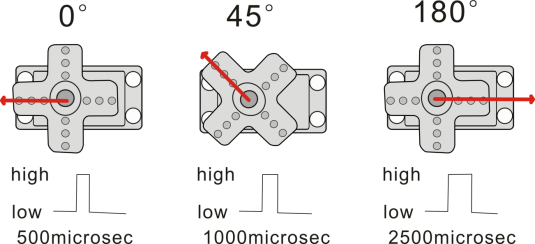
The corresponding servo angles are shown below:
Specification
Working voltage: DC 4.8V ~ 6V
Operating angle range: about 180 ° (at 500 → 2500 μsec)
Pulse width range: 500 → 2500 μsec
No-load speed: 0.12 ± 0.01 sec / 60 (DC 4.8V) 0.1 ± 0.01 sec / 60 (DC 6V)
No-load current: 200 ± 20mA (DC 4.8V) 220 ± 20mA (DC 6V)
Stopping torque: 1.3 ± 0.01kg · cm (DC 4.8V) 1.5 ± 0.1kg · cm (DC 6V)
Stop current: ≦ 850mA (DC 4.8V) ≦ 1000mA (DC 6V)
Standby current: 3 ± 1mA (DC 4.8V) 4 ± 1mA (DC 6V)
Equipment

Connection Diagram
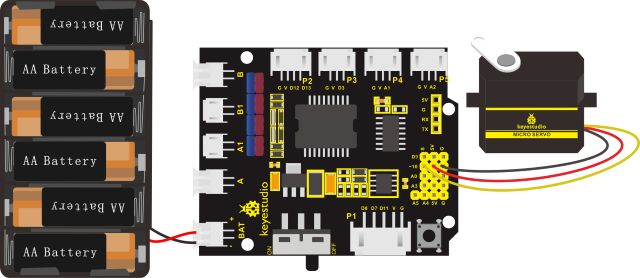
Wiring note: the brown line of servo is linked with Gnd(G), the red one is connected to 5v(V) and the orange one is attached to digital 10.
The servo has to be connected to external power due to its high demand for driving servo current. Generally, the current of development board is not big enough. If without connected power, the development board could be burnt.
Test Code 1
/*
keyestudio smart turtle robot
lesson 4.1
Servo
http://www.keyestudio.com
*/
#define servoPin 10  //servo Pin
int pos; //the angle variable of servo
int pulsewidth; //pulse width variable of servo

void setup() {
  pinMode(servoPin, OUTPUT);  //set the pins of servo to output
  procedure(0); //set the angle of servo to 0 degree
}

void loop() {
  for (pos = 0; pos <= 180; pos += 1) { // goes from 0 degrees to 180 degrees
    // in steps of 1 degree
    procedure(pos);              // tell servo to go to position in variable 'pos'
    delay(15);                   //control the rotation speed of servo
  }
  for (pos = 180; pos >= 0; pos -= 1) { // goes from 180 degrees to 0 degrees
    procedure(pos);              // tell servo to go to position in variable 'pos'
    delay(15);
  }
}

//function to control servo
void procedure(int myangle) {
  pulsewidth = myangle * 11 + 500;  //calculate the value of pulse width
  digitalWrite(servoPin,HIGH);
  delayMicroseconds(pulsewidth);   //The duration of high level is pulse width
  digitalWrite(servoPin,LOW);
  delay((20 - pulsewidth / 1000));  //the cycle is 20ms, the low level last for the rest of time
}
Upload code successfully, then servo swings back in the range of 0° to 180°
There is another guide for restraining servo—- servo library file, the following link of official website is for your reference.
https://www.arduino.cc/en/Reference/Servo
The library file of servo is used in the following code
Test Code 2
/*
 keyestudio smart turtle robot
 lesson 4.2
 servo
 http://www.keyestudio.com
*/
#include <Servo.h>
Servo myservo;  // create servo object to control a servo
// twelve servo objects can be created on most boards
int pos = 0;    // variable to store the servo position

void setup() {
  myservo.attach(10);  // attaches the servo on pin 9 to the servo object
}
void loop() {
  for (pos = 0; pos <= 180; pos += 1) { // goes from 0 degrees to 180 degrees
    // in steps of 1 degree
    myservo.write(pos);              // tell servo to go to position in variable 'pos'
    delay(15);                       // waits 15ms for the servo to reach the position
  }
  for (pos = 180; pos >= 0; pos -= 1) { // goes from 180 degrees to 0 degrees
    myservo.write(pos);              // tell servo to go to position in variable 'pos'
    delay(15);                       // waits 15ms for the servo to reach the position
  }
}
Test Result:
Upload code successfully and power on, then the servo swings in the range of 0° to 180°. We usually control it by library file.
Code Explanation
Arduino comes with #include <Servo.h> (servo function and statement)
The following are some common statements of the servo function:
1. attach(interface)——Set servo interface, port 9 and 10 are available
2. write(angle)——Used for the statement to set rotation angle of servo, and the set angle range is from 0° to 180°
3. read()——used for the statement to read angle of servo, namely, reading the command value of“write()”
4. attached()——Judge if the parameter of servo is sent to its interface
Note: The above written format is“servo variable name, specific statement()”, for instance: myservo.attach(9)
Project 5: Ultrasonic Sensor
Description

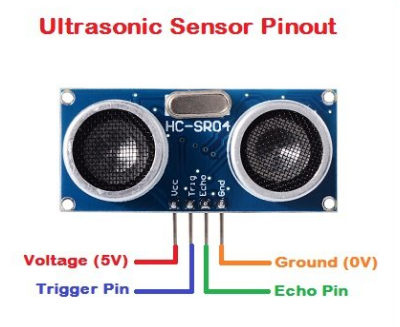
The HC-SR04 ultrasonic sensor uses sonars to determine distance to an object like bats do. It offers excellent non-contact range detection with high accuracy and stable readings in an easy-to-use package. It comes complete with ultrasonic transmitter and receiver modules.
The HC-SR04 or the ultrasonic sensor is being used in a wide range of electronics projects for creating obstacle detection and distance measuring application as well as various other applications. Here we have brought the simple method to measure the distance with Arduino and ultrasonic sensor and how to use ultrasonic sensor with Arduino.
Specification
Power Supply :+5V DC
Quiescent Current : <2mA
Working Current: 15mA
Effectual Angle: <15°
Ranging Distance : 2cm – 400 cm
Resolution : 0.3 cm
Measuring Angle: 30 degree
Trigger Input Pulse width: 10uS
Components

Working Principle
As the above picture shown, it is like two eyes. One is transmitting end, the other is receiving end.
The ultrasonic module will emit the ultrasonic waves after triggering a signal. When the ultrasonic waves encounter the object and are reflected back, the module outputs an echo signal, so it can determine the distance of the object from the time difference between the trigger signal and echo signal.
The t is the time that emitting signal meets obstacle and returns. And the propagation speed of sound in the air is about 343m/s, and distance = speed *time. However, the ultrasonic wave emits and comes back, which is 2 times of distance. Therefore, it needs to be divided by 2, the distance measured by ultrasonic wave = (speed * time)/2
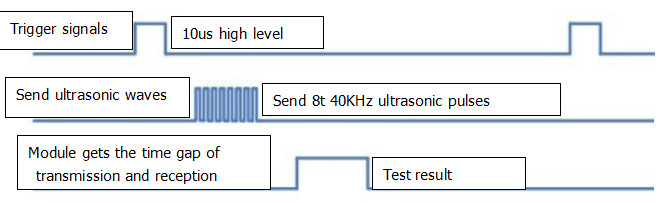
Use method and timing chart of ultrasonic module: Setting the delay time of Trig pin of SR04 to 10μs at least, which can trigger it to detect distance. 2. After triggering, the module will automatically send eight 40KHz ultrasonic pulses and detect whether there is a signal return. This step will be completed automatically by the module. 3. If the signal returns, the Echo pin will output a high level, and the duration of the high level is the time from the transmission of the ultrasonic wave to the return.
Circuit diagram of ultrasonic sensor:
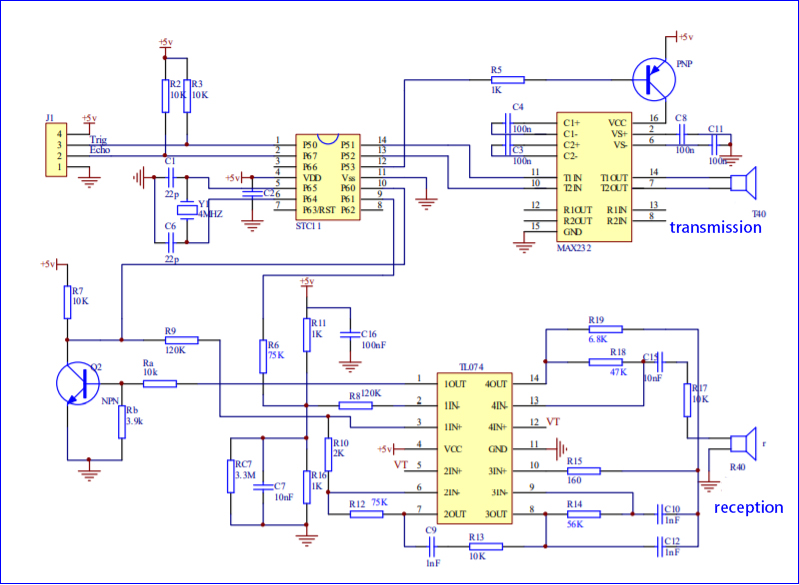
Connection Diagram
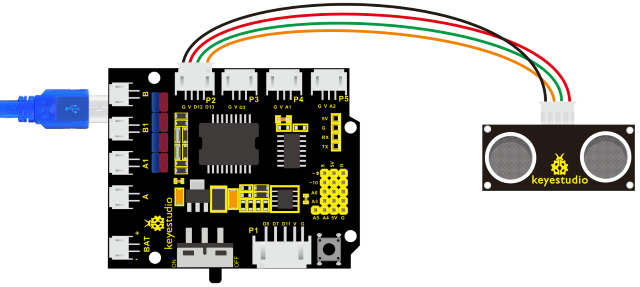
Wiring guide
Ultrasonic sensor keyestudio V5 sensor shield
VCC → 5v(V)
Trig → 12(S)
Echo → 13(S)
Gnd → Gnd(G)
Test Code
/*
 keyestudio smart turtle robot
 lesson 5.1
 Ultrasonic sensor
 http://www.keyestudio.com
*/
int trigPin = 12;    // Trigger
int echoPin = 13;    // Echo
long duration, cm, inches;
void setup() {
  //Serial Port begin
  Serial.begin (9600);
  //Define inputs and outputs
  pinMode(trigPin, OUTPUT);
  pinMode(echoPin, INPUT);
}

void loop() {
  // The sensor is triggered by a HIGH pulse of 10 or more microseconds. Give a short LOW pulse beforehand to ensure a clean HIGH pulse:
  digitalWrite(trigPin, LOW);
  delayMicroseconds(2);
  digitalWrite(trigPin, HIGH);
  delayMicroseconds(10);
  digitalWrite(trigPin, LOW);
   // Read the signal from the sensor: a HIGH pulse whose duration is the time (in microseconds) from the sending of the ping to the reception of its echo off of an object.
  duration = pulseIn(echoPin, HIGH);
   // Convert the time into a distance
  cm = (duration/2) / 29.1;     // Divide by 29.1 or multiply by 0.0343
  inches = (duration/2) / 74;   // Divide by 74 or multiply by 0.0135
  Serial.print(inches);
  Serial.print("in, ");
  Serial.print(cm);
  Serial.print("cm");
  Serial.println();
  delay(250);
}
Test Result
Upload test code on the development board, open serial monitor and set baud rate to 9600. The detected distance will be displayed, and the unit is cm and inch. Hinder the ultrasonic sensor by hand, the displayed distance value gets smaller.

Code Explanation
int trigPin- this pin is defined to transmit ultrasonic waves, generally output.
int echoPin - this is defined as the pin of reception, generally input
cm = (duration/2) / 29.1-
inches = (duration/2) / 74-
We can calculate the distance by using the following formula: distance = (traveltime/2) x speed of sound
The speed of sound is: 343m/s = 0.0343 cm/uS = 1/29.1 cm/uS Or in inches: 13503.9in/s = 0.0135in/uS = 1/74in/uS
We need to divide the traveltime by 2 because we have to take into account that the wave was sent, hit the object, and then returned back to the sensor.
Extension Practice
We have just measured the distance displayed by the ultrasonic. How about controlling the LED with the measured distance? Let’s try it and connect an LED light module to the D9 pin.

/*
 keyestudio smart turtle robot
 lesson 5.2
 Ultrasonic LED
 http://www.keyestudio.com
*/
int trigPin = 12;    // Trigger
int echoPin = 13;    // Echo
long duration, cm, inches;

void setup() {
  Serial.begin (9600);  //Serial Port begin
  pinMode(trigPin, OUTPUT);  //Define inputs and outputs
  pinMode(echoPin, INPUT);
}

void loop()
{
  // The sensor is triggered by a HIGH pulse of 10 or more microseconds.
  // Give a short LOW pulse beforehand to ensure a clean HIGH pulse:
  digitalWrite(trigPin, LOW);
  delayMicroseconds(2);
  digitalWrite(trigPin, HIGH);
  delayMicroseconds(10);
  digitalWrite(trigPin, LOW);
  // Read the signal from the sensor: a HIGH pulse whose
  // duration is the time (in microseconds) from the sending
  // of the ping to the reception of its echo off of an object.
  duration = pulseIn(echoPin, HIGH);
  // Convert the time into a distance
  cm = (duration/2) / 29.1;     // Divide by 29.1 or multiply by 0.0343
  inches = (duration/2) / 74;   // Divide by 74 or multiply by 0.0135
  Serial.print(inches);
  Serial.print("in, ");
  Serial.print(cm);
  Serial.print("cm");
  Serial.println();
  delay(250);
  if (cm>=2 && cm<=10)
  {
    Serial.println("HIGH");
    digitalWrite(3, HIGH);
  }
  else
  {
    Serial.println("LOW");
    digitalWrite(3, LOW);
  }
}
Upload test code to development board and block ultrasonic sensor by hand, then check if LED is on.
Project 6: IR Reception
Description

There is no doubt that infrared remote control is ubiquitous in daily life. It is used to control various household appliances, such as TVs, stereos, video recorders and satellite signal receivers. Infrared remote control is composed of infrared transmitting and infrared receiving systems, that is, an infrared remote control and infrared receiving module and a single-chip microcomputer capable of decoding.
The 38K infrared carrier signal emitted by remote controller is encoded by the encoding chip in the remote controller. It is composed of a section of pilot code, user code, user inverse code, data code, and data inverse code. The time interval of the pulse is used to distinguish whether it is a 0 or 1 signal and the encoding is made up of these 0, 1 signals.
The user code of the same remote control is constant while the data code can distinguish the key.
When the remote control button is pressed, the remote control sends out an infrared carrier signal. When the IR receiver receives the signal, the program will decode the carrier signal and determines which key is pressed. The MCU decodes the received 01 signal, thereby judging what key is pressed by the remote control.
Infrared receiver we use is an infrared receiver module. Mainly composed of an infrared receiver head, which is a device that integrates reception, amplification, and demodulation. Its internal IC has completed demodulation, and can achieve from infrared reception to output and be compatible with TTL signals. Additionally, it is suitable for infrared remote control and infrared data transmission. The infrared receiving module made by the receiver has only three pins, signal line, VCC and GND. It is very convenient to communicate with Arduino and other microcontrollers.
Specification

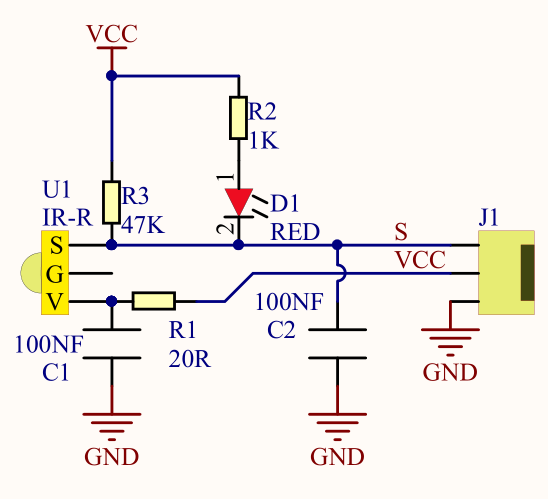
Operating Voltage: 3.3-5V(DC)
Interface: 3PIN
Output Signal: Digital signal
Receiving Angle: 90 degrees
Frequency: 38khz
Receiving Distance: 10m
Components required

Connection Diagram

Respectively link“-”,“+”and S of IR receiver module with G(GND), V(VCC)and A1 of keyestudio development board.
Attention: On the condition that digital ports are not available, analog ports can be regarded as digital ports. A0 equals to D14, A1 is equivalent to digital.
Import the library of IR receiver firstly before editing test code.
/*
  keyestudio smart turtle robot
 lesson 6.1
 IRremote
 http://www.keyestudio.com
*/
#include <IRremote.h>     //IRremote library statement
int RECV_PIN = A1;        //define the pins of IR receiver as A1
IRrecv irrecv(RECV_PIN);
decode_results results;   // decode results exist in the“result” of “decode results”
void setup()
{
  Serial.begin(9600);
  irrecv.enableIRIn(); // Enable receiver
}

 void loop() {
  if (irrecv.decode(&results))//decode successfully, receive a set of infrared signals
   {
     Serial.println(results.value, HEX);//Wrap word in 16 HEX to output and receive code
     irrecv.resume(); // Receive the next value
   }
   delay(100);
 }
Test Result
Upload test code, open serial monitor and set baud rate to 9600, point remote control to IR receiver. Then the corresponding value will be shown. If the code is pressed too long, the error codes will appear.
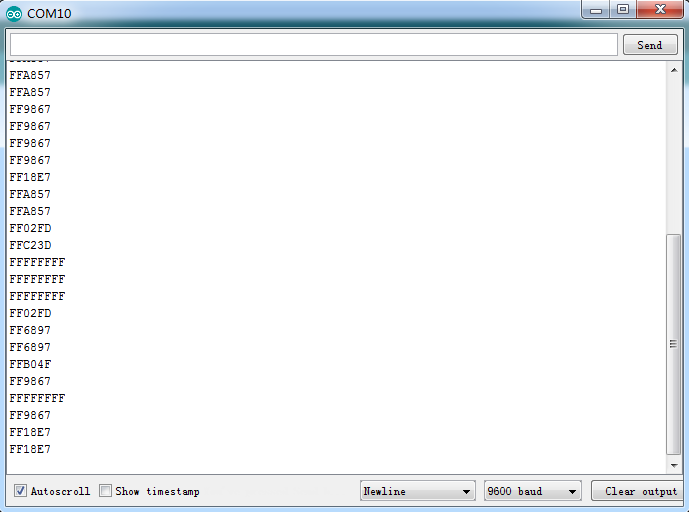
The keys value of Keyestudio remote control are shown below.

Code Explanation
irrecv.enableIRIn(): after enabling IR decoding, the IR signals will be received, then function“decode()”will check continuously to make ure if decoding successfully.
irrecv.decode(&results): after decoding successfully, this function will come back to “true”, and keep result in “results”. After decoding a IR signals, run the resume()function and continue to receive the next signal.
Extension Practice
We decoded the key value of IR remote control. How about controlling LED by the measured value? We could design an experiment.
Attach an LED to D9, then press the keys of remote control to make LED light on and off.

/*
keyestudio smart turtle robot
lesson 6.2
IRremote
http://www.keyestudio.com
*/
#include <IRremote.h>
int RECV_PIN = A1;//define the pin of IR receiver as A1
int LED_PIN = 9;//define the pin of LED as pin 3
int a=0;
IRrecv irrecv(RECV_PIN);
decode_results results;

void setup()
{Serial.begin(9600);
  irrecv.enableIRIn(); //Initialize the IR receiver
  pinMode(LED_PIN,OUTPUT);//set pin 4 of LED to OUTPUT
}

void loop() {
  if (irrecv.decode(&results))
  {
    if(results.value==0xFF02FD && (a==0)) //according to the above key value, press“OK”on remote control , LED will be controlled
    {
      Serial.println("HIGH");
      digitalWrite(LED_PIN,HIGH);//LED will be on
      a=1;
    }
    else if(results.value==0xFF02FD && (a==1)) //press again
    {
      Serial.println("LOW");
      digitalWrite(LED_PIN,LOW);//LED will go off
      a=0;
    }
    irrecv.resume(); // receive the next value
  }
}
Upload code to development board, press“OK”key on remote control to make LED on and off.
Project 7: Bluetooth Remote Control
Description
Bluetooth, a simple wireless communication module, has went viral since the last few decades and been used in most of the battery-powered devices for its easy-to-use function.
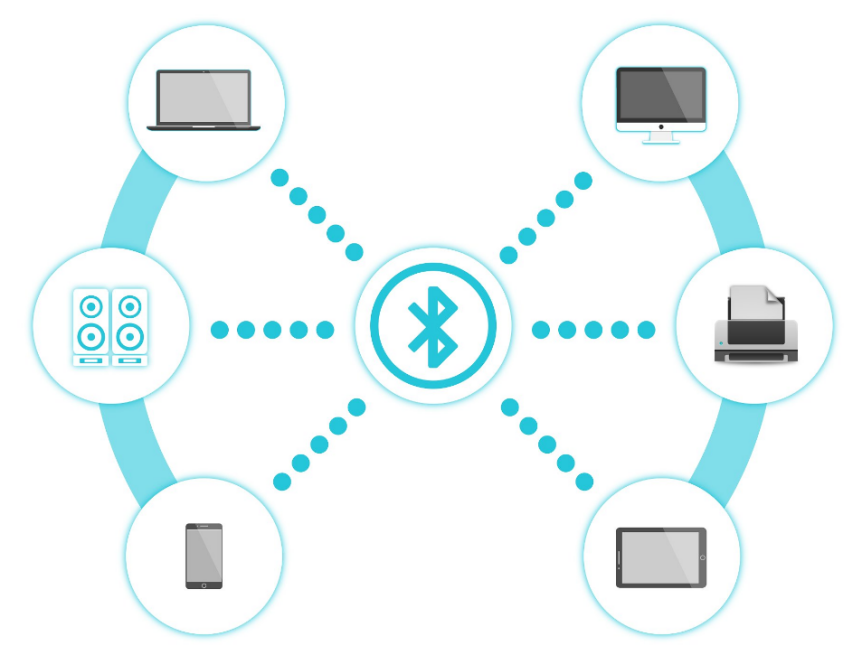
Over the past years, there have been many upgrades of Bluetooth standard to fulfil the demands of customers and the development of technology as well as to follow the trend of time.
Over the few years, there are many things changed including data transmission rate, power consumption with wearable and IoT Devices and Security System.
Here are we going to learn about HM-10 BLE 4.0 with Arduino Board? The HM-10 is a readily available Bluetooth 4.0 module. This module is used for establishing wireless data communication. The module is designed by using the Texas Instruments CC2540 or CC2541 Bluetooth low energy (BLE) System on Chip (SoC).
Specification:

Bluetooth protocol: Bluetooth Specification V4.0 BLE
No byte limit in serial port Transceiving
In open environment, realize 100m ultra-distance communication with iphone4s
Working frequency: 2.4GHz ISM band
Modulation method: GFSK(Gaussian Frequency Shift Keying)
Transmission power: -23dbm, -6dbm, 0dbm, 6dbm, can be modified by AT command.
Sensitivity: ≤-84dBm at 0.1% BER
Transmission rate: Asynchronous: 6K bytes ; Synchronous: 6k Bytes
Security feature: Authentication and encryption
Supporting service: Central & Peripheral UUID FFE0, FFE1
Power consumption: Auto sleep mode, stand by current 400uA~800uA, 8.5mA during transmission.
Power supply: 5V DC
Working temperature: –5 to +65 °C
Components

Connection Diagram
1. STATE: state test pins, connected to internal LED, generally keep it unconnected.
2. RXD: serial interface, receiving terminal.
3. TXD: serial interface, transmitting terminal.
4. GND: Ground.
5. VCC: positive pole of the power source.
6. EN/BRK: break connect, it means breaking the Bluetooth connection, generally, keep it unconnected.
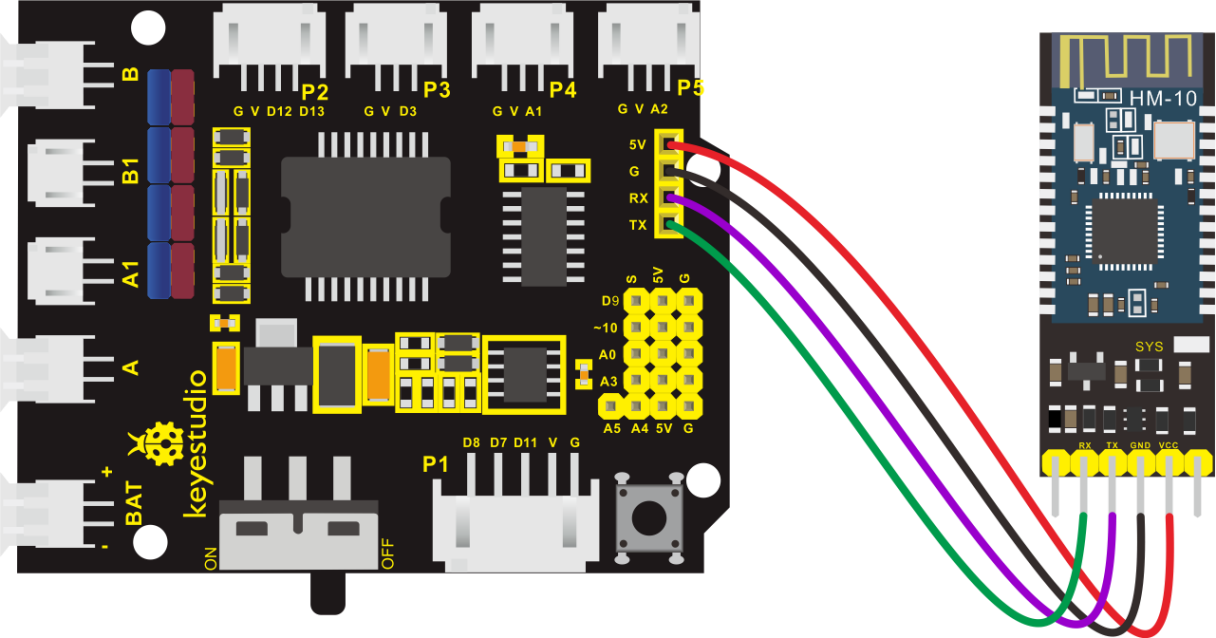
Pay attention to the pin direction when inserting Bluetooth module, and don’t insert it before uploading test code.
Test Code
/*
  keyestudio smart turtle robot
 lesson 7.1
bluetooth
http://www.keyestudio.com
*/
char ble_val; //character variable, used to store the value received by Bluetooth


void setup() {
  Serial.begin(9600);
}
void loop() {
  if(Serial.available() > 0)  //make sure if there is data in serial buffer
  {
    ble_val = Serial.read();  //Read data from serial buffer
    Serial.println(ble_val);  //Print
  }
}
(There will be contradiction between serial communication of code and communication of Bluetooth when uploading code. Therefore, don’t link Bluetooth module before uploading code.)
After uploading code on development board, then insert Bluetooth module and wait for the command from your cellphone.
Download APP
The code is for reading the received signal, and we also need a device to send signals. In this project, we send signals to control robot car via a cellphone. So, we need to download the APP.
iOS system
Note: Allow APP to access“location”in settings of your cellphone when connecting to Bluetooth module, as a result, Bluetooth may not be connected.
Enter APP STORE to search BLE Scanner 4.0 to download.

Android system
Enter Google Play to find out BLE Scanner and download.
(Enable“location”in settings of your cellphone. Otherwise, app may not be searched.)
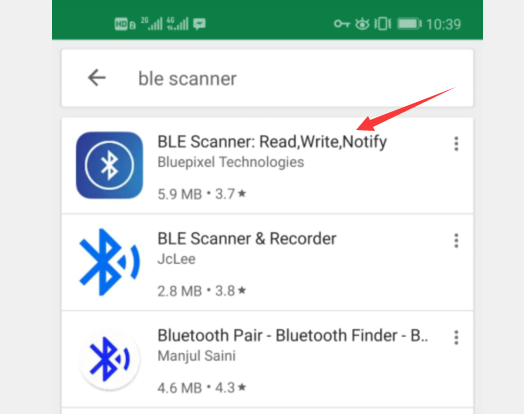
After installation, open App and enable“Location and Bluetooth” permission.
Open App, the name of Bluetooth module is HMSoft.
Then click “connect” to link it with Bluetooth
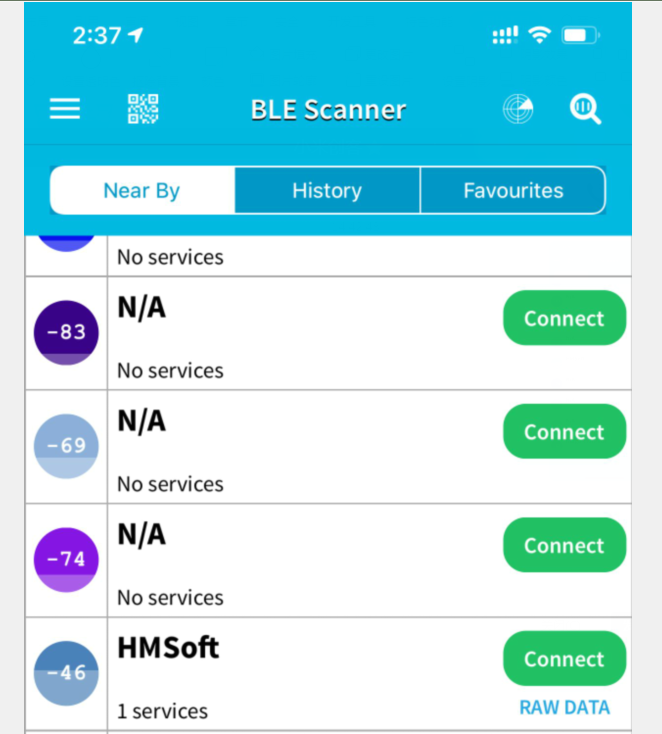
After connecting to HMSoft, click it to get multiple options, such as device information, access permission, general and custom service. Choose “CUSTOM SERVICE”
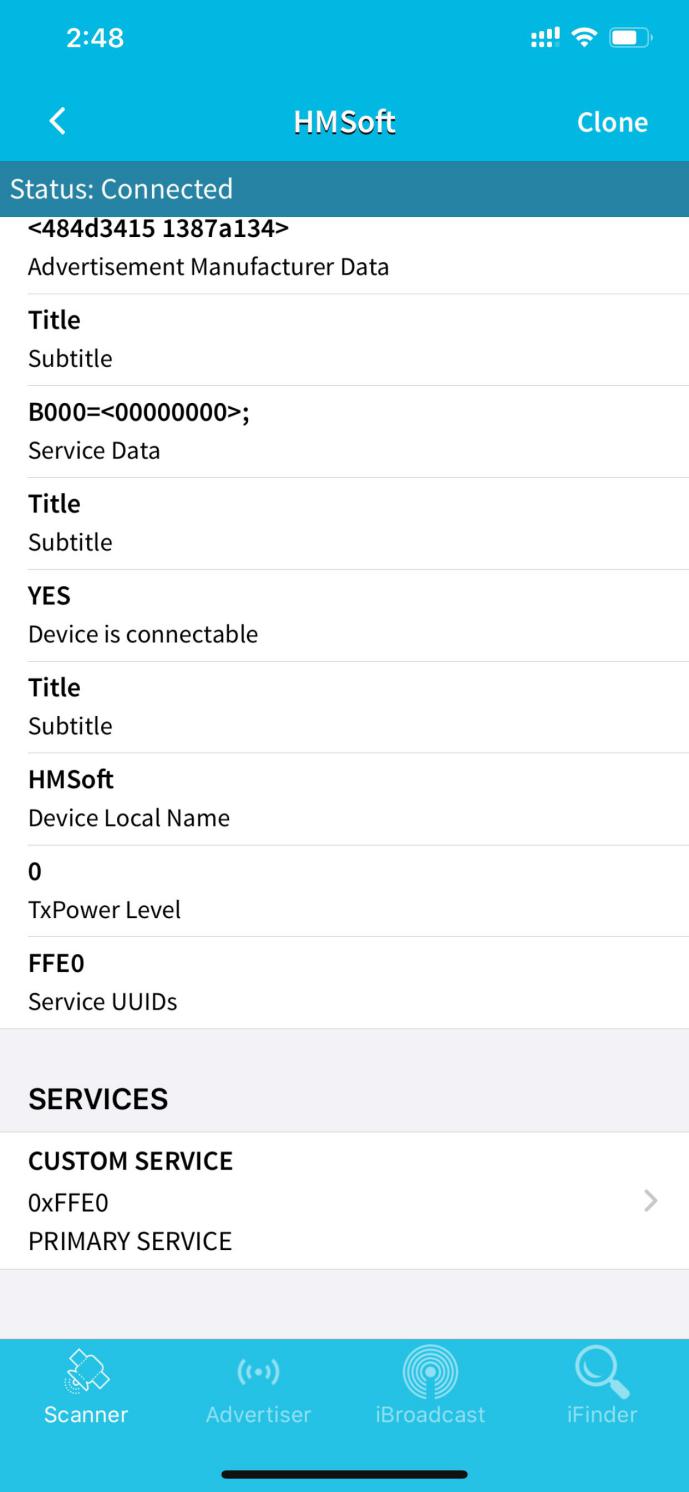
Then the following page pops up.
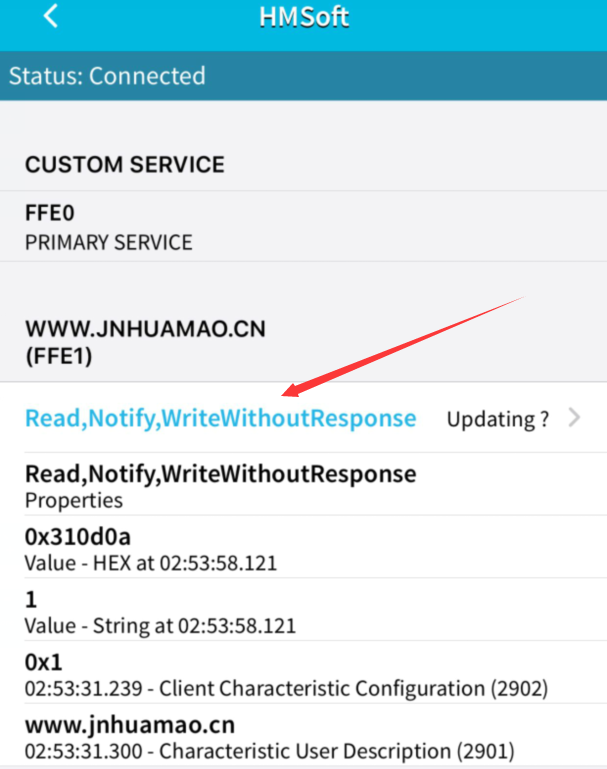
Click (Read,Notify,WriteWithoutResponse) to enter the following page.
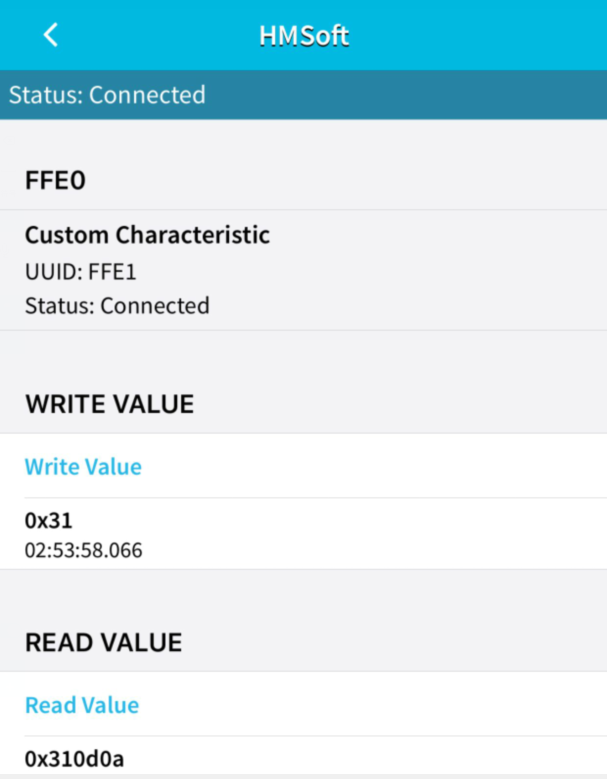
Click Write Value to enter HEX or Text.
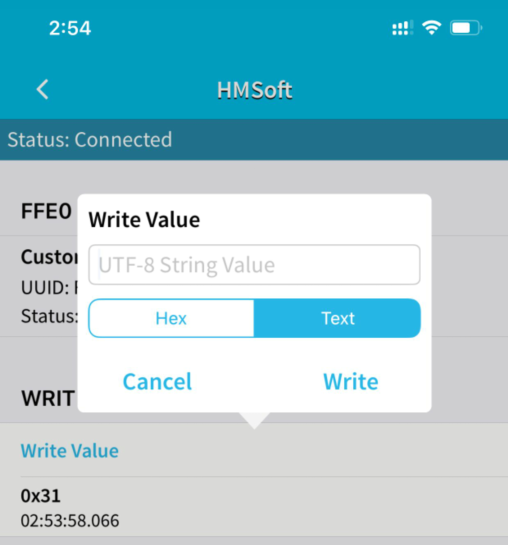
Open the serial monitor on Arduino, enter a 0 or other characters on Text interface.
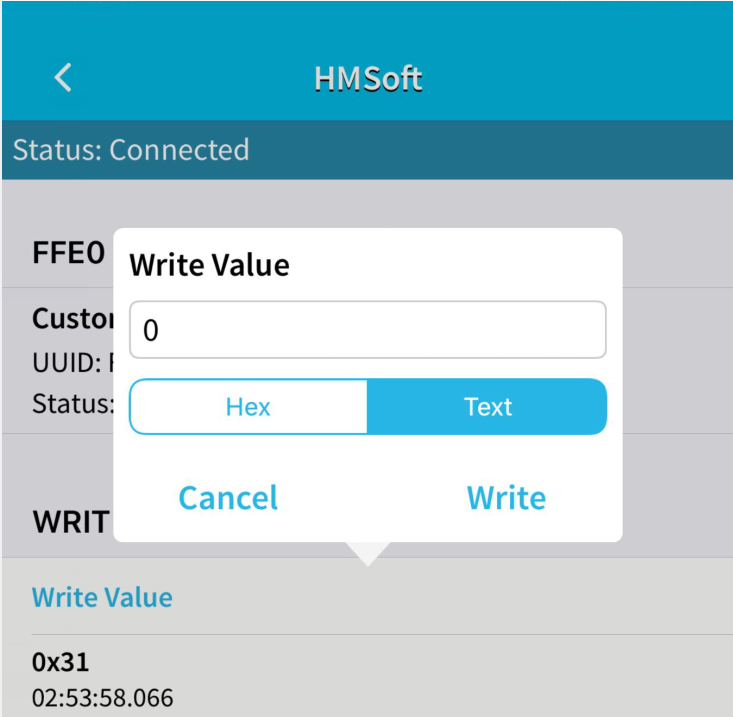
Then click “Write”, and open serial monitor to view if there is a “0” signal.
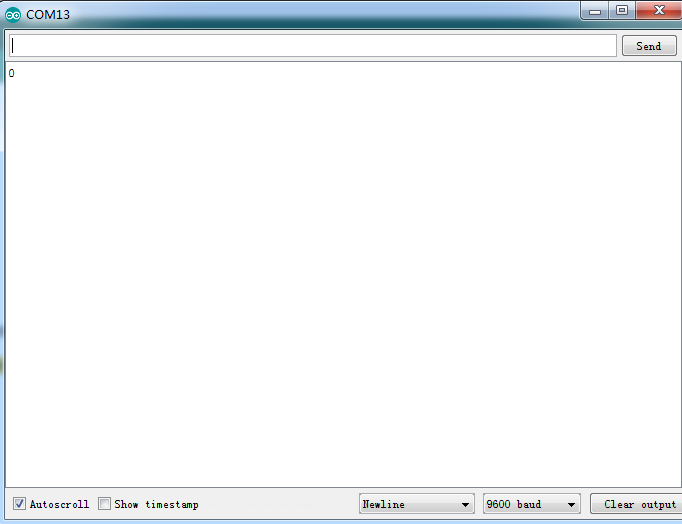
Code Explanation
Serial.available() : The current rest characters when return to buffer area. Generally, this function is used to judge if there is data in buffer. When Serial.available()>0, it means that serial receives the data and can be read
**Serial.read():**Read a data of a Byte in buffer of serial port, for instance, device sends data to Arduino via serial port, then we could read data by “Serial.read()”
Extension Practice
We could send a command via Bluetooth to turn a LED on and off. D9 is connected to a LED, as shown below:
/*
 keyestudio smart turtle robot
 lesson 7.2
 Bluetooth
 http://www.keyestudio.com
*/
int ledpin = 9;

void setup()
{
  Serial.begin(9600);
  pinMode(ledpin,OUTPUT);
}

void loop()
{
  int i;
  if (Serial.available())
  {
    i=Serial.read();
    Serial.println("DATA RECEIVED:");
    if(i=='1')
    {
      digitalWrite(ledpin,1);
      Serial.println("led on");
    }
    if(i=='0')
    {
      digitalWrite(ledpin,0);
      Serial.println("led off");
    }
   }
}
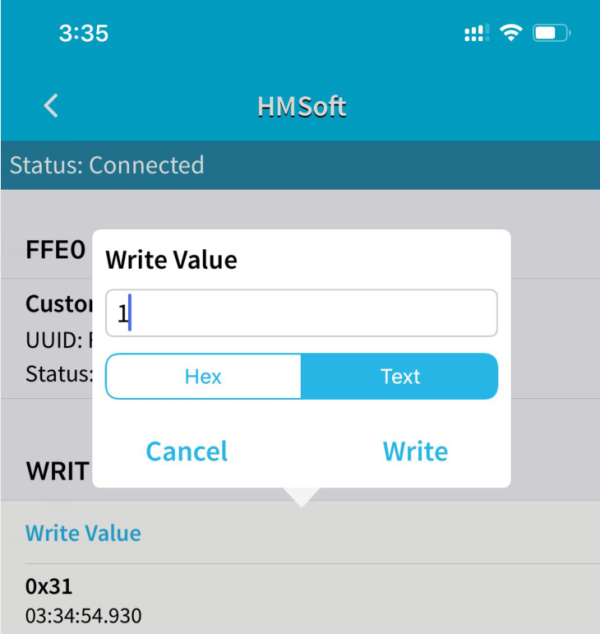
Click“Write”on APP. When you enter 1, LED will be on; when you input 0, it will be off. (Remember to remove the Bluetooth module after finishing experiment. Otherwise, burning code will be affected)
Project 8: Motor Driving and Speed Control
(1) Description
There are many ways to drive a motor. Our robot car uses the most common solution–L298P–which is an excellent high-power motor driver IC produced by STMicroelectronics. It can directly drive DC motors, two-phase and four-phase stepping motors. The driving current is up to 2A, and the output terminal of motor adopts eight high-speed Schottky diodes as protection.
We designed a shield based on the circuit of L298p.
The stacked design reduces the technical difficulty of using and driving the motor.
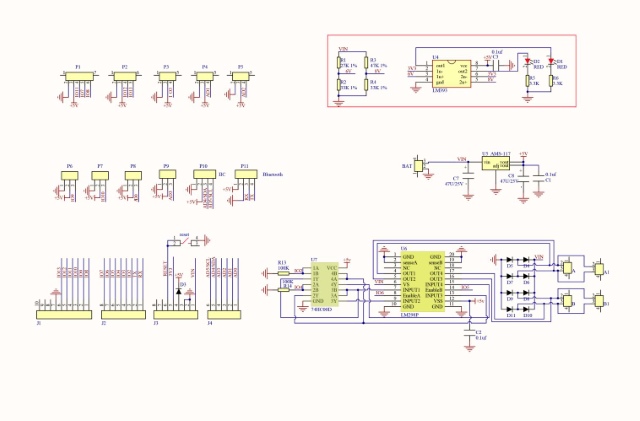
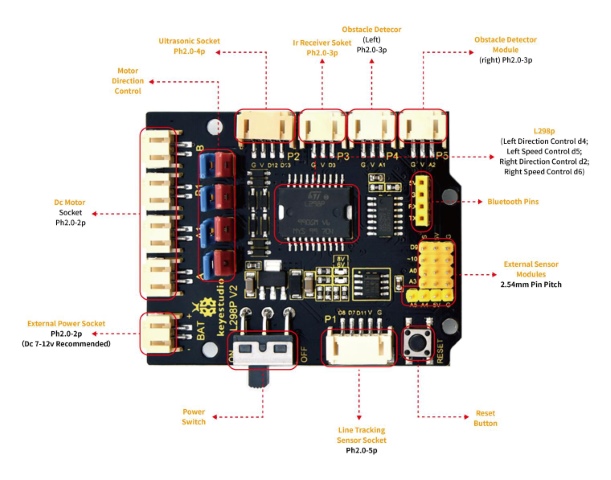
(2) Specification
Circuit Diagram for L298P Board
Logic part input voltage: DC5V
Driving part input voltage: DC 7-12V
Logic part working current: <36mA
Driving part working current: <2A
Maximum power dissipation: 25W (T=75℃)
Working temperature: 0℃~+50℃
Control signal input level: high level 2.3V<Vin<5V, low level -0.3V<Vin<1.5V
(3) Drive Robot to Move
From the above diagram, it is known that the direction pin of B motor is D4; a speed pin is D5; D2 is the direction pin of A motor; and D9 is speed pin.
PWM drives the robot car. The PWM value is in the range of 0-255. The larger the number, the faster the rotation of the motor.
D2 |
D6 (PWM) |
Motor(A) |
D4 |
D5 (PWM) |
Motor(B) |
|
|---|---|---|---|---|---|---|
Go forward |
LOW |
200 |
Rotate clockwise |
LOW |
200 |
Rotate clockwise |
Go back |
HIGH |
200 |
Rotate anticlockwise |
HIGH |
200 |
Rotate anticlockwise |
Rotate anticlockwise |
HIGH |
200 |
Rotate anticlockwise |
LOW |
200 |
Rotate clockwise |
Rotate clockwise |
LOW |
200 |
Rotate clockwise |
HIGH |
200 |
Rotate anticlockwise |
Stop |
/ |
0 |
Stop |
/ |
0 |
Stop |
(4) Components

(5) Connection Diagram
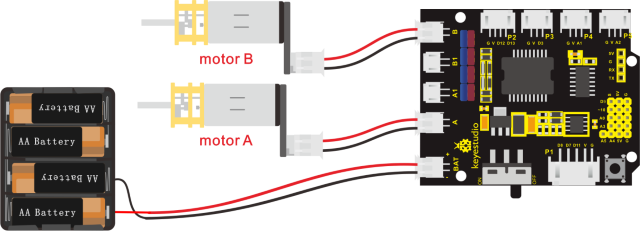
(6) Test Code:
/*
 keyestudio smart turtle robot
 lesson 8.1
 motor driver shield
 http://www.keyestudio.com
*/
#define ML_Ctrl 2     //define the direction control pin of A motor
#define ML_PWM 6   //define the PWM control pin of A motor
#define MR_Ctrl 4    //define the direction control pin of B motor
#define MR_PWM 5   //define the PWM control pin of B motor

void setup()
{
  pinMode(ML_Ctrl, OUTPUT);//set direction control pin of A motor to output
  pinMode(ML_PWM, OUTPUT);//set PWM control pin of A motor to output
  pinMode(MR_Ctrl, OUTPUT);//set direction control pin of B motor to output
  pinMode(MR_PWM, OUTPUT);//set PWM control pin of B motor to output
}
void loop()
{
  //front
  digitalWrite(ML_Ctrl,LOW);//set the direction control pin of A motor to LOW
  analogWrite(ML_PWM,200);//set the PWM control speed of A motor to 200
  digitalWrite(MR_Ctrl,LOW);//set the direction control pin of B motor to LOW
  analogWrite(MR_PWM,200);// set the PWM control speed of B motor to 200
  delay(2000);//delay in 2000ms
  //back
  digitalWrite(ML_Ctrl,HIGH);//set the direction control pin of A motor to HIGH level
  analogWrite(ML_PWM,200);// set the PWM control speed of A motor to 200
  digitalWrite(MR_Ctrl,HIGH);//set the direction control pin of B motor to HIGH level
  analogWrite(MR_PWM,200);//set the PWM control speed of B motor to 200
  delay(2000);//delay in 2000ms
  //left
  digitalWrite(ML_Ctrl,HIGH);//set the direction control pin of A motor to HIGH level
  analogWrite(ML_PWM,200);//set the PWM control speed of A motor to 200
  digitalWrite(MR_Ctrl,LOW);//set the direction control pin of B motor to LOW level
  analogWrite(MR_PWM,200);//set the PWM control speed of B motor to 200
  delay(2000);//delay in 2000ms
  //right
  digitalWrite(ML_Ctrl,LOW);//set the direction control pin of A motor to LOW level
  analogWrite(ML_PWM,200);//set the PWM control speed of A motor to 200
  digitalWrite(MR_Ctrl,HIGH);// set the direction control pin of B motor to HIGH level
  analogWrite(MR_PWM,200);//set the PWM control speed of B motor to 200
  delay(2000);//delay in 2000ms
  //stop
  analogWrite(ML_PWM,0);//set the PWM control speed of A motor to 0
  analogWrite(MR_PWM,0);//set the PWM control speed of B motor to 0
  delay(2000);// delay in 2000ms
}
(7) Test Result:
Hook up by connection diagram, upload code and power on, the smart car goes forward and back for 2s, turns left and right for 2s, and stops for 2s alternately.
(8) Code Explanation
digitalWrite(ML_Ctrl,LOW): the rotation direction of motor is decided by the high/low level and and the pins that decide rotation direction are digital pins.
analogWrite(ML_PWM,200): the speed of motor is regulated by PWM, and the pins that decide the speed of motor must be PWM pins.
(9) Extension Practice
Adjust the speed that PWM controls the motor, hook up in the same way.
/*
 keyestudio smart turtle robot
 lesson 8.2
 motor driver
 http://www.keyestudio.com
*/
#define ML_Ctrl  2   //define the direction control pin of A motor
#define ML_PWM 6   //define the PWM control pin of A motor
#define MR_Ctrl  4   //define the direction control pin of B motor
#define MR_PWM 5   //define the PWM control pin of B motor

void setup()
{ pinMode(ML_Ctrl, OUTPUT);//set the direction control pin of A motor to OUTPUT
  pinMode(ML_PWM, OUTPUT);//set the PWM control pin of A motor to OUTPUT
  pinMode(MR_Ctrl, OUTPUT);//set the direction control pin of B motor to OUTPUT

  pinMode(MR_PWM, OUTPUT);//set the PWM control pin of B motor to OUTPUT
}

void loop()
{ digitalWrite(ML_Ctrl,LOW);//set the direction control pin of A motor to low level
  analogWrite(ML_PWM,100);//set the PWM control speed of A motor to 100
  digitalWrite(MR_Ctrl,LOW);//set the direction control pin of B motor to low level
  analogWrite(MR_PWM,100);//set the PWM control speed of B motor to 100

  //front
  delay(2000);//delay in 2000ms
   digitalWrite(ML_Ctrl,HIGH);//set the direction control pin of A motor to high level
  analogWrite(ML_PWM,100);//set the PWM control speed of A motor to 100
  digitalWrite(MR_Ctrl,HIGH);//set the direction control pin of B motor to high level
  analogWrite(MR_PWM,100);//set the PWM control speed of B motor to 100

   //back
  delay(2000);//delay in 2000ms
  digitalWrite(ML_Ctrl,HIGH);//set the direction control pin of A motor to HIGH level
  analogWrite(ML_PWM,100);// set the PWM control speed of A motor to 100
  digitalWrite(MR_Ctrl,LOW);//set the direction control pin of B motor to LOW level
  analogWrite(MR_PWM,100);//set the PWM control speed of B motor to 100

    //left
  delay(2000);//delay in 2000ms
   digitalWrite(ML_Ctrl,LOW);//set the direction control pin of A motor to LOW level
  analogWrite(ML_PWM,100);//100 set the PWM control speed of A motor to 100
  digitalWrite(MR_Ctrl,HIGH);//set the direction control pin of B motor to HIGH level

  analogWrite(MR_PWM,100);//set the PWM control speed of B motor to 100

   //right
  delay(2000);//delay in 2000ms
  analogWrite(ML_PWM,0);//set the PWM control speed of A motor to 0
  analogWrite(MR_PWM,0);// set the PWM control speed of B motor to 0

    //stop
  delay(2000);//delay in 2000ms
}
After uploading the code successfully, do you find the motors rotate faster?
Project 9: 8*8 LED matrix
Description
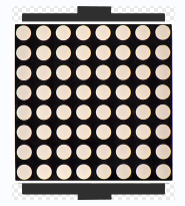
A fun way to make a small display is to use an 8x8 matrix or a 4-digit 7-segment display. Matrices like these are ‘multiplexed’ - to control 64 LEDs you need 16 pins. That’s a lot of pins, and there are driver chips like the MAX7219 that can control a matrix for you. But there’s a lot of wiring to set up and they take up a ton of space. After all, wouldn’t it be awesome if you could control a matrix without tons of wiring?
We control and drive an 8*8 LED board by the HT16K33 chip, which is convenient for wiring and greatly save the resources of microcontroller.
Components
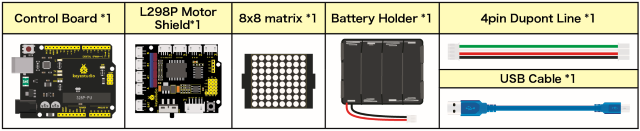
8*8 Dot Matrix
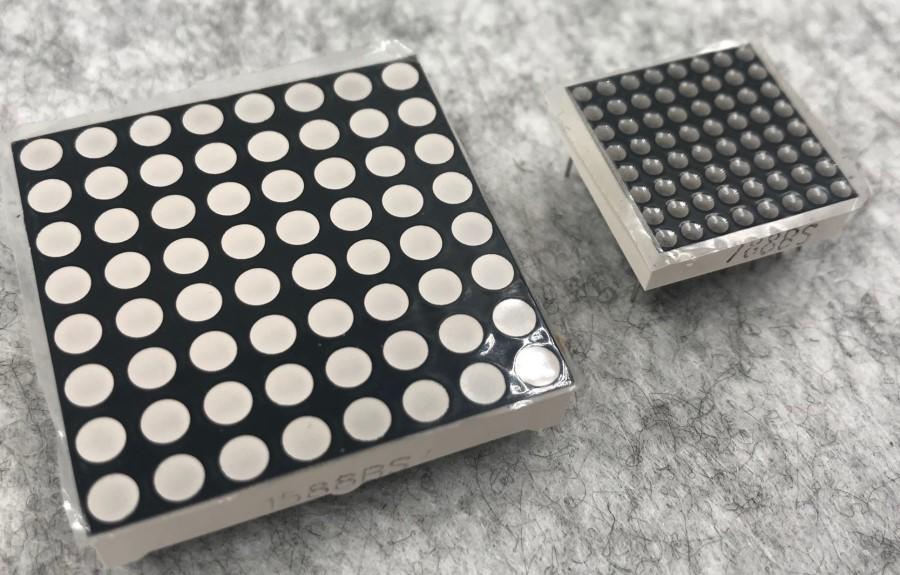
Composed of LED emitting tube diodes, LED dot matrix are applied widely to public information display like advertisement screen and bulletin board, by controlling LED to show words, pictures and videos, etc.
Divided into single-color, double-color, and three-color lights according to emitting color , LED dot matrix could show red, yellow, green and even true color.
There are different types of matrices, including 4×4, 8×8 and 16×16 and etc.
The 8×8 dot matrix contains 64 LEDs.
The inner structure of 8×8 dot matrix is shown below.
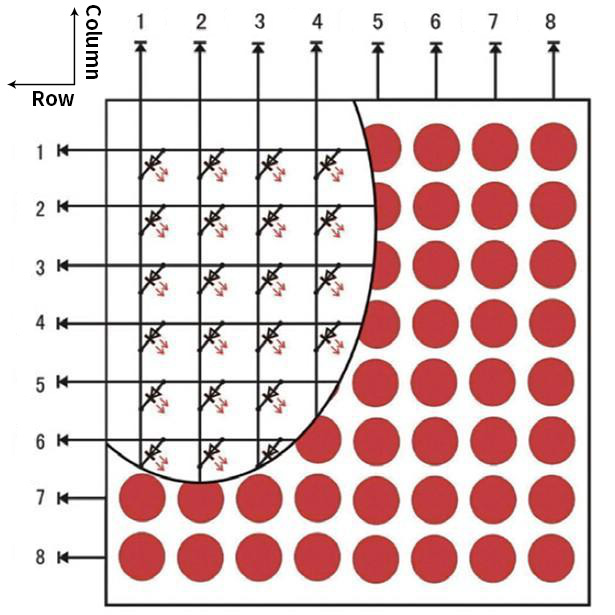
Every LED is installed on the cross point of row line and column line. When the voltage on a row line increases, and the voltage on the column line reduces, the LED on the cross point will light up. 8×8 dot matrix has 16 pins. Put the silk-screened side down and the numbers are 1,8, 9 and 16 in anticlockwise order as marked below.
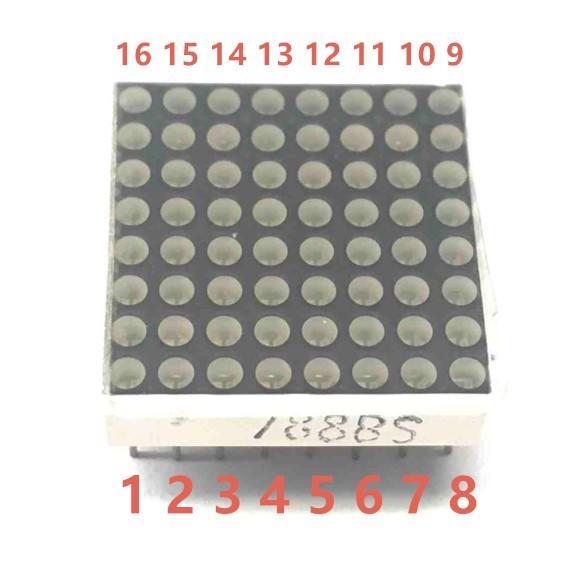
The definition inner pins are shown below:
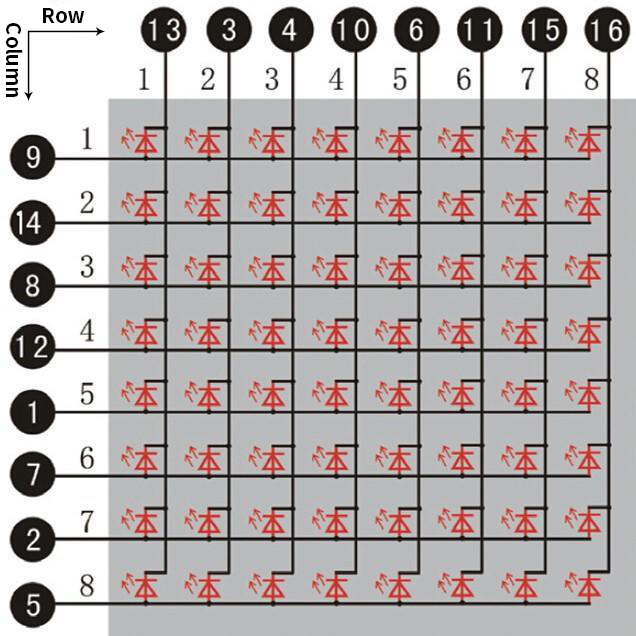
For instance, to light up the LED on row 1 and column 1, you should increase the voltage of pin 9 and reduce the voltage of pin 13.
HT16K33 8X8 Dot Matrix
The HT16K33 is a memory mapping and multi-purpose LED controller driver. The max. Display segment numbers in the device is 128 patterns (16 segments and 8 commons) with a 13*3 (MAX.) matrix key scan circuit. The software configuration features of the HT16K33 makes it suitable for multiple LED applications including LED modules and display subsystems. The HT16K33 is compatible with most microcontrollers and communicates via a two-line bidirectional I2C-bus.
The picture below is the working schematic of HT16K33 chip
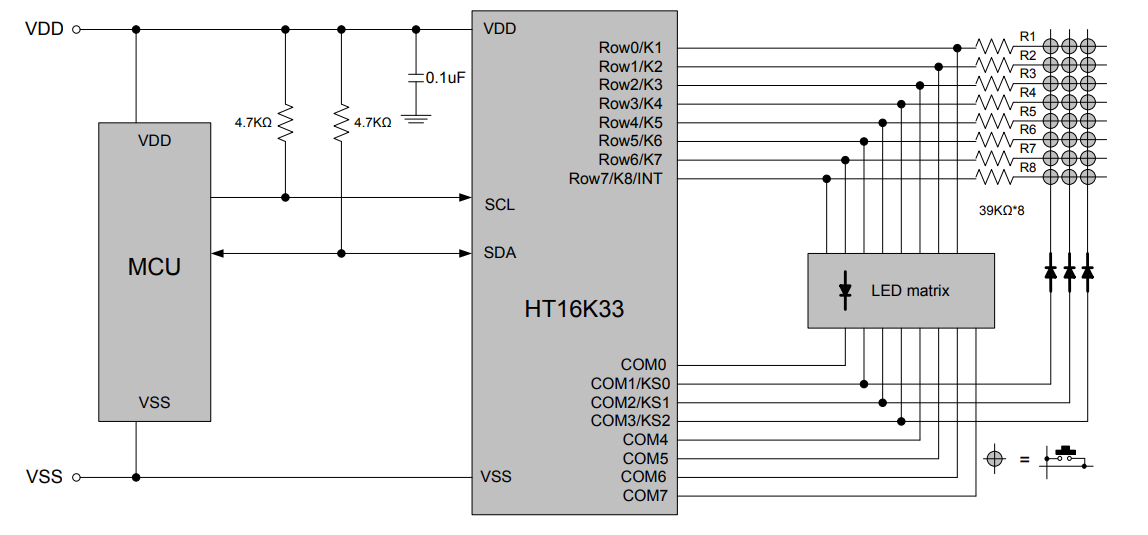
We design the drive module of 8*8 dot matrix based on the above principle. We could control the dot matrix by I2C communication and two pins of microcontroller, according to the above diagram.
Specification of 8*8 dot matrix
Input voltage: 5V
Rated input frequency: 400KHZ
Input power: 2.5W
Input current: 500mA
Introduction for Modulus Tool
The online version of dot matrix modulus tool: http://dotmatrixtool.com/#
① Open the link to enter the following page.
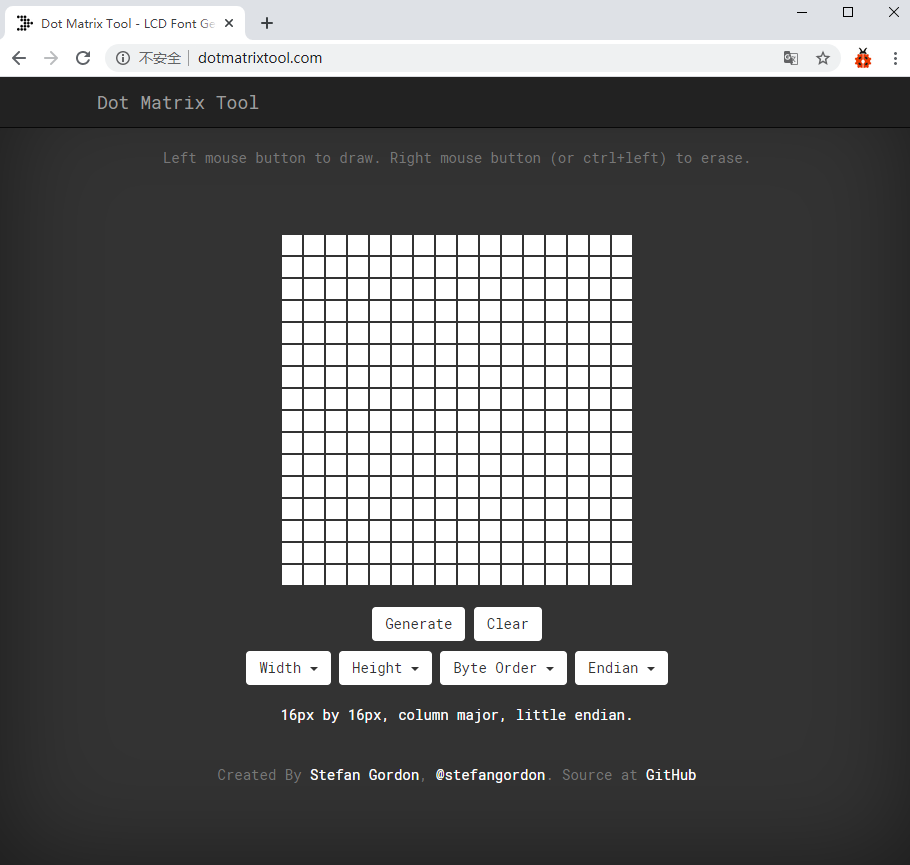
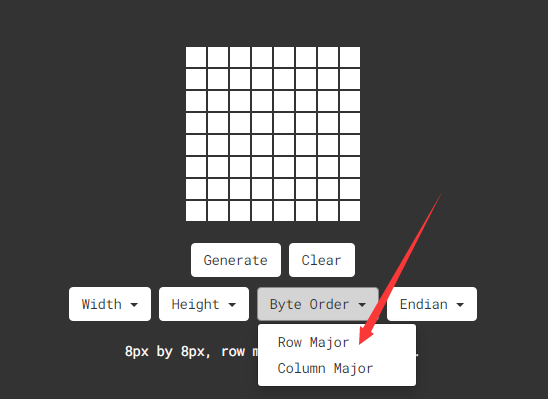
② The dot matrix is 8*8 in this project, so set the height to 8, width to 8, as shown below.
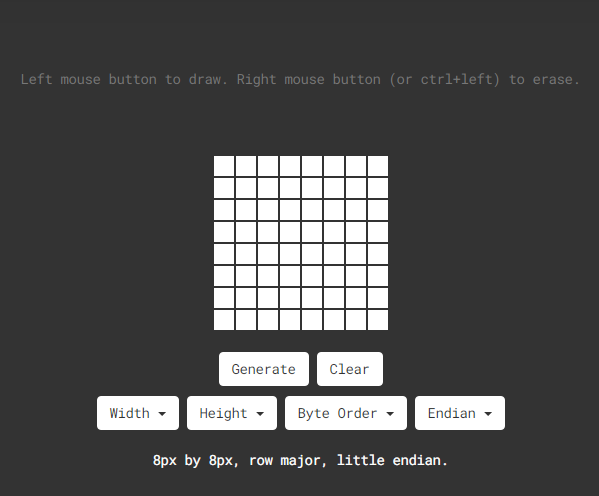
Click Byte order to select“Row major”
③ Generate hexadecimal data from the pattern
As shown below, the left button of the mouse is for selection while the right is for canceling. Thus you could use them to draw the pattern you want, then click Generate, to yield the hexadecimal data needed.
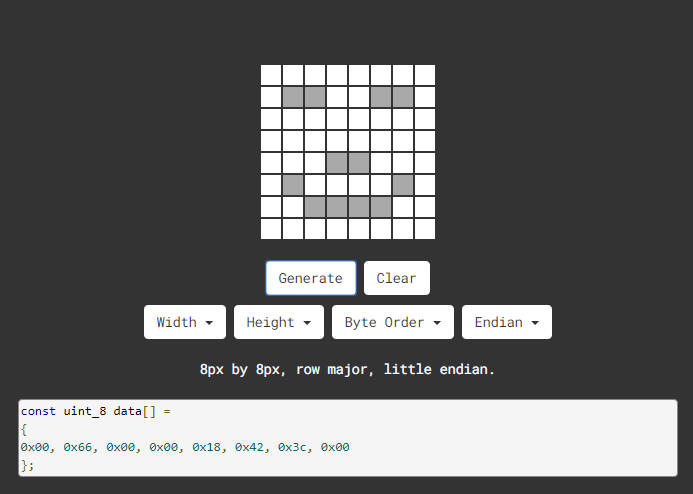
The generated hexadecimal code(0x00, 0x66, 0x00, 0x00, 0x18, 0x42, 0x3c, 0x00) is what will be displayed, so you need to save it for next procedure.
Connection Diagram
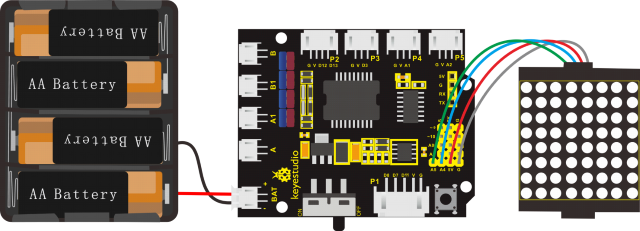
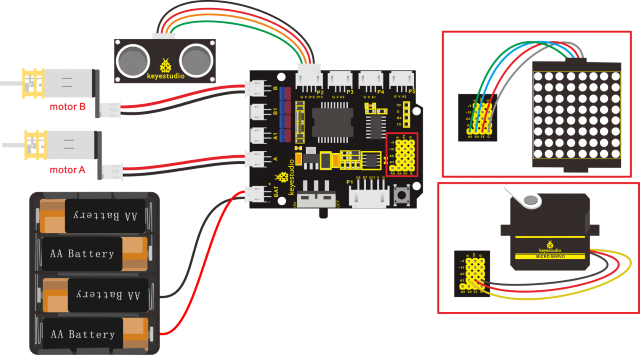
Note: The pin G, V, SDA and SCL of dot matrix module are separately connected to G, 5V, A4 and A5 of motor drive shield. Plug power to BAT interface.
Test Code:
/*
 keyestudio smart turtle robot
 lesson 9.1
 Matrix
 http://www.keyestudio.com
*/
#include <Matrix.h>
Matrix myMatrix(A4,A5);    //set pins to communication pins
// define an array
uint8_t LedArray1[8]={0x00, 0x66, 0x00, 0x00, 0x18, 0x42, 0x3c, 0x00};
uint8_t  LEDArray[8]; //define an array(by modulus tool) without initial value

void setup(){
  myMatrix.begin(0x70);  //communication address
  myMatrix.clear();    //clear matrix
}

void loop(){
  for(int i=0; i<8; i++)  // there is eight data, loop for eight times
  {
LEDArray[i]=LedArray1[i];  //Call the emoticon array data in the subroutine LEDArray
for(int j=7; j>=0; j--)  //Every data(byte) has 8 bit, therefore, loop for eight times
    {
      if((LEDArray[i]&0x01)>0) //judge if the last bit of data is greater than 0
      {
        myMatrix.drawPixel(j, i,1);  //light up the corresponding point
      }
      else  //otherwise
      {
        myMatrix.drawPixel(j, i,0);  //turn off the corresponding point
      }
      LEDArray[i] = LEDArray[i]>>1;  //LEDArray[i] moves right for one bit to judge the previous one bit
    }
  }
  myMatrix.writeDisplay();  // dot matrix shows
}
Test Result
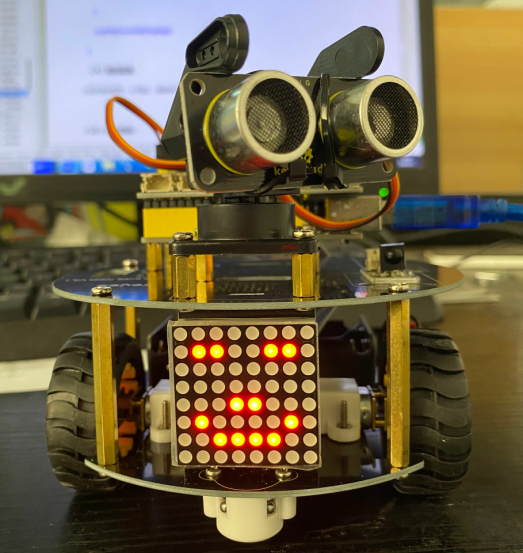
When uploading the code, plugging in, and turning on the robot car, the 8*8 dot matrix shows a smile facial pattern.
Extension Practice:
Let’s make dot matrix draw a heart-shaped pattern. What you need to do is entering the website and drawing the following pattern.
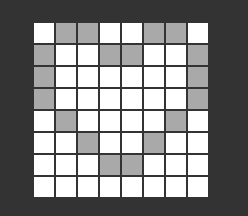
Then we get the code of drawing the heart-shaped pattern.
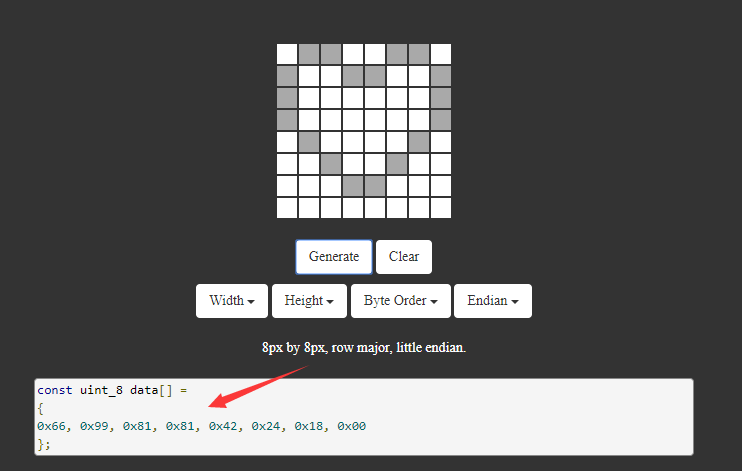
Replace the above code of heart-shaped pattern, then the complete code is shown below:
/*
 keyestudio smart turtle robot
 lesson 9.2
 Matrix
 http://www.keyestudio.com
*/
#include <Matrix.h>
Matrix myMatrix(A4,A5);    //set pins to communication pins
//define an array
uint8_t LedArray1[8]={0x66,0x99,0x81,0x81,0x42,0x24,0x18,0x00};
uint8_t  LEDArray[8]; //define an array(by modulus tool) without initial value
void setup(){
  myMatrix.begin(0x70);  //communication address
  myMatrix.clear();    //Clear
}
void loop(){
  for(int i=0; i<8; i++)  // there is eight data, loop for eight times
  {
    LEDArray[i]=LedArray1[i];  //Call the emoticon array data in the subroutine LEDArray
    for(int j=7; j>=0; j--)  //Every data(byte) has 8 bits, therefore, loop for eight times

    {
      if((LEDArray[i]&0x01)>0) //judge if the last bit of data is greater than 0
      {
        myMatrix.drawPixel(j, i,1);  //light up the corresponding point
      }
      else  //otherwise
      {
        myMatrix.drawPixel(j, i,0);  //turn off the corresponding point
      }
      LEDArray[i] = LEDArray[i]>>1;  //LEDArray[i] moves right for one bit to judge the previous one bit
    }
  }
  myMatrix.writeDisplay();  // dot matrix shows
}
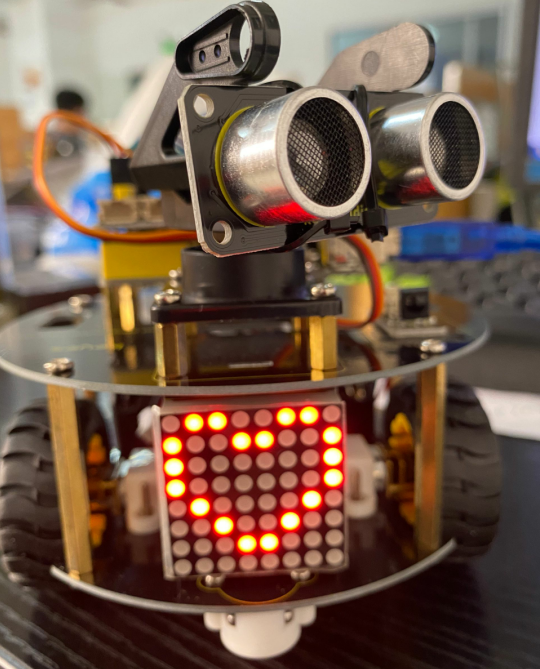
Uploading code, plugging in and turning on the robot car, 8*8 dot matrix shows the heart-shaped pattern.
Project 10: Line Tracking Robot
Description
The previous projects are inclusive of the knowledge of multiple sensors and modules. Next, we will work on a little challenging task.
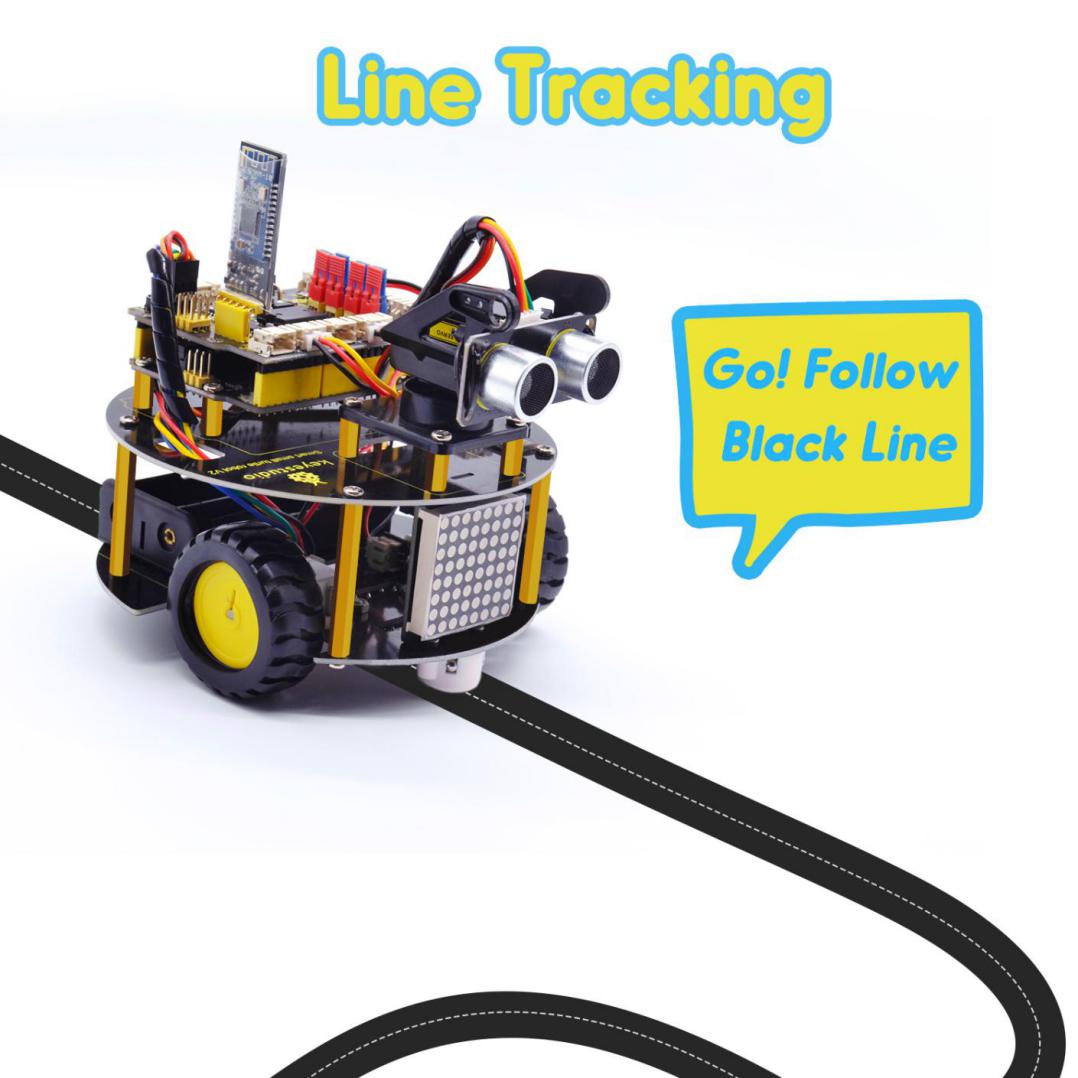
Built on the working principle of the line tracking sensor we could make a line tracking car.
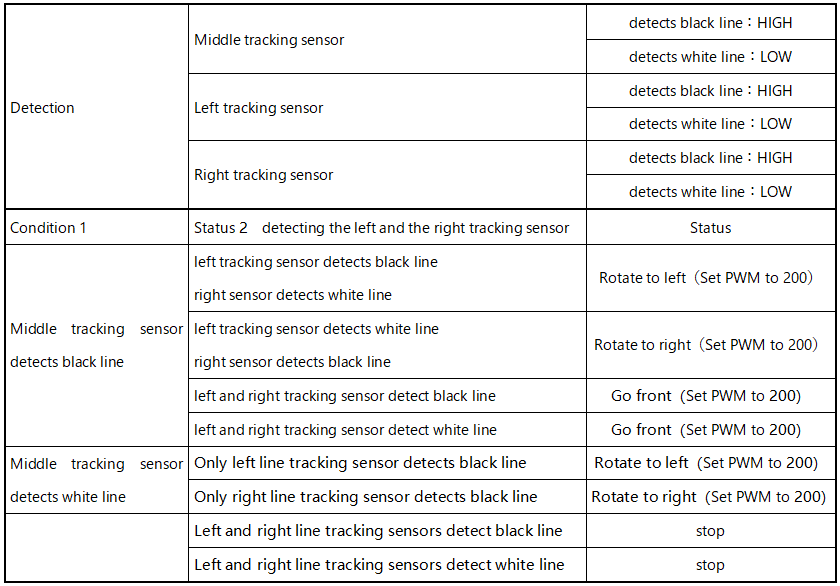
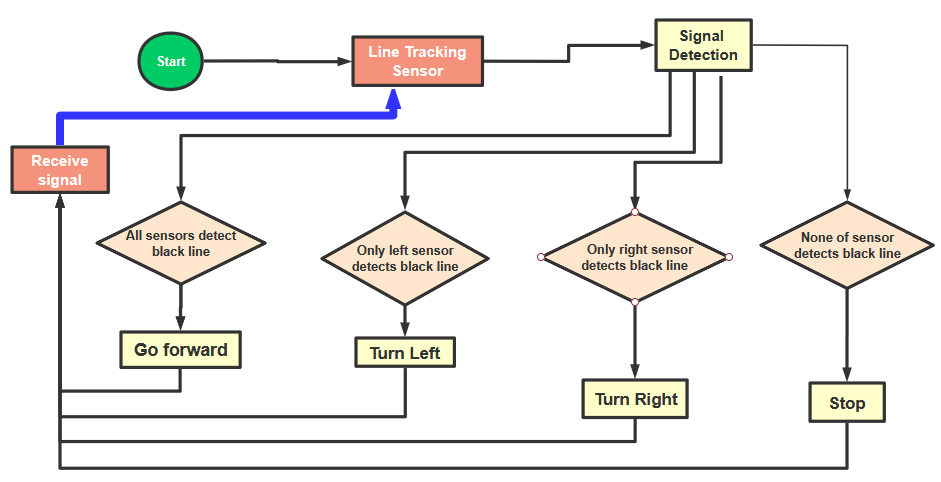
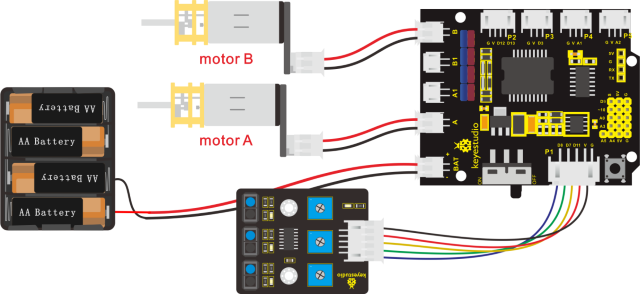
Program Process
Flow Chart
Connection Diagram
Test Code
/*
 keyestudio smart turtle robot
 lesson 10
 Thacking turtle
 http://www.keyestudio.com
*/
int left_ctrl = 2;//define direction control pin of A motor
 int left_pwm = 6;//define PWM control pin of A motor
 int right_ctrl = 4;//define direction control pin of B motor
 int right_pwm = 5;//define PWM control pin of B motor
 int sensor_l = 11;//define the pin of left line tracking sensor
 int sensor_c = 7;//define the pin of middle line tracking sensor
 int sensor_r = 8;//define the pin of right line tracking sensor
int l_val,c_val,r_val;//define these variables

void setup() {
  Serial.begin(9600);//start serial monitor and set baud rate to 9600
  pinMode(left_ctrl,OUTPUT);//set direction control pin of A motor to OUTPUT
  pinMode(left_pwm,OUTPUT);//set PWM control pin of A motor to OUTPUT
  pinMode(right_ctrl,OUTPUT);//set direction control pin of B motor to OUTPUT
  pinMode(right_pwm,OUTPUT);//set PWM control pin of B motor to OUTPUT
  pinMode(sensor_l,INPUT);//set the pins of left line tracking sensor to INPUT
  pinMode(sensor_c,INPUT);//set the pins of middle line tracking sensor to INPUT
  pinMode(sensor_r,INPUT);//set the pins of right line tracking sensor to INPUT
}

void loop()
{
  tracking(); //run main program
}

void tracking()
{
  l_val = digitalRead(sensor_l);//read the value of left line tracking sensor
  c_val = digitalRead(sensor_c);//read the value of middle line tracking sensor
  r_val = digitalRead(sensor_r);//read the value of right line tracking sensor

  if(c_val == 1)//if the state of middle one is 1, which means detecting black line

  {
    front();//car goes forward
  }
  else
  {
    if((l_val == 1)&&(r_val == 0))//if only left line tracking sensor detects black trace

    {
      left();//car turns left
    }
    else if((l_val == 0)&&(r_val == 1))///if only right line tracking sensor detects black trace

    {
      right();//car turns right
    }
    else//if none of line tracking sensor detects black line
    {
      Stop();//car stops
    }
  }
}
void front()//define the status of going forward
{
  digitalWrite(left_ctrl,LOW);
  analogWrite(left_pwm,200);
  digitalWrite(right_ctrl,LOW);
  analogWrite(right_pwm,200);
}
void back()//define the state of going back
{
  digitalWrite(left_ctrl,HIGH);
  analogWrite(left_pwm,200);
  digitalWrite(right_ctrl,HIGH);
  analogWrite(right_pwm,200);
}
void left()//define the left-turning state
{
  digitalWrite(left_ctrl,HIGH);
  analogWrite(left_pwm,200);
  digitalWrite(right_ctrl,LOW);
  analogWrite(right_pwm,200);
}
void right()//define the right-turning state
{
  digitalWrite(left_ctrl,LOW);
  analogWrite(left_pwm,200);
  digitalWrite(right_ctrl,HIGH);
  analogWrite(right_pwm,200);
}
void Stop()//define the state of stop
{
  analogWrite(left_pwm,0);
  analogWrite(right_pwm,0);
}
Test Result
Uploading the code to the development board, plugging in and pressing the on-button of the robot car. Turtle car walks along black lines.
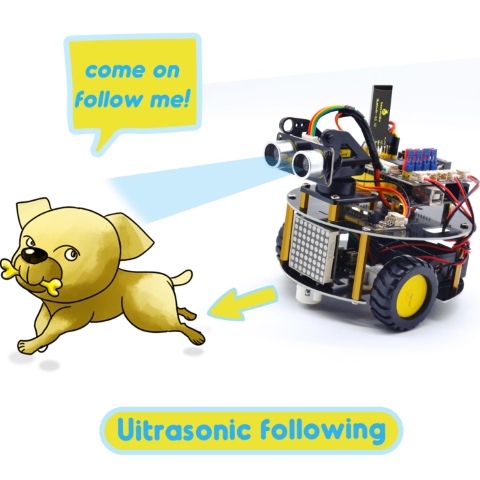
Project 11: Ultrasonic Follow Robot
Description
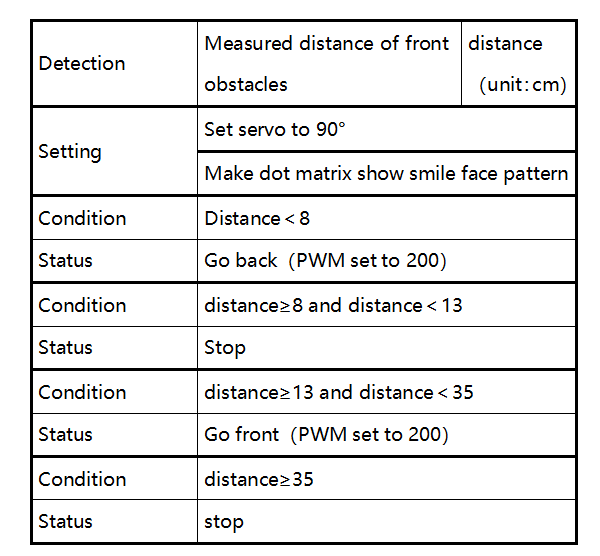
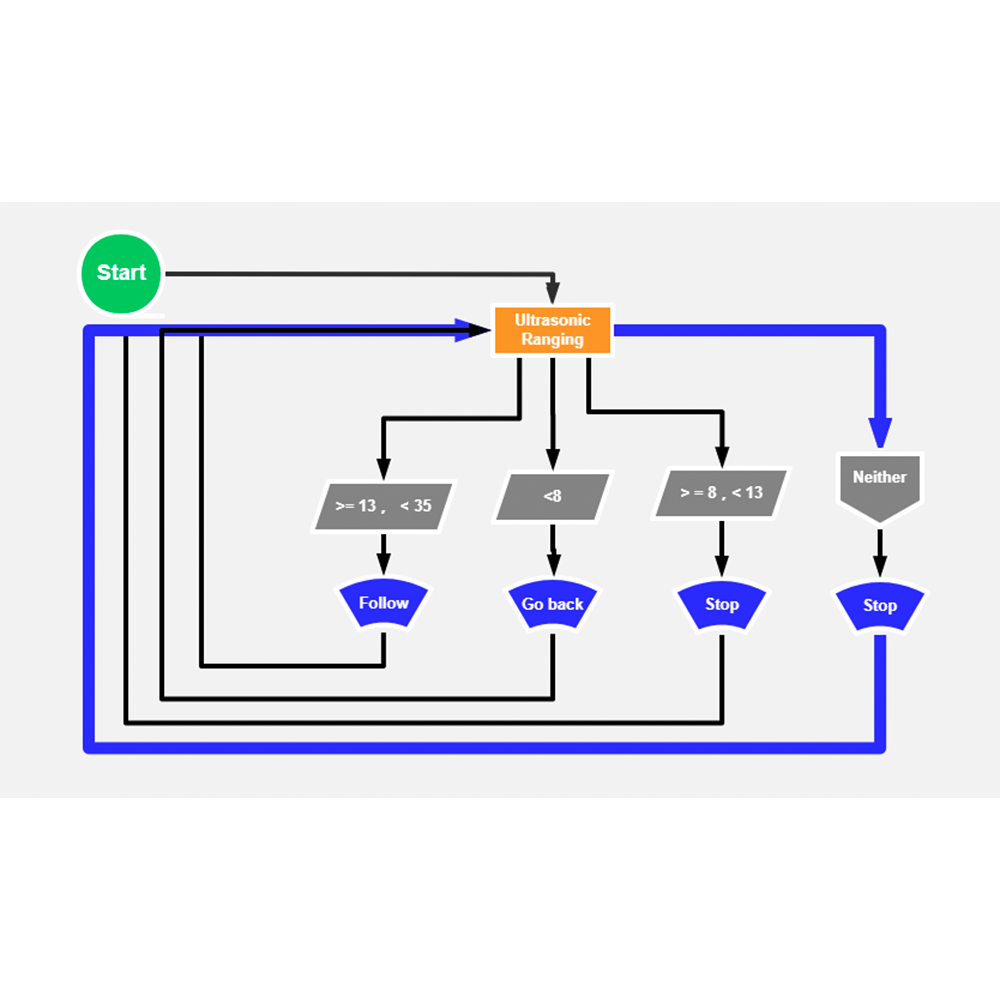
In this project, we detect the distance from the obstacle to drive two motors so as to make robot car move and 8*8 dot matrix shows smile facial pattern.
The specific logic of ultrasonic follow robot car is shown below:
Flow Chart
Hook-up Diagram
Test Code
/*
 keyestudio smart turtle robot
 lesson 11
 flowing turtle
 http://www.keyestudio.com
*/

 int left_ctrl = 2;//define the direction control pin of A motor
 int left_pwm = 6;//define the speed control pin of A motor
 int right_ctrl = 4;//define the direction control pin of B motor
 int right_pwm = 5;//define the speed control pin of B motor
#include "SR04.h" //define the function library of ultrasonic sensor
#define TRIG_PIN 12// set the signal of ultrasonic sensor to D12
#define ECHO_PIN 13// set the signal of ultrasonic sensor to D13
SR04 sr04 = SR04(ECHO_PIN,TRIG_PIN);
long distance;

void setup() {
  Serial.begin(9600);//open serial monitor and set baud rate to 9600
  pinMode(left_ctrl,OUTPUT);//set direction control pin of A motor to OUTPUT
  pinMode(left_pwm,OUTPUT);//set PWM control pin of A motor to OUTPUT
  pinMode(right_ctrl,OUTPUT);//set direction control pin of B motor to OUTPUT
  pinMode(right_pwm,OUTPUT);//set PWM control pin of B motor to OUTPUT

}

void loop() {
  distance = sr04.Distance();//the distance detected by ultrasonic sensor
   if(distance<8)//if distance is less than 8
  {
    back();//go back
  }
  else if((distance>=8)&&(distance<13))//if 8≤distance<13
  {
    Stop();//stop
  }
  else if((distance>=13)&&(distance<35))//if 13≤distance<35
{
    front();//follow
  }
  else//otherwise
  {
    Stop();//stop
  }
}

void front()//define the status of going front
{
  digitalWrite(left_ctrl,LOW);
  analogWrite(left_pwm,200);
  digitalWrite(right_ctrl,LOW);
  analogWrite(right_pwm,200);
}
void back()//define the status of going back
{
  digitalWrite(left_ctrl,HIGH);
  analogWrite(left_pwm,200);
  digitalWrite(right_ctrl,HIGH);
  analogWrite(right_pwm,200);
}
void left()//define the status of turning left
{
  digitalWrite(left_ctrl,HIGH);
  analogWrite(left_pwm,200);
  digitalWrite(right_ctrl,LOW);
  analogWrite(right_pwm,200);
}
void right()//define the status of right turning
{
  digitalWrite(left_ctrl,LOW);
  analogWrite(left_pwm,200);
  digitalWrite(right_ctrl,HIGH);
  analogWrite(right_pwm,200);
}
void Stop()//define the state of stop
{
  analogWrite(left_pwm,0);
  analogWrite(right_pwm,0);
}
Test Result
Uploading the code to the development board, and plugging in, and adjusting the servo on the turtle robot car to 90°,dot matrix will display a smile facial pattern and follow the obstacle to move.
(This robot car can only moves forward and backward).
Project 12: Ultrasonic Avoiding Robot
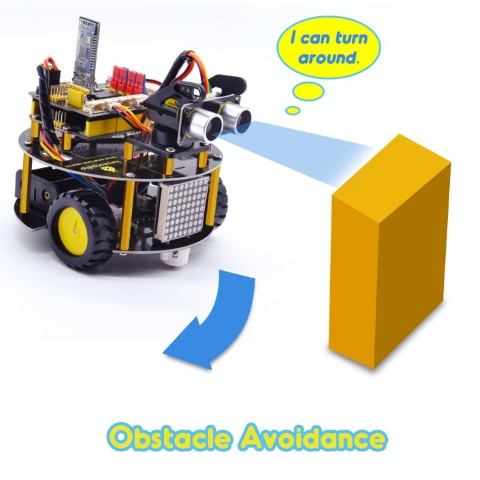
Description
We’ve learned LED matrix, motor drive, ultrasonic sensor and servo in previous lessons. Next, we could make an ultrasonic avoiding robot!
The measured distance between an ultrasonic sensor and obstacle can be used to control the servo to rotate so as to make robot car move.
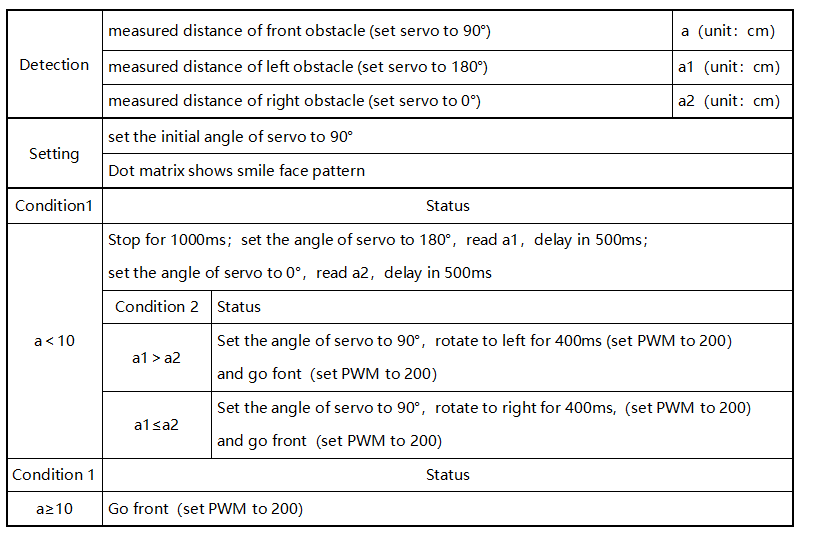
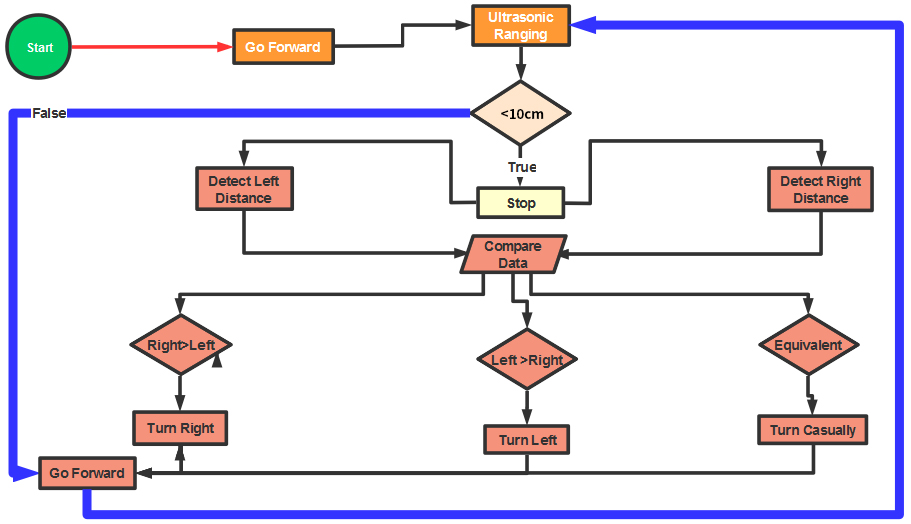
The specific logic of ultrasonic avoiding smart car is shown below:
Connection Diagram
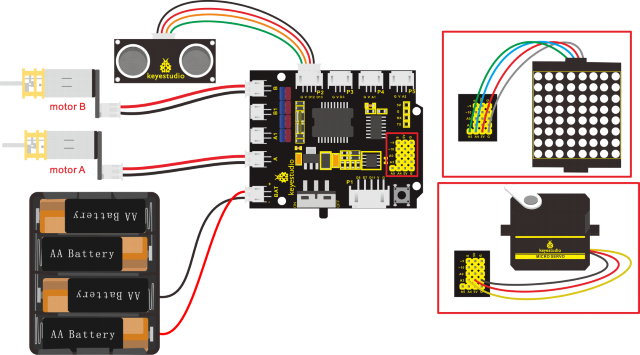
Test Code
/*
 keyestudio smart turtle robot
 lesson 12
 avoiding turtle
 http://www.keyestudio.com
*/
#include <ks_Matrix.h>
Matrix myMatrix(A4,A5);// set the pins of dot matrix to A4 and A5.
//Array, used to store the data of pattern, can be calculated by yourself or obtained from the modulus tool
uint8_t matrix_heart[8]={0x66,0x99,0x81,0x81,0x42,0x24,0x18,0x00};
uint8_t matrix_smile[8]={0x42,0xa5,0xa5,0x00,0x00,0x24,0x18,0x00};
uint8_t matrix_front2[8]={0x18,0x24,0x42,0x99,0x24,0x42,0x81,0x00};
uint8_t matrix_back2[8]={0x00,0x81,0x42,0x24,0x99,0x42,0x24,0x18};
uint8_t matrix_left2[8]={0x48,0x24,0x12,0x09,0x09,0x12,0x24,0x48};
uint8_t matrix_right2[8]={0x12,0x24,0x48,0x90,0x90,0x48,0x24,0x12};
uint8_t matrix_stop2[8]={0x18,0x18,0x18,0x18,0x18,0x00,0x18,0x18};
uint8_t  LEDArray[8];
const int left_ctrl = 2;//define direction control pin of A motor
const int left_pwm = 6;//define PWM control pin of A motor
const int right_ctrl = 4;//define direction control pin of B motor
const int right_pwm = 5;//define PWM control pin of B motor
#include "SR04.h"//define the library of ultrasonic sensor
#define TRIG_PIN 12// set the signal input of ultrasonic sensor to D12
#define ECHO_PIN 13//set the signal output of ultrasonic sensor to D13
SR04 sr04 = SR04(ECHO_PIN,TRIG_PIN);
long distance1,distance2,distance3;//define three distance
const int servopin = 10;//set the pin of servo to D10
int myangle;
int pulsewidth;
int val;

void setup() {
  Serial.begin(9600);//open serial monitor and set baud rate to 9600
  pinMode(left_ctrl,OUTPUT);//set direction control pin of A motor to OUTPUT
  pinMode(left_pwm,OUTPUT);//set PWM control pin of A motor to OUTPUT
  pinMode(right_ctrl,OUTPUT);//set direction control pin of B motor to OUTPUT
  pinMode(right_pwm,OUTPUT);//set PWM control pin of B motor to OUTPUT
  servopulse(servopin,90);//the angle of servo is 90 degree
  delay(300);
  myMatrix.begin(112);
  myMatrix.clear();
}

void loop()
 {
  avoid();//run the main program
}

void avoid()
{
  distance1=sr04.Distance(); //obtain the value detected by ultrasonic sensor

  if((distance1 < 10)&&(distance1 != 0))//if the distance is greater than 0 and less than 10

  {
    car_Stop();//stop
    myMatrix.clear();
    myMatrix.writeDisplay();//show stop pattern
    matrix_display(matrix_stop2);  //show stop pattern
    delay(100);
    servopulse(servopin,180);//servo rotates to 180°
    delay(200);
    distance2=sr04.Distance();//measure the distance
    delay(100);
    servopulse(servopin,0);//rotate to 0 degree
    delay(200);
    distance3=sr04.Distance();//measure the distance
    delay(100);
    if(distance2 > distance3)//compare the distance, if left distance is more than right distance
    {
      car_left();//turn left
      myMatrix.clear();
      myMatrix.writeDisplay();
      matrix_display(matrix_left2);    //display left-turning pattern
      servopulse(servopin,90);//servo rotates to 90 degree
      //delay(50);
      myMatrix.clear();
      myMatrix.writeDisplay();
      matrix_display(matrix_front2);   //show forward pattern
    }
    else//if the right distance is greater than the left
    {
      car_right();//turn right
      myMatrix.clear();
      myMatrix.writeDisplay();
      matrix_display(matrix_right2);   //display right-turning pattern
      servopulse(servopin,90);//servo rotates to 90 degree
      //delay(50);
      myMatrix.clear();
      myMatrix.writeDisplay();
      matrix_display(matrix_front2);  //show forward pattern
    }
  }
  else//otherwise
  {
    car_front();//go forward
    myMatrix.clear();
    myMatrix.writeDisplay();
    matrix_display(matrix_front2);  // show forward pattern
  }
}

void servopulse(int servopin,int myangle)//the running angle of servo
{
  for(int i=0; i<20; i++)
  {
    pulsewidth = (myangle*11)+500;
    digitalWrite(servopin,HIGH);
    delayMicroseconds(pulsewidth);
    digitalWrite(servopin,LOW);
    delay(20-pulsewidth/1000);
  }

}

void car_front()//car goes forward
{
  digitalWrite(left_ctrl,LOW);
  analogWrite(left_pwm,200);
  digitalWrite(right_ctrl,LOW);
  analogWrite(right_pwm,200);
}
void car_back()//go back
{
  digitalWrite(left_ctrl,HIGH);
  analogWrite(left_pwm,200);
  digitalWrite(right_ctrl,HIGH);
  analogWrite(right_pwm,200);
}
void car_left()//car turns left
{
  digitalWrite(left_ctrl,HIGH);
  analogWrite(left_pwm,200);
  digitalWrite(right_ctrl,LOW);
  analogWrite(right_pwm,200);
}
void car_right()//car turns right
{
  digitalWrite(left_ctrl,LOW);
  analogWrite(left_pwm,200);
  digitalWrite(right_ctrl,HIGH);
  analogWrite(right_pwm,200);
}

void car_Stop()//stop
{
   analogWrite(left_pwm,0);
  analogWrite(right_pwm,0);
}

//this function is used for dot matrix display
void matrix_display(unsigned char matrix_value[])
{
  for(int i=0; i<8; i++)
    {
      LEDArray[i]=matrix_value[i];
      for(int j=7; j>=0; j--)
      {
        if((LEDArray[i]&0x01)>0)
        myMatrix.drawPixel(j, i,1);
        LEDArray[i] = LEDArray[i]>>1;
      }
    }
    myMatrix.writeDisplay();
}
Test Result
Uploading the code on the keyestudio V4.0 board, wiring according to the connection diagram and turning on the robot car, the smart car can automatically avoid obstacles.
Project 13: IR Remote Control Robot
Description
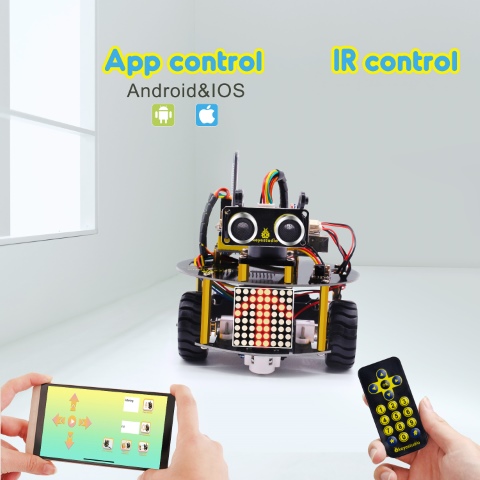
In this project, we will make IR remote control robot car!
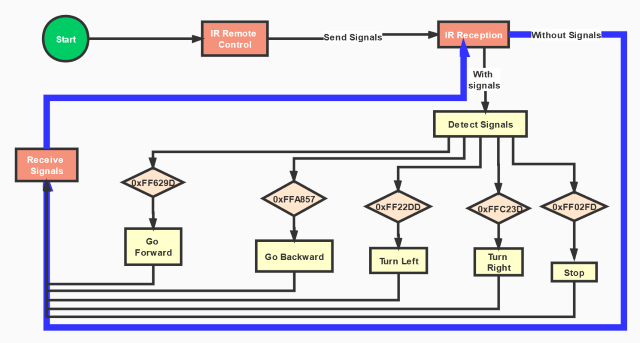
Press the button on IR remote control to drive robot car to move, and the corresponding state pattern is displayed on the 8*16 LED matrix.
The specific logic of IR remote control robot car is shown below:
Initial setup: Dot matrix displays smile face
Remote control |
Key Value |
Key state |
|---|---|---|
|
FF629D |
Go front(PWM set to 200) |
|
FFA857 |
Back(PWM set to 200) |
|
FF22DD |
Rotate to left(PWM set to 200) |
|
FFC23D |
Rotate to right (PWM set to 200) |
|
FF02FD |
Stop |
|
FF30CF |
Turn left |
|
FF7A85 |
Turn right |


Flow Chart
Hook-up Diagram
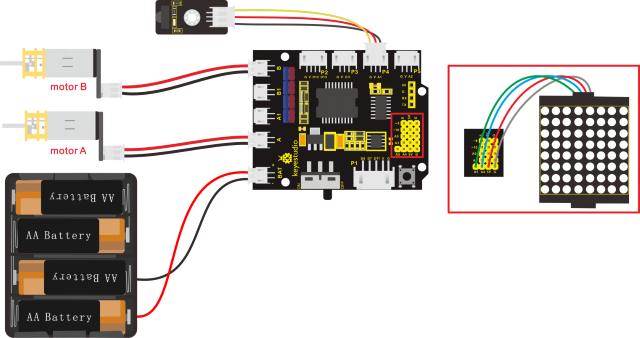
Note: IR receiver is connected to P4 interface.
Test Code
/*
keyestudio smart turtle robot
lesson 13
remote control turtle
http://www.keyestudio.com
*/
#include <ks_Matrix.h>
Matrix myMatrix(A4,A5);
//Array, used to store the data of pattern, can be calculated by yourself or obtained from the modulus tool
uint8_t matrix_heart[8]={0x66,0x99,0x81,0x81,0x42,0x24,0x18,0x00};
uint8_t matrix_smile[8]={0x42,0xa5,0xa5,0x00,0x00,0x24,0x18,0x00};
uint8_t matrix_front2[8]={0x18,0x24,0x42,0x99,0x24,0x42,0x81,0x00};
uint8_t matrix_back2[8]={0x00,0x81,0x42,0x24,0x99,0x42,0x24,0x18};
uint8_t matrix_left2[8]={0x48,0x24,0x12,0x09,0x09,0x12,0x24,0x48};
uint8_t matrix_right2[8]={0x12,0x24,0x48,0x90,0x90,0x48,0x24,0x12};
uint8_t matrix_stop2[8]={0x18,0x18,0x18,0x18,0x18,0x00,0x18,0x18};
uint8_t  LEDArray[8];
const int left_ctrl = 4;//define the direction control pin of A motor
const int left_pwm = 5;//define the speed control of A motor
const int right_ctrl = 2;//define the direction control pin of B motor
const int right_pwm = 6;//define the speed control pin of B motor
#include <IRremote.h>//function library of IR remote control
int RECV_PIN = A1;//set the pin of IR receiver to A0
IRrecv irrecv(RECV_PIN);
long irr_val;
decode_results results;
void setup()
{
  pinMode(left_ctrl,OUTPUT);//
  pinMode(left_pwm,OUTPUT);//
  pinMode(right_ctrl,OUTPUT);//
  pinMode(right_pwm,OUTPUT);//
    Serial.begin(9600);//
  // In case the interrupt driver crashes on setup, give a clue
  // to the user what's going on.
  Serial.println("Enabling IRin");
  irrecv.enableIRIn(); // Start the receiver
  Serial.println("Enabled IRin");
 myMatrix.begin(112);
 myMatrix.clear();
}
void loop()
 {
  if (irrecv.decode(&results))
 {
    irr_val = results.value;
    Serial.println(irr_val, HEX);//serial prints the read IR remote signals
    switch(irr_val)
    {
      case 0xFF629D : car_front();
      myMatrix.clear();
      myMatrix.writeDisplay();
      matrix_display(matrix_front2);
      break;

      case 0xFFA857 : car_back();
      myMatrix.clear();
      myMatrix.writeDisplay();
      matrix_display(matrix_back2);
      break;
      case 0xFF22DD : car_left();
      myMatrix.clear();
      myMatrix.writeDisplay();
      matrix_display(matrix_left2);
      break;

      case 0xFFC23D : car_right();
      myMatrix.clear();
      myMatrix.writeDisplay();
      matrix_display(matrix_right2);
      break;

      case 0xFF02FD : car_Stop();
      myMatrix.clear();
      myMatrix.writeDisplay();
      matrix_display(matrix_stop2);
      break;
    }
        irrecv.resume(); // Receive the next value
  }
}
void car_front()//define the state of going front
{
  digitalWrite(left_ctrl,LOW);
  analogWrite(left_pwm,200);
  digitalWrite(right_ctrl,LOW);
  analogWrite(right_pwm,200);
}
void car_back()//define the status of going back
{
  digitalWrite(left_ctrl,HIGH);
  analogWrite(left_pwm,200);
  digitalWrite(right_ctrl,HIGH);
  analogWrite(right_pwm,200);
}
void car_left()//set the status of left turning
{
  digitalWrite(left_ctrl,LOW);
  analogWrite(left_pwm,200);
  digitalWrite(right_ctrl,HIGH);
  analogWrite(right_pwm,200);
}
void car_right()//set the status of right turning
{
  digitalWrite(left_ctrl,HIGH);
  analogWrite(left_pwm,200);
  digitalWrite(right_ctrl,LOW);
  analogWrite(right_pwm,200);
}
void car_Stop()//define the state of stop
{
   analogWrite(left_pwm,0);
  analogWrite(right_pwm,0);
}
//The function that dot matrix shows pattern
void matrix_display(unsigned char matrix_value[])
{
  for(int i=0; i<8; i++)
    {
      LEDArray[i]=matrix_value[i];
      for(int j=7; j>=0; j--)
      {
        if((LEDArray[i]&0x01)>0)
        myMatrix.drawPixel(j, i,1);
        LEDArray[i] = LEDArray[i]>>1;
      }
    }
    myMatrix.writeDisplay();
}
Test Result
Upload code and press buttons on IR remote control to make turtle robot car to move.
Project 14: Bluetooth Remote Control
Description
We’ve learned the basic knowledge of Bluetooth. And in this lesson, we will make a Bluetooth remote smart car. In this experiment, we default the HM-10 Bluetooth module as a Slave and the cellphone as a Host.
keyes BT car is an APP rolled out by keyestudio team. You can control the robot car by it readily.
Test the key value of App
Special note: before uploading the test code, you need to remove the Bluetooth module. Otherwise, the test code will fail to upload. You can reconnect the Bluetooth module when the code is uploaded successfully.
/*
keyestudio
lesson 14.1
Bluetooth test
http://www.keyestudio.com
*/
char BLE_val;
void setup()
{
  Serial.begin(9600);
}
void loop()
{
  if(Serial.available()>0)
  {
    BLE_val = Serial.read();
    Serial.println(BLE_val);
  }
}
Upload code to V4.0 development board, and connect to Bluetooth module, as shown below:
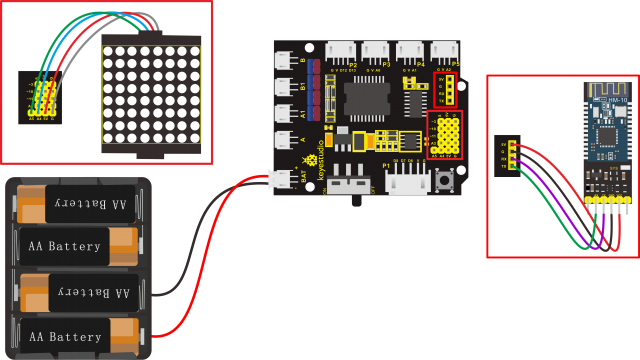
Insert a Bluetooth module, LED indicator of Bluetooth module will flash. Next, download the App.
Special note: RXD, TXD, GND and VCC of Bluetooth module are respectively connected to TX, RX, -(GND)and +(VCC). The STATE and BRK pins don’t need to be connected.
The pin G, V, SDA and SCL of dot matrix are linked with G, 5V, A4 and A5 separately. Plug power to BAT interface.
For iOS system
Search keyes BT car in App store
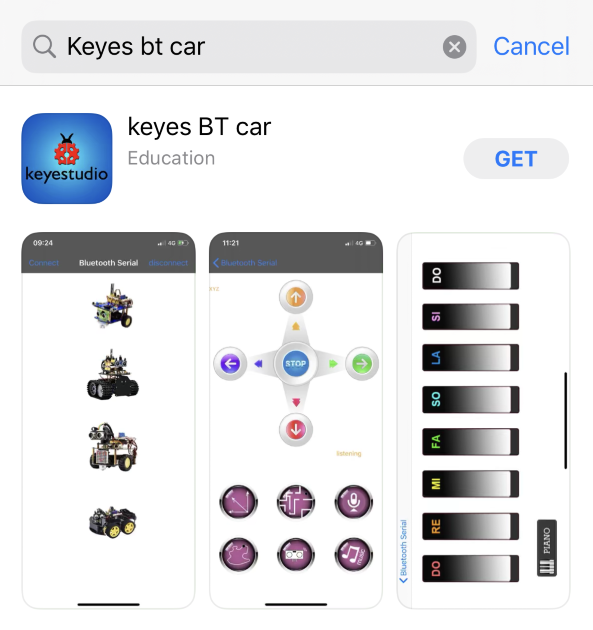
After installation, enter its interface.
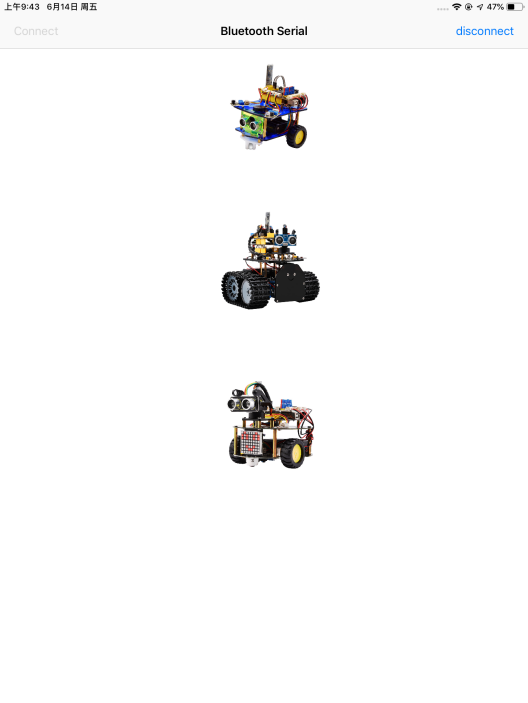
Click “Connect” to search and pair Bluetooth.
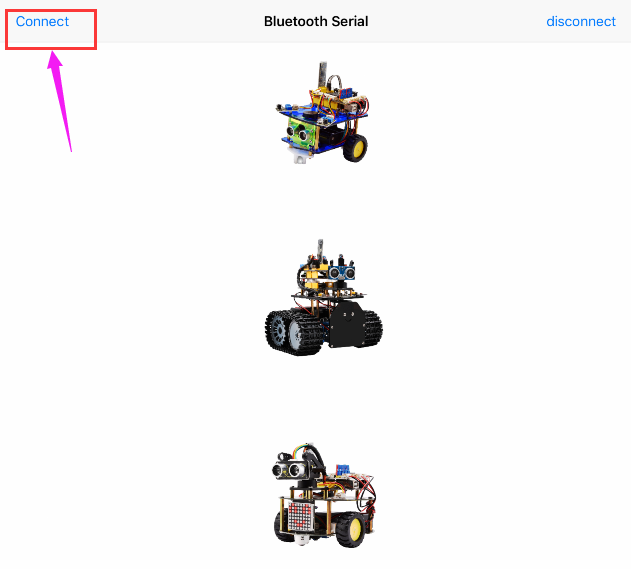
5.Click to enter the main page of turtle smart car.
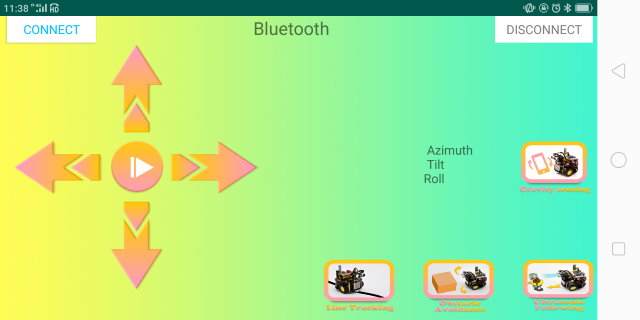
For Android System
Enter Google play store to search for Turtle Car allow APP to access“location”, you could enable “location”in settings of your cellphone.
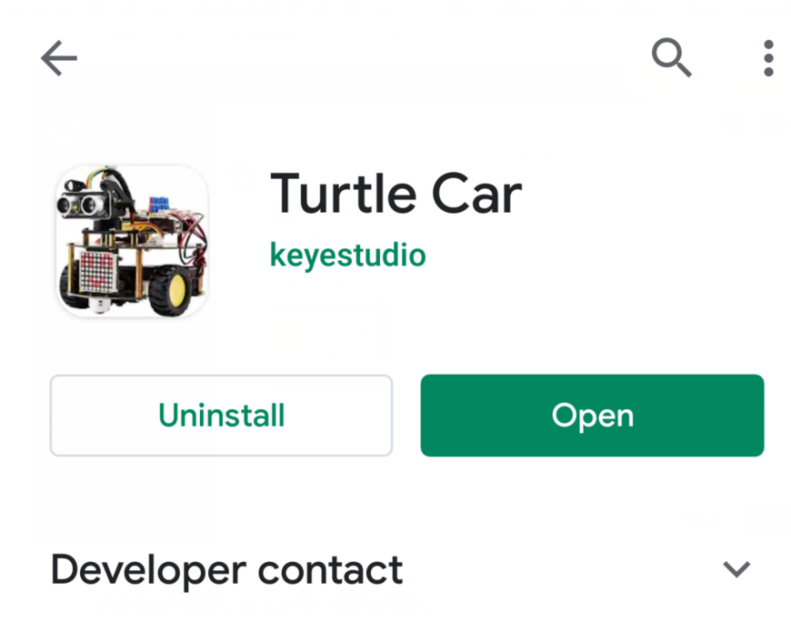
The app icon is shown below after installation.
Click app to enter the following page.
After connecting Bluetooth, plug in power and LED indicator of Bluetooth module will flicker. Tap  to search Bluetooth.
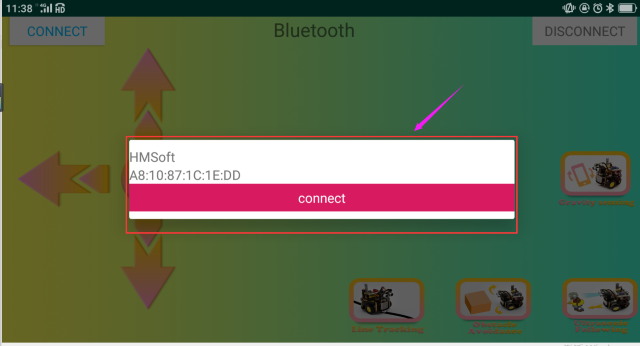
Click“connect”below HMSoft, then the Bluetooth will be connected and its LED indicator will stay on.
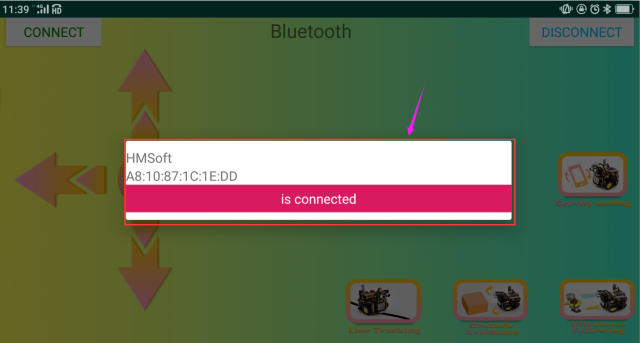
After connecting Bluetooth module, open serial monitor to set baud rate to 9600. Pressing the button of the Bluetooth APP, and the corresponding characters are displayed as shown below:
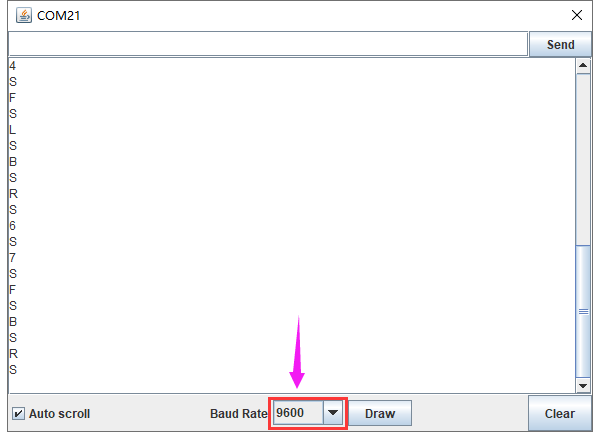
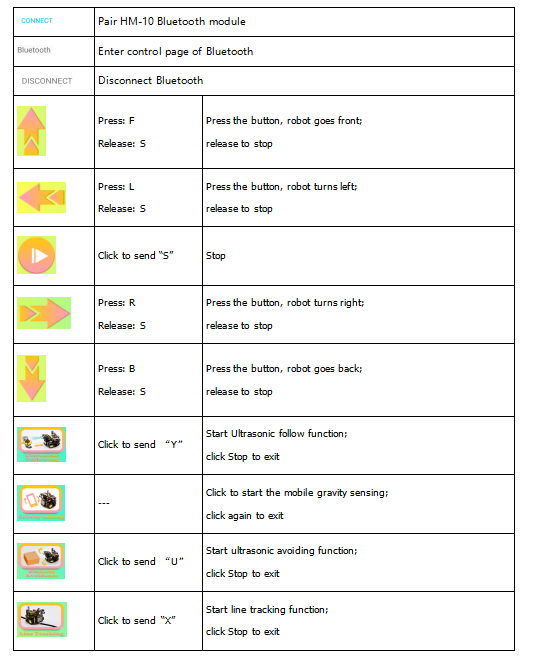
We have read the characters of each key on mobile APP via serial port and know the function of those keys.
Flow Chart
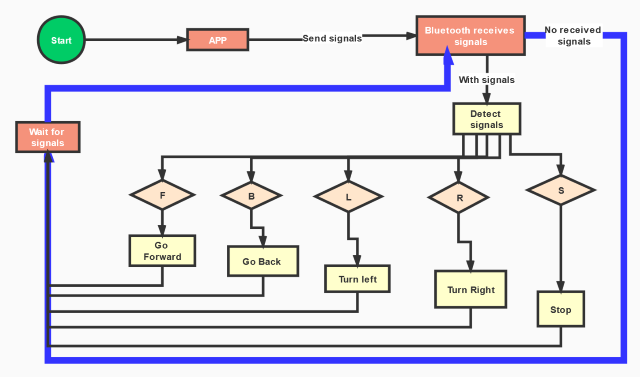
Connection Diagram
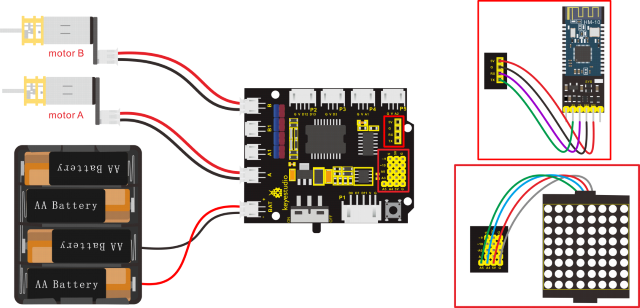
Test Code
/*
keyestudio smart turtle robot
lesson 14.2
Bluetooth Control turtle
http://www.keyestudio.com
*/
#include <ks_Matrix.h>
Matrix myMatrix(A4,A5);
//Array, used to store the data of pattern, can be calculated by yourself or obtained from the modulus tool
uint8_t matrix_heart[8]={0x66,0x99,0x81,0x81,0x42,0x24,0x18,0x00};
uint8_t matrix_smile[8]={0x42,0xa5,0xa5,0x00,0x00,0x24,0x18,0x00};
uint8_t matrix_front2[8]={0x18,0x24,0x42,0x99,0x24,0x42,0x81,0x00};
uint8_t matrix_back2[8]={0x00,0x81,0x42,0x24,0x99,0x42,0x24,0x18};
uint8_t matrix_left2[8]={0x48,0x24,0x12,0x09,0x09,0x12,0x24,0x48};
uint8_t matrix_right2[8]={0x12,0x24,0x48,0x90,0x90,0x48,0x24,0x12};
uint8_t matrix_stop2[8]={0x18,0x18,0x18,0x18,0x18,0x00,0x18,0x18};
uint8_t  LEDArray[8];
unsigned char data_line = 0;
unsigned char delay_count = 0;
const int left_ctrl = 2;//define direction control pin of A motor
const int left_pwm = 6;//define PWM control pin of A motor
const int right_ctrl = 4;//define direction control pin of B motor
const int right_pwm = 5;//define PWM control pin of B motor
char BLE_val;
void setup()
{
  Serial.begin(9600);
  pinMode(left_ctrl,OUTPUT);
  pinMode(left_pwm,OUTPUT);
  pinMode(right_ctrl,OUTPUT);
  pinMode(right_pwm,OUTPUT);
 myMatrix.begin(112);
 myMatrix.clear();
}

void loop()
{
  if(Serial.available()>0)
  {
    BLE_val = Serial.read();
    Serial.println(BLE_val);
  }
  switch(BLE_val)
  {
    case 'F': car_front();
    myMatrix.clear();
    myMatrix.writeDisplay();
    matrix_display(matrix_front2);
    break;

    case 'B': car_back();
    myMatrix.clear();
    myMatrix.writeDisplay();
    matrix_display(matrix_back2);
    break;

    case 'L': car_left();
    myMatrix.clear();
    myMatrix.writeDisplay();
    matrix_display(matrix_left2);
    break;

    case 'R': car_right();
    myMatrix.clear();
    myMatrix.writeDisplay();
    matrix_display(matrix_right2);
    break;

    case 'S': car_Stop();
    myMatrix.clear();
    myMatrix.writeDisplay();
    matrix_display(matrix_stop2);
    break;
  }

}
void car_front()//go front
{
  digitalWrite(left_ctrl,LOW);
  analogWrite(left_pwm,200);
  digitalWrite(right_ctrl,LOW);
  analogWrite(right_pwm,200);
}
void car_back()//go backward
{
  digitalWrite(left_ctrl,HIGH);
  analogWrite(left_pwm,200);
  digitalWrite(right_ctrl,HIGH);
  analogWrite(right_pwm,200);
}
void car_left()//turn left
{
  digitalWrite(left_ctrl,HIGH);
  analogWrite(left_pwm,200);
  digitalWrite(right_ctrl,LOW);
  analogWrite(right_pwm,200);
}
void car_right()//turn right
{
  digitalWrite(left_ctrl,LOW);
  analogWrite(left_pwm,200);
  digitalWrite(right_ctrl,HIGH);
  analogWrite(right_pwm,200);
}

void car_Stop()//stop
{

  analogWrite(left_pwm,0);
  analogWrite(right_pwm,0);
}
// the function that dot matrix shows patterns
void matrix_display(unsigned char matrix_value[])
{
  for(int i=0; i<8; i++)
    {
      LEDArray[i]=matrix_value[i];
      for(int j=7; j>=0; j--)
      {
        if((LEDArray[i]&0x01)>0)
        myMatrix.drawPixel(j, i,1);
        LEDArray[i] = LEDArray[i]>>1;
      }
    }
    myMatrix.writeDisplay();
}
Test Result
Uploading the program to development board, inserting Bluetooth module and opening the App to connect with Bluetooth, we can control the turtle robot car to move through icons on the App.
Special Note: you need to remove the Bluetooth module before uploading the test code. Otherwise, the test code will fail to upload.
And the Bluetooth module can be reconnected after uploading code successfully.
Project 15: Multi-purpose Bluetooth Robot
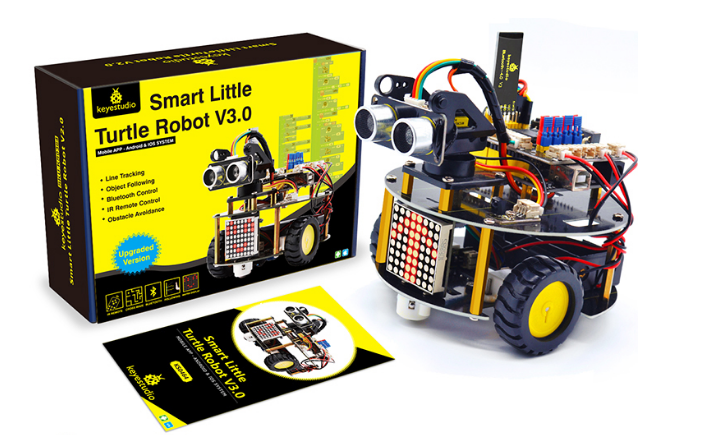
Description
In previous projects, the turtle robot car only performs a single function. However, in this lesson, we will integrate all of its functions via Bluetooth control.
Here is a simple flow chart of this multi-purpose robot car for your reference.
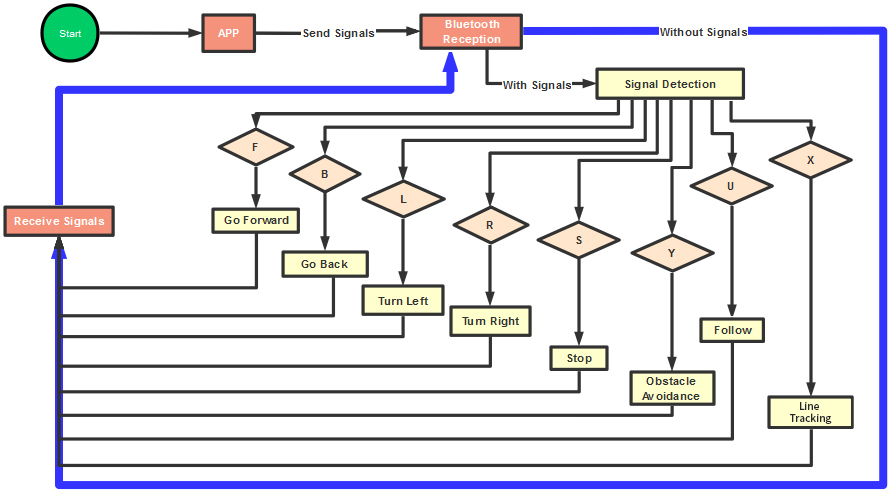
Connection Diagram
Test Code
/*
keyestudio smart turtle robot
lesson 15
Multifunctional turtle robot
http://www.keyestudio.com
*/
#include <ks_Matrix.h>
Matrix myMatrix(A4,A5);
//Array, used to store the data of pattern, can be calculated by yourself or obtained from the modulus tool
uint8_t matrix_heart[8]={0x66,0x99,0x81,0x81,0x42,0x24,0x18,0x00};
uint8_t matrix_smile[8]={0x42,0xa5,0xa5,0x00,0x00,0x24,0x18,0x00};
uint8_t matrix_front2[8]={0x18,0x24,0x42,0x99,0x24,0x42,0x81,0x00};
uint8_t matrix_back2[8]={0x00,0x81,0x42,0x24,0x99,0x42,0x24,0x18};
uint8_t matrix_left2[8]={0x48,0x24,0x12,0x09,0x09,0x12,0x24,0x48};
uint8_t matrix_right2[8]={0x12,0x24,0x48,0x90,0x90,0x48,0x24,0x12};
uint8_t matrix_stop2[8]={0x18,0x18,0x18,0x18,0x18,0x00,0x18,0x18};
uint8_t  LEDArray[8];
#include "SR04.h"
#define TRIG_PIN 12
#define ECHO_PIN 13
SR04 sr04 = SR04(ECHO_PIN,TRIG_PIN);
long distance,distance1,distance2,distance3;
const int left_ctrl = 2;
const int left_pwm = 6;
const int right_ctrl = 4;
const int right_pwm = 5;
const int sensor_l = 11;
const int sensor_c = 7;
const int sensor_r = 8;
int l_val,c_val,r_val;
const int servopin = 10;
int myangle;
int pulsewidth;
int val;
char BLE_val;

void setup() {
  Serial.begin(9600);
  //irrecv.enableIRIn(); // Start the receiver
  servopulse(servopin,90);
  pinMode(left_ctrl,OUTPUT);
  pinMode(left_pwm,OUTPUT);
  pinMode(right_ctrl,OUTPUT);
  pinMode(right_pwm,OUTPUT);
  pinMode(sensor_l,INPUT);
  pinMode(sensor_c,INPUT);
  pinMode(sensor_r,INPUT);
  myMatrix.begin(112);
  myMatrix.clear();
  myMatrix.writeDisplay();
}

void loop() {
  if(Serial.available()>0)
  {
    BLE_val = Serial.read();
    Serial.println(BLE_val);
  }
  switch(BLE_val)
  {
    case 'F': car_front();
    myMatrix.clear();
    myMatrix.writeDisplay();
    matrix_display(matrix_front2);
    break;
        case 'B': car_back();
    myMatrix.clear();
    myMatrix.writeDisplay();
    matrix_display(matrix_back2);
    break;
    case 'L': car_left();
    myMatrix.clear();
    myMatrix.writeDisplay();
    matrix_display(matrix_left2);
    break;
    case 'R': car_right();
    myMatrix.clear();
    myMatrix.writeDisplay();
    matrix_display(matrix_right2);
    break;

    case 'S': car_Stop();
    myMatrix.clear();
    myMatrix.writeDisplay();
    matrix_display(matrix_stop2);
    break;
    case 'X': tracking();
    break;
    case 'Y': follow_car();
    break;
    case 'U': avoid();
    break;
  }
}

void avoid()
{
  myMatrix.clear();
  myMatrix.writeDisplay();
  matrix_display(matrix_smile);
  int track_flag = 0;
  while(track_flag == 0)
  {
    distance1=sr04.Distance();
    if((distance1 < 10)&&(distance1 != 0))
    {
      car_Stop();
      myMatrix.clear();
      myMatrix.writeDisplay();
      matrix_display(matrix_stop2);
      delay(100);
      servopulse(servopin,180);
      delay(100);
      distance2=sr04.Distance();
      delay(100);
      servopulse(servopin,0);
      delay(100);
      distance3=sr04.Distance();
      delay(100);
      if(distance2 > distance3)
      {
        car_left();
        myMatrix.clear();
        myMatrix.writeDisplay();
        matrix_display(matrix_left2);
        servopulse(servopin,90);
        //delay(100);
      }
      else
      {
        car_right();
        myMatrix.clear();
        myMatrix.writeDisplay();
        matrix_display(matrix_right2);
        servopulse(servopin,90);
        //delay(100);
      }
    }
    else
    {
      car_front();
      myMatrix.clear();
      myMatrix.writeDisplay();
      matrix_display(matrix_front2);
    }
    if(Serial.available()>0)
    {
      BLE_val = Serial.read();
      if(BLE_val == 'S')
      {
        track_flag = 1;
      }
    }
  }
}

void follow_car()
{
  servopulse(servopin,90);
  int track_flag = 0;
  while(track_flag == 0)
  {
    distance = sr04.Distance();
      if(distance<8)
    {
      car_back();
      myMatrix.clear();
      myMatrix.writeDisplay();
      matrix_display(matrix_back2);
    }
    else if((distance>=8)&&(distance<13))
    {
      car_Stop();
      myMatrix.clear();
      myMatrix.writeDisplay();
      matrix_display(matrix_stop2);
    }
    else if((distance>=13)&&(distance<35))
    {
      car_front();
      myMatrix.clear();
      myMatrix.writeDisplay();
      matrix_display(matrix_front2);
    }
    else
    {
      car_Stop();
      myMatrix.clear();
      myMatrix.writeDisplay();
      matrix_display(matrix_stop2);
    }
    if(Serial.available()>0)
    {
      BLE_val = Serial.read();
      if(BLE_val == 'S')
      {
        track_flag = 1;
      }
    }
  }
}

void servopulse(int servopin,int myangle)
{
  for(int i=0;i<20;i++)
  {
    pulsewidth = (myangle*11)+500;
    digitalWrite(servopin,HIGH);
    delayMicroseconds(pulsewidth);
    digitalWrite(servopin,LOW);
    delay(20-pulsewidth/1000);
  }
}

void tracking()
{
  myMatrix.clear();
  myMatrix.writeDisplay();
  matrix_display(matrix_smile);
  int track_flag = 0;
  while(track_flag == 0)
  {
    l_val = digitalRead(sensor_l);
    c_val = digitalRead(sensor_c);
    r_val = digitalRead(sensor_r);
      if(c_val == 1)
    {
      car_front2();
      myMatrix.clear();
      myMatrix.writeDisplay();
      matrix_display(matrix_front2);
    }
    else
    {
      if((l_val == 1)&&(r_val == 0))
      {
        car_left();
        myMatrix.clear();
        myMatrix.writeDisplay();
        matrix_display(matrix_left2);
      }
      else if((l_val == 0)&&(r_val == 1))
      {
        car_right();
        myMatrix.clear();
        myMatrix.writeDisplay();
        matrix_display(matrix_right2);
      }
      else
      {
        car_Stop();
        myMatrix.clear();
        myMatrix.writeDisplay();
        matrix_display(matrix_stop2);
      }
    }
    if(Serial.available()>0)
    {
      BLE_val = Serial.read();
      if(BLE_val == 'S')
      {
        track_flag = 1;
      }
    }
  }
}
void car_front()
{
  digitalWrite(left_ctrl,LOW);
  analogWrite(left_pwm,200);
  digitalWrite(right_ctrl,LOW);
  analogWrite(right_pwm,200);
}
void car_front2()
{
  digitalWrite(left_ctrl,LOW);
  analogWrite(left_pwm,100);
  digitalWrite(right_ctrl,LOW);
  analogWrite(right_pwm,100);
}
void car_back()
{
  digitalWrite(left_ctrl,HIGH);
  analogWrite(left_pwm,200);
  digitalWrite(right_ctrl,HIGH);
  analogWrite(right_pwm,200);
}

void car_left()
{
  digitalWrite(left_ctrl,HIGH);
  analogWrite(left_pwm,200);
  digitalWrite(right_ctrl,LOW);
  analogWrite(right_pwm,200);
}
void car_right()
{
  digitalWrite(left_ctrl,LOW);
  analogWrite(left_pwm,200);
  digitalWrite(right_ctrl,HIGH);
  analogWrite(right_pwm,200);
}
void car_Stop()
{
  analogWrite(left_pwm,0);
  analogWrite(right_pwm,0);
}


//the function that dot matrix shows patterns
void matrix_display(unsigned char matrix_value[])
{
  for(int i=0; i<8; i++)
    {
      LEDArray[i]=matrix_value[i];
      for(int j=7; j>=0; j--)
      {
        if((LEDArray[i]&0x01)>0)
        myMatrix.drawPixel(j, i,1);
        LEDArray[i] = LEDArray[i]>>1;
      }
    }
    myMatrix.writeDisplay();
}
Test Result
Uploading code to development board, plugging in and turning on it , the turtle robot car can not only go forward and back but turn left and right. Moreover, it is known that the mobile APP, connected to Bluetooth successfully, can be used to control the movement of the car.
8. Resources
Wiki page: https://wiki.keyestudio.com/Main_Page
Official website: https://keyestudio.com/