KS5035 Keyestudio ESP32 S3 Mini Sensor Shield - Pin header
1. Introduction
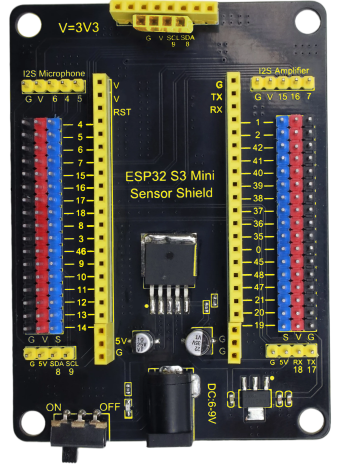
Keyestudio ESP32 S3 Mini Sensor Shield - Pin header is an expansion board designed to be compatible with S3 mini(MB0183). The board leads out all the IO ports of S3 Mini in 3-pin(G,V,S), making it convenient for developers to connect more peripherals. It also has 1 MIC interface, 1 speaker interface and 2 screen interfaces, facilitating the development of peripherals, including the Xiaozhi AI speech model.
2. Parameters
Operating voltage: DC6-9V
Maximum output current at 5V: 1.5A
Maximum output current at 3.3V: 0.5A
Pin spacing: 2.54mm
Operating temperature: -25℃ - +55℃
Dimensions: 64mm * 88mm
Environmental attribute: ROHS
3. Working Principle
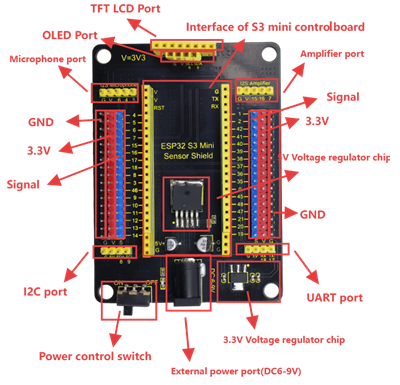
The 6-9V battery input provides the energy. The MIC29302 reduces the battery voltage to 5V to supply power to some interfaces and the AMS1117, while the AMS1117 converts 5V to 3.3V to supply power to most sensor interfaces.
4. Pin-out
5. Arduino
Arduino IDE download (including CH340 driver installation): Arduino IDE ESP32 chip package: ESP32 Please read the above reference links carefully.
6. Test
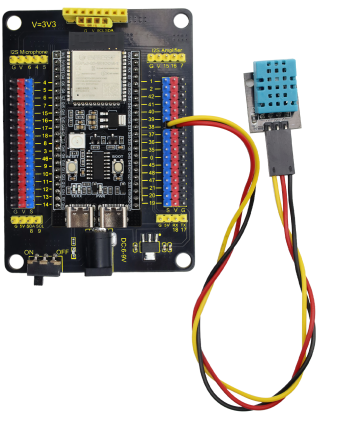
Wiring
S3 mini(MB0183) |
S3 mini shield |
DHT11 |
|---|---|---|
/ |
G |
GND |
/ |
V |
3V3 |
io38 |
io38 |
S |
Library: Bonezegei_DHT11
#include <Bonezegei_DHT11.h>

//param = DHT11 signal pin
Bonezegei_DHT11 dht(38);

void setup() {
  Serial.begin(115200);
  dht.begin();
}

void loop() {

  if (dht.getData()) {                         // get All data from DHT11
    float tempDeg = dht.getTemperature();      // return temperature in celsius
    float tempFar = dht.getTemperature(true);  // return temperature in fahrenheit if true celsius of false
    int hum = dht.getHumidity();               // return humidity
    String str  = "Temperature: ";
           str += tempDeg;
           str += "°C  ";
           str += tempFar;
           str += "°F  Humidity:";
           str += hum;
    Serial.println(str.c_str());
    //Serial.printf("Temperature: %0.1lf°C  %0.1lf°F Humidity:%d \n", tempDeg, tempFar, hum);
  }
  delay(2000);  //delay atleast 2 seconds for DHT11 to read tha data
}
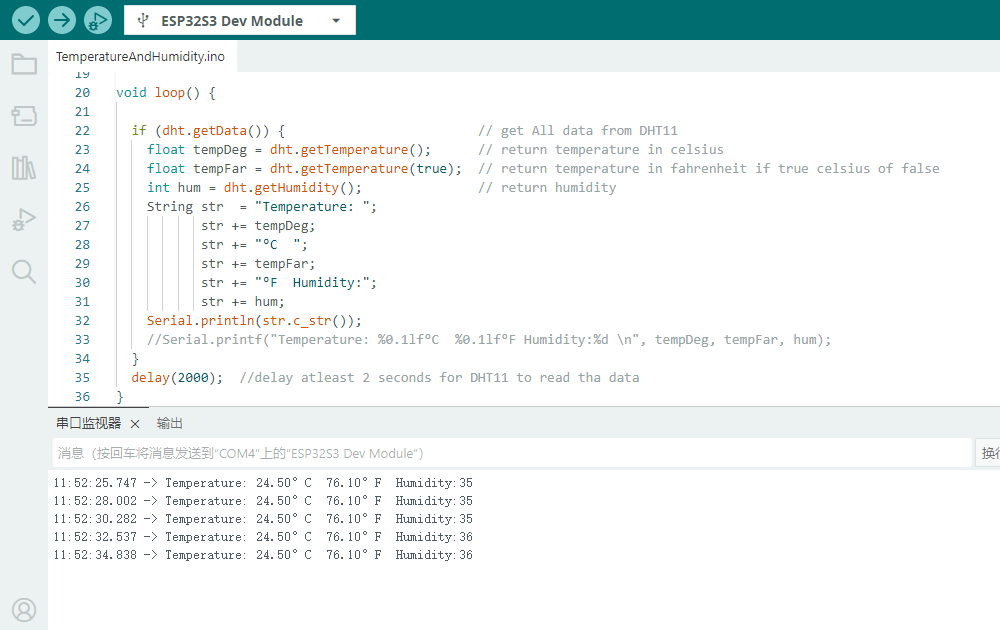
Test Result
7. The Don’ts
1.Do not directly connect high-power modules or motors to the IO expansion ports.
2.Do not connect a voltage greater than DC 9V to the External Power Port.