Project 3 Ultrasonic Obstacle Avoidance Smart Car
Ultrasonic obstacle avoidance is easy to realize, simple in calculation. It is easy to control it in real time with practical measuring accuracy. Therefore, it has become a common method for obstacle avoidance. For the application method of ultrasonic, please refer to “Arduino ultrasonic ranging instruction”. Below is the connection diagram for ultrasonic obstacle avoidance:
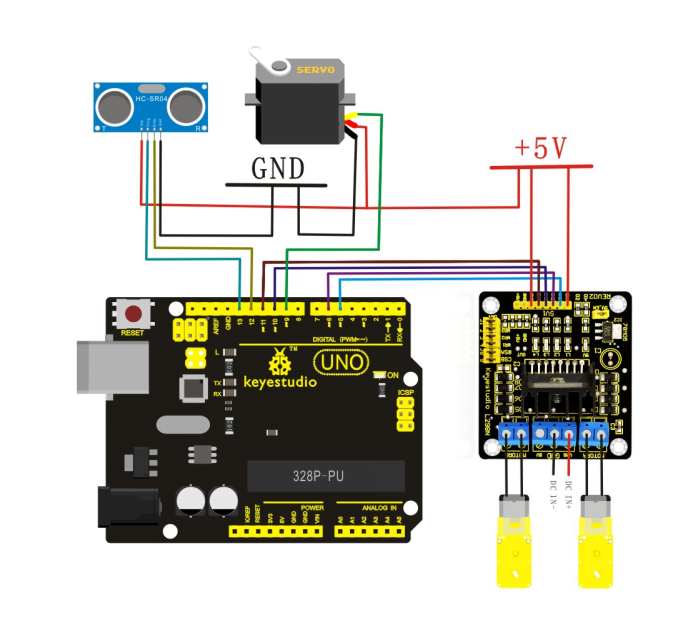
1. Connection of motor
Motor 1 to L298N MOTOA
Motor 2 to L298N MOTOB
2. Power supply of L298N
Use 1 contact of battery case of 6 cells of AA batteries to supply power for L298N motor driver module, another contact for Arduino main board. The + of the power supply for L298N motor driver module is connected to the VMS of L298N; the - to the GND. + 5V interface of L298N is not connected to anything.
3. The enable and turning function of the motor (with program)
int pinLB=5;	//  define pin 5 for left and back, connected to pin PWM5of the controller
int pinLF=6;	// define pin 6 for left and front, connected to pin PWM6 of the controller board
int pinRB=10;	// define pin 10 for right and back, connected to pin PWM10 of the controller board
int pinRF=11;	// define pin 11 for right and front, connected to pin PWM11 of the controller board
4. Connection of the servo motor
myservo.attach(9); // set servo motor output as pin 9(PWM)
5.Connection of the ultrasonic sensor
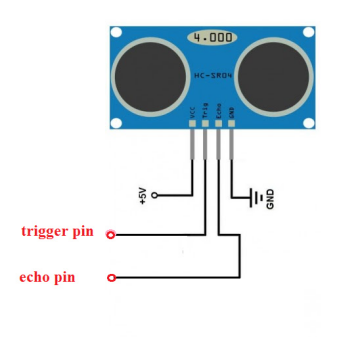
4.pins for this sensor
VCC to +5V
TRIQ signal input
ECHO signal output GND to GND
int inputPin = 13;  // define receiving pin for ultrasonic signal
int outputPin =12; // define sending pin for ultrasonic signal
5.Ultrasonic obstacle avoidance smart car program (ARDUINO)
Code 4
/*
       L = left
       R = right
       F = front
       B = back
*/

#include <Servo.h>
int pinLB=5;    // define pin 6 as left and back
int pinLF=6;    // define pin 9 as left and front
int pinRB=10;	// define pin 10 as right and back
int pinRF=11;	// define pin 11 as right and front
int inputPin = 13;  // define receiving pin for ultrasonic signal
int outputPin =12; // define sending pin for ultrasonic signal
int Fspeedd = 0;  // speed going forward
int Rspeedd = 0;  // speed going right
int Lspeedd = 0;     // speed going left
int directionn = 0;  //F=8 B=2 L=4 R=6
Servo myservo;	// set  myservo
int delay_time = 250; // settling time for the servo motor moving backwards

int Fgo = 8;        // going forward
int Rgo = 6;        // going right
int Lgo = 4;	// going left
int Bgo = 2;	// going backwards


void setup()
{
    Serial.begin(9600);	// define motor output
    pinMode(pinLB,OUTPUT); // pin  5 (PWM)
    pinMode(pinLF,OUTPUT); // pin  6 (PWM)
    pinMode(pinRB,OUTPUT); // pin 10 (PWM)
    pinMode(pinRF,OUTPUT); // pin  11 (PWM)

    pinMode(inputPin, INPUT);	// define receiving pin for ultrasonic signal
    pinMode(outputPin, OUTPUT); // define sending pin for ultrasonic signal
    myservo.attach(9);//  set servo motor output as pin 9(PWM)
}

void advance(int a)	// going forward
{
    digitalWrite(pinRB,LOW); // motor move right and back
    digitalWrite(pinRF,HIGH);
    digitalWrite(pinLB,LOW); // motor move to left and back
    digitalWrite(pinLF,HIGH);
    delay(a * 100);
}

void right(int b)	// turn right(1 wheel)
{
    digitalWrite(pinRB,LOW);  //motor move right and back
    digitalWrite(pinRF,HIGH);
    digitalWrite(pinLB,HIGH);
    digitalWrite(pinLF,HIGH);
    delay(b * 100);
}

void left(int c)	// turn left(1 wheel)
{
    digitalWrite(pinRB,HIGH);
    digitalWrite(pinRF,HIGH);
    digitalWrite(pinLB,LOW);  // motor move left and back
    digitalWrite(pinLF,HIGH);
    delay(c * 100);
}

void turnR(int d)	// turn right( 2 wheels)
{
    digitalWrite(pinRB,LOW); // motor move right and back
    digitalWrite(pinRF,HIGH);
    digitalWrite(pinLB,HIGH);
    digitalWrite(pinLF,LOW); //motor move left and front
    delay(d * 100);
}

void turnL(int e)// turn left(2 wheels)
{
    digitalWrite(pinRB,HIGH);
    digitalWrite(pinRF,LOW);  // motor move right and front
    digitalWrite(pinLB,LOW);  // motor move left and back
    digitalWrite(pinLF,HIGH);
    delay(e * 100);
}

void stopp(int f)// stop
{
    digitalWrite(pinRB,HIGH);
    digitalWrite(pinRF,HIGH);
    digitalWrite(pinLB,HIGH);
    digitalWrite(pinLF,HIGH);
    delay(f * 100);
}

void back(int g)// going backwards
{
    digitalWrite(pinRB,HIGH); // motor move right and back
    digitalWrite(pinRF,LOW);
    digitalWrite(pinLB,HIGH); // motor move left and back
    digitalWrite(pinLF,LOW);
    delay(g * 100);
}

void detection()// measure 3 angles(0.90.179)
{
    int delay_time = 250;  // settling time for the servo motor moving backwards
    ask_pin_F();// read the distance upfront
    if(Fspeedd < 10)// if distance less than  10cm
    {
        stopp(1);// clear output information
        back(2);// going backwards for  0.2 second
    }

    if(Fspeedd < 25)// if distance less than 25cm
    {
        stopp(1);// clear output information
        ask_pin_L();// read the distance on the left
        delay(delay_time);// settling time for the servo
        ask_pin_R();// read the distance on the right
        delay(delay_time);// settling time for the servo
        if(Lspeedd > Rspeedd) // if distance on the left is more than that on the right
        {
        	directionn = Rgo;// going right
        }
        if(Lspeedd <= Rspeedd) // if distance on the left is less than that on the right
        {
        	directionn = Lgo;// going left
        }
        if (Lspeedd < 10 && Rspeedd < 10)  // if both distance are less than 10cm
        {
        	directionn = Bgo;// going backwards
        }
    }
    else// if the distance upfront is more than 25cm
    {
    	directionn = Fgo;// going forward
    }
}

void ask_pin_F()  // measure the distance upfront
{
    myservo.write(90);
    digitalWrite(outputPin, LOW);  // ultrasonic sends out low voltage 2μs delayMicroseconds(2);
    digitalWrite(outputPin, HIGH); // ultrasonic sends out high voltage  10μs, at least 10μs
    delayMicroseconds(10);
    digitalWrite(outputPin, LOW);// maintain low voltage sending
    float Fdistance = pulseIn(inputPin, HIGH); // read the time difference
    Fdistance= Fdistance/5.8/10;// convert time into distance(unit: cm)
    Serial.print("F distance:");// output distance in cm
    Serial.println(Fdistance);// display distance
    Fspeedd = Fdistance;// read the distance data into  Fspeedd
}

void ask_pin_L()// measure the distance on the left
{
    myservo.write(9);
    delay(delay_time);
    digitalWrite(outputPin, LOW); // ultrasonic sends out low voltage 2μs
    delayMicroseconds(2);
    digitalWrite(outputPin, HIGH);// ultrasonic sends out high voltage  10μs, at least 10μs
    delayMicroseconds(10);
    digitalWrite(outputPin, LOW);// maintain low voltage sending
    float Ldistance = pulseIn(inputPin, HIGH); //  read the time difference
    Ldistance= Ldistance/5.8/10;// convert time into distance(unit: cm)
    Serial.print("L distance:");	//output distance in cm
    Serial.println(Ldistance);// display distance
    Lspeedd = Ldistance;// read the distance data into  Lspeedd
}

void ask_pin_R()//  measure the distance on the right
{
    myservo.write(177); delay(delay_time);
    digitalWrite(outputPin, LOW);  // ultrasonic sends out low voltage 2μs
    delayMicroseconds(2);
    digitalWrite(outputPin, HIGH); // ultrasonic sends out high voltage  10μs, at least 10μs
    delayMicroseconds(10);
    digitalWrite(outputPin, LOW);	// maintain low voltage sending
    float Rdistance = pulseIn(inputPin, HIGH); //read the time difference
    Rdistance= Rdistance/5.8/10;		// convert time into distance (unit: cm)
    Serial.print("R distance:");	// output distance in cm
    Serial.println(Rdistance);// display distance
    Rspeedd = Rdistance;// read the distance data into    Rspeedd
}

void loop()
{
    myservo.write(90); // reset the servo motor and prepare it for the next measurement
    detection();	// measure the angle and decide which direction to move
    if(directionn == 2) //if  directionn = 2
    {
        back(8);// going backwards
        turnL(2);// slightly move to the left to avoid stuck in the dead end
        Serial.print(" Reverse ");  // display direction (backwards)
    }
    if(directionn == 6)// if  direction = 6
    {
        back(1);
        turnR(6);// turn right
        Serial.print(" Right ");// display direction(right)
    }
    if(directionn == 4)//if  direction = 4
    {
        back(1);
        turnL(6);// turn left
        Serial.print(" Left ");// display direction(left)
    }
    if(directionn == 8)//if  direction= 8
    {
        advance(1);// going forward
        Serial.print(" Advance ");  //display direction(forward)
        Serial.print("  ");
    }
}