Lesson 10: Charging Principle of the Solar Tracking Kit
(1)Solar and usb charging module:
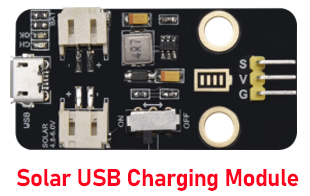
This module integrates a charging and discharging chip, which can be connected with an external rechargeable battery and a solar panel through the PH2.0MM interfaces.
In this kit, we provide a battery box that holds one 18650 battery, so you will need to prepare a rechargeable 18650 battery yourself.
The module has a Micro USB port and you can use the computer to charge the 18650 battery through the micro USB port.
In addition, it has a boost module which can increase the voltage of batteries to 6.6V. The DIP switch on the module is the OUTPUT switch of 6.6V. The pin G and V of this module can output 6.6V and the pin S can read the battery voltage after the resistance 1/2 voltage.
Parameters:
Charging Interface |
Micro USB HP2.0MM Interface for Solar Panel |
|---|---|
Input voltage of the solar panel interface |
4.4-6V |
Constant voltage charging value of the battery |
4.15-4.24V |
Maximum charging current |
800mA |
Output interface |
3 P 2.54mm Bent Needle |
Input Voltage |
6.6V |
Maximum output current |
1A |
External Battery |
18650 battery |
Environmental attributes |
ROHS |
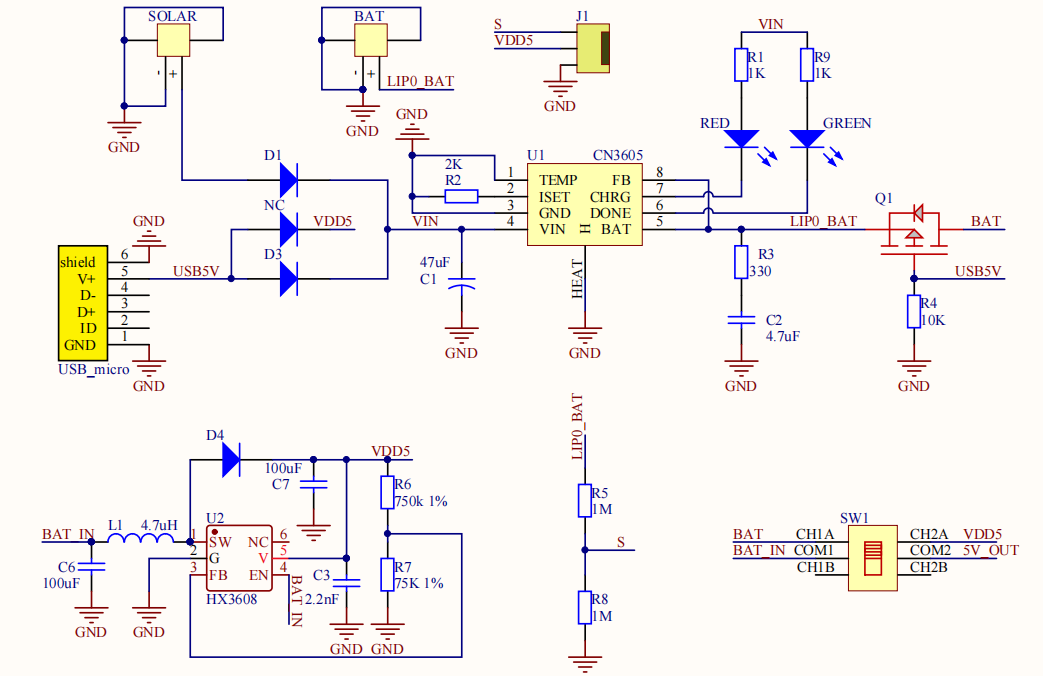
Schematic Diagram
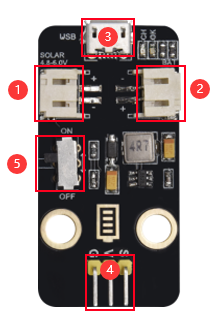
Features
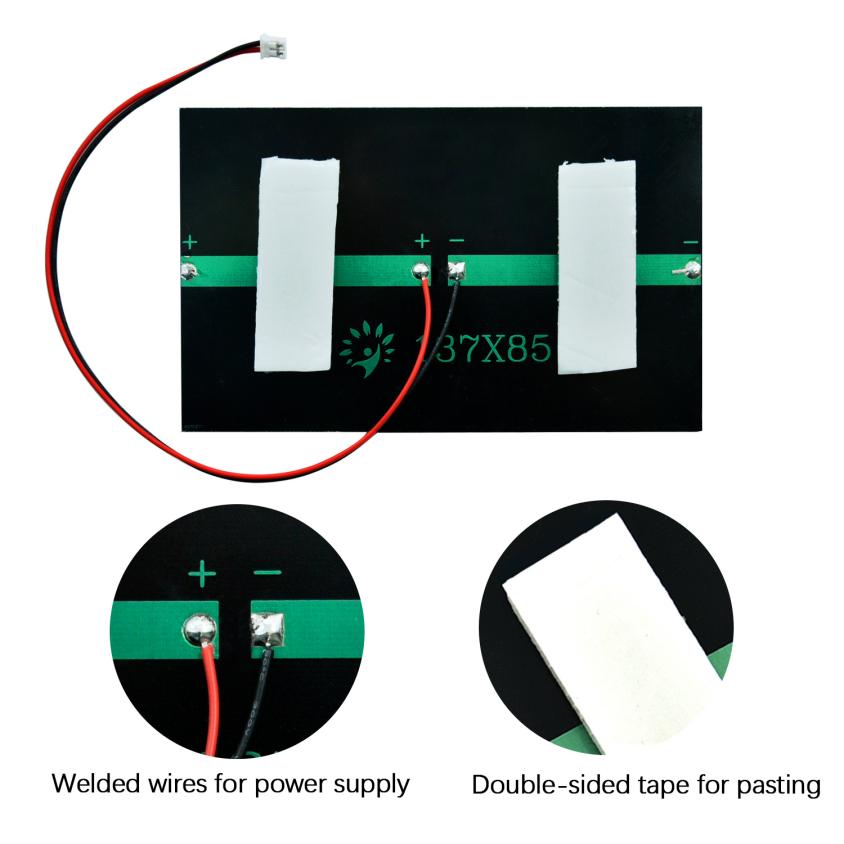
(2)PET Solar Panel
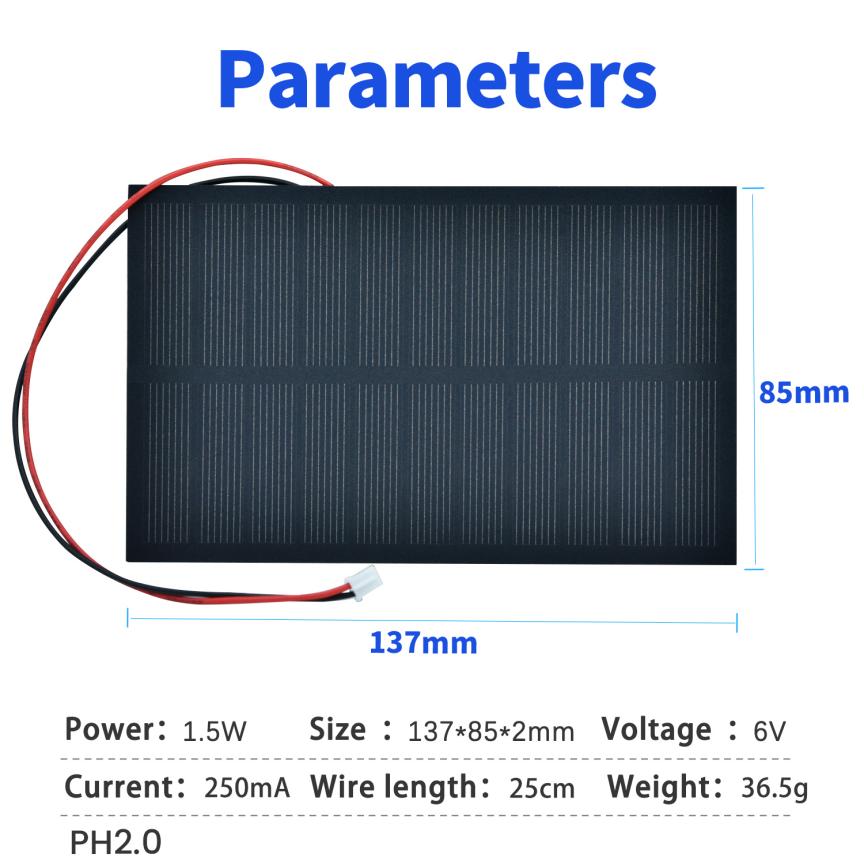
The main factors that affect the output performance of solar panels are as follows:
(1) Load impedance
(2) Sunlight intensity
(3)Temperature
(4) Illumination angle and illumination area
You can use a multimeter to measure the output current of the solar panel, adjust the multimeter to DC current level and large range jack, connect the red pen of the multimeter to the positive pole of the solar panel and the black pen to the negative pole of the solar panel, and measure it.
Can solar panels store electricity?
No, generally it needs to be paired with a battery to store electricity.
Can solar panels generate electricity on cloudy days?
No, the power generated by solar panels on cloudy days is very small. In this case, they have voltage but no current.
Can solar panels generate electricity under indoor lighting?
No, solar panels cannot generate electricity under indoor lighting.
(3)Charge the battery with the solar panel.
In this kit, we provide a battery case that is compatible with one 18650 battery, and it is also configured with two interfaces so that you can charge the battery or use it for power.
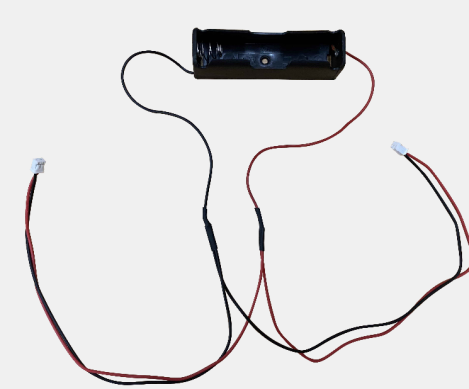
You will need to prepare yourself a 18650 battery as well as a battery charger.
The following parameters are available for your purchase:
Specifications |
|
|---|---|
Size |
18650 |
Positive Terminal: |
|
Capacity |
>2200mAh |
Nominal Voltage |
3.7V |
Maximum Voltage |
4.2V |
Discharge cut-off Voltage |
2.5V |
Rechargeable |
Yes |
Approx. Dimensions |
18.5mm x 65.2mm |
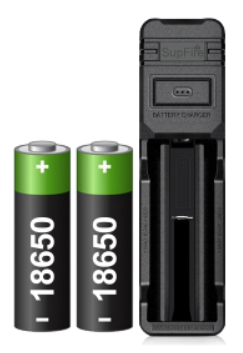 with a top
We can connect the solar panel to the charging module and a 18650 lithium case, so that the solar panel will charge the battery.
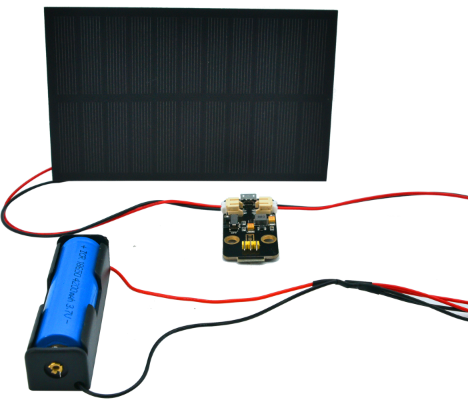
Solar panels are not batteries, do not have the function of power storage. It can store electricity in the battery.
The output of solar panels is weak in environments where there is no sunlight, indoor lighting and low winter light. The energy carried by these lights is very small, even if it is brighter.
Note:
The solar panel may require long periods of direct sunlight to charge the batteries enough. 18650 batteries should not be exposed to direct sunlight as well as avoiding high temperatures around it to avoid burnout.
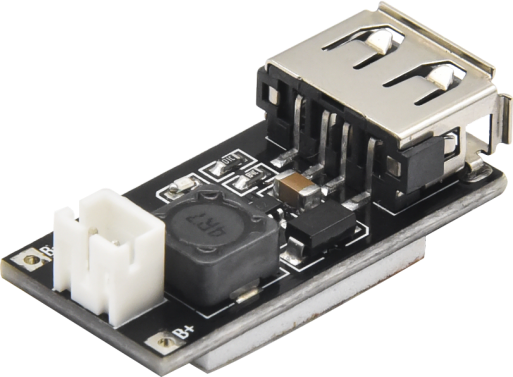 (4)Smart phone charging Module
The mobile phone charging module is a lithium battery boost module of 3.7V which can output 5V, 1A through the PH2.0 terminal and USB port.
Parameters:
Property |
non-isolated boost module (BOOST) |
|---|---|
Input voltage |
1-5V |
Output voltage |
5士0.1V |
Output current: |
Rated 1-1.5A (single cell lithium battery input), maximum 1.5A (single cell lithium battery input) |
Conversion efficiency |
Up to 96% . |
Switching frequency |
500KHz . |
Working temperature |
industrial grade (-40°C to +85°C ) |
Full load heating |
30°C |
Quiescent current |
130uA |
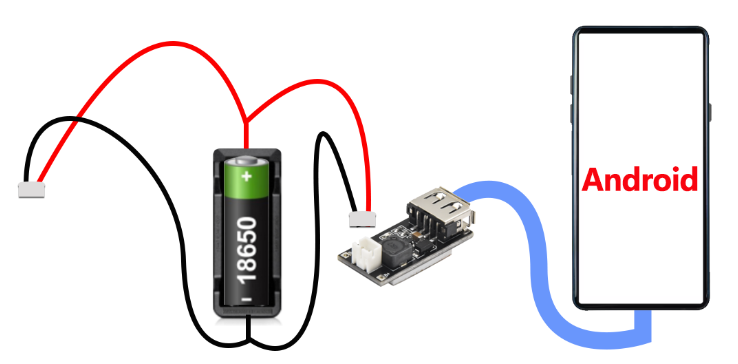
PH2.0 terminal of the phone charging module can be connected to the battery case.
The USB port of it can be connected to an android phone and charged.
Note that the power of 18650 battery must be sufficient (voltage up to 3.2-4.2V) to charge an Android phone. Otherwise it does not work, even if the phone shows it is charging.
(5)Charging Principle of the Solar Tracking Kit
1、Maximum charging current of micro USB port 1A
2、Solar panel maximum charging current 80mA
3、Maximum output voltage of USB A port female holder: 5V/1.5A (can be used for mobile phone charging)
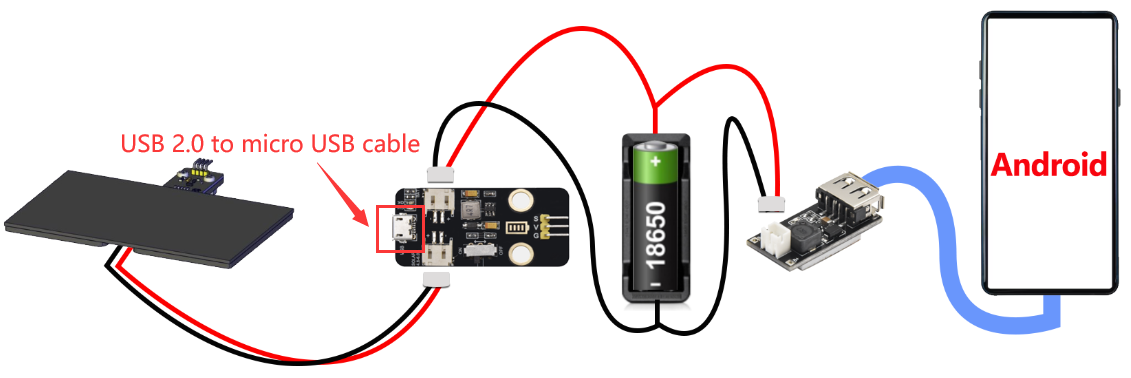
4、Battery type: 18650 lithium battery with a top, recommended to buy capacity greater than 2200mAh
Note:
1).The charging protocol of phone charging Module only supports Android but not iOS.
2).The solar panel can’t charge mobile phones directly; it need to store electricity in a battery and the battery charge the phone.
3).The voltage of the 18650 battery needs to be in the range of 3.2—4.2V to charge the cell phone. When the voltage of the battery is less than 3.2V, even though the phone shows that it is charging, it is not actually charging.
4).The solar panel may require long periods of direct sunlight to charge the batteries enough. 18650 batteries should not be exposed to direct sunlight as well as avoiding high temperatures around it to avoid burnout.
5).If you want to charge your 18650 battery quickly, you can charge the battery using the 18650 dedicated charger. Or use a USB 2.0 to micro USB cable to connect the charging module and charge the battery using a computer or power supply. (USB 2.0 to micro USB cable not included in kit)
6).This is just a simulation experiment and will not meet your daily power needs, don’t use it as your regular cell phone power source.