5.4.11 Progetto 6.1 Controllo SK6812
1. Descrizione
La lampada d’atmosfera della casa intelligente è composta da 4 LED SK6812RGB. I LED RGB sono moduli luminosi semplici, che possono regolare il colore per ottenere effetti luminosi di diversi colori. Inoltre, possono essere ampiamente utilizzati in edifici, ponti, strade, giardini, cortili, piani e altri ambiti di illuminazione decorativa e allestimento di luoghi, durante feste e ricorrenze come Natale, Halloween, San Valentino, Pasqua, la Festa nazionale, nonché in altri scenari d’atmosfera.
In questo esperimento realizzeremo vari effetti di illuminazione.
2. Conoscenze sui componenti
Dal diagramma schematico, possiamo vedere che questi quattro LED RGB sono tutti collegati in serie. In effetti, indipendentemente dal numero, possiamo usare un pin per controllare un LED RGB e farlo visualizzare qualsiasi colore. Ciascun LED RGB è un pixel indipendente, composto dai colori R, G e B, che può raggiungere 256 livelli di luminosità e realizzare la riproduzione a colori completa di 16777216 colori.
Inoltre, il pixel contiene un circuito driver amplificatore di conformazione del segnale di latch dei dati e un circuito di modellazione del segnale, che garantiscono efficacemente un’elevata uniformità del colore del punto luce.

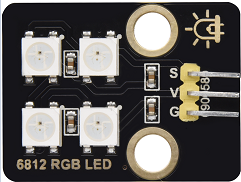
3. Pin
SK6812 |
26 |
|---|---|
\ |
4. Codice di Test
#include <Adafruit_NeoPixel.h>
#ifdef __AVR__
 #include <avr/power.h>                              // Required for 16 MHz Adafruit Trinket
#endif
#define LED_PIN    26                                // Which pin on the Arduino is connected to the NeoPixels?
#define LED_COUNT 4                                  // How many NeoPixels are attached to the Arduino?
Adafruit_NeoPixel strip(LED_COUNT, LED_PIN, NEO_GRB + NEO_KHZ800); // Declare our NeoPixel strip object:

void setup() {
#if defined(__AVR_ATtiny85__) && (F_CPU == 16000000)
  clock_prescale_set(clock_div_1);                   // These lines are specifically to support the Adafruit Trinket 5V 16 MHz.
#endif
  strip.begin();                                     // INITIALIZE NeoPixel strip object (REQUIRED)
  strip.show();                                      // Turn OFF all pixels ASAP
  strip.setBrightness(50);                           // Set BRIGHTNESS to about 1/5 (max = 255)
}

void loop() {
  colorWipe(strip.Color(255,   0,   0), 50);         // Red
  colorWipe(strip.Color(  0, 255,   0), 50);         // Green
  colorWipe(strip.Color(  0,   0, 255), 50);         // Blue

  theaterChase(strip.Color(127, 127, 127), 50);      // White, half brightness
  theaterChase(strip.Color(127,   0,   0), 50);      // Red, half brightness
  theaterChase(strip.Color(  0,   0, 127), 50);      // Blue, half brightness

  rainbow(10);                                       // Flowing rainbow cycle along the whole strip
  theaterChaseRainbow(50);                           // Rainbow-enhanced theaterChase variant
}

void colorWipe(uint32_t color, int wait) {
  for(int i=0; i<strip.numPixels(); i++) {           // For each pixel in strip...
    strip.setPixelColor(i, color);                   // Set pixel's color (in RAM)
    strip.show();                                    // Update strip to match
    delay(wait);                                     // Pause for a moment
  }
}

void theaterChase(uint32_t color, int wait) {
  for(int a=0; a<10; a++) {                         // Repeat 10 times...
    for(int b=0; b<3; b++) {                        // 'b' counts from 0 to 2...
      strip.clear();                                // Set all pixels in RAM to 0 (off)
      for(int c=b; c<strip.numPixels(); c += 3) {    // 'c' counts up from 'b' to end of strip in steps of 3...
        strip.setPixelColor(c, color);               // Set pixel 'c' to value 'color'
      }
      strip.show();                                 // Update strip with new contents
      delay(wait);                                  // Pause for a moment
    }
  }
}

void rainbow(int wait) {
  for(long firstPixelHue = 0; firstPixelHue < 5*65536; firstPixelHue += 256) {
    for(int i=0; i<strip.numPixels(); i++) {        // For each pixel in strip...
      int pixelHue = firstPixelHue + (i * 65536L / strip.numPixels());
      strip.setPixelColor(i, strip.gamma32(strip.ColorHSV(pixelHue)));
    }
    strip.show();                                   // Update strip with new contents
    delay(wait);                                   // Pause for a moment
  }
}

void theaterChaseRainbow(int wait) {
  int firstPixelHue = 0;                           // First pixel starts at red (hue 0)
  for(int a=0; a<30; a++) {                        // Repeat 30 times...
    for(int b=0; b<3; b++) {                       // 'b' counts from 0 to 2...
      strip.clear();                               // Set all pixels in RAM to 0 (off)
      for(int c=b; c<strip.numPixels(); c += 3) {  // 'c' counts up from 'b' to end of strip in increments of 3...
        int      hue   = firstPixelHue + c * 65536L / strip.numPixels();
        uint32_t color = strip.gamma32(strip.ColorHSV(hue)); // hue -> RGB
        strip.setPixelColor(c, color);             // Set pixel 'c' to value 'color'
      }
      strip.show();                               // Update strip with new contents
      delay(wait);                               // Pause for a moment
      firstPixelHue += 65536 / 90;               // One cycle of color wheel over 90 frames
    }
  }
}
5. Risultato del Test
Le lampade d’atmosfera della casa intelligente mostreranno una varietà di colori ed effetti luminosi.