Project 10 IR Remote Control of Smart Car
1.Introduction
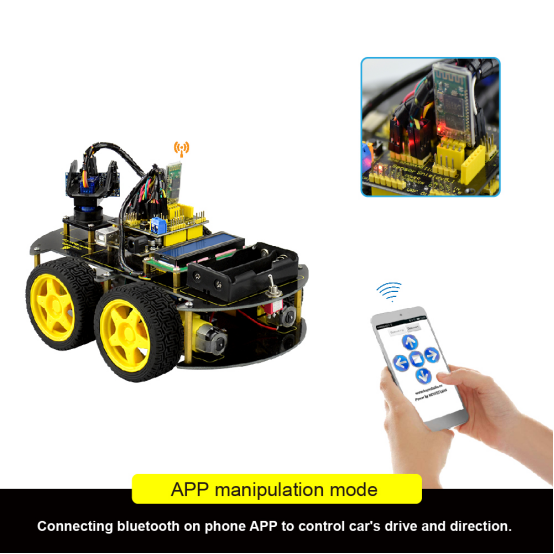
This project,regarding Arduino microcontroller as main control, uses IR module to receive IR remote signal and send the signal to Arduino. Arduino will analyze the signal and then control the driver motor and the motion of the car with IR remote control. In addition, you can observe the state of the car through keyestudio 1602 I2C Module.
2.Principle
Connecting Arduino to IR receiving module,Bluetooth module and IR receiving module communicating with IR remote control.
IR remote control will send these button message“
 ”
” “ ”
“ ” “ ”
“ ” “ ”
“ ” “ ”
“ ” “to IR receiving module.
IR receiving module will send signal to Arduino , and it will control the motion of the car.
When Arduino receiving this message “
 ”,the car goes forwards;when receiving this“
 ”, the car goes backward;when receiving“
 ”,the car turns left;when receiving“
 ”,the car turns right;when receiving“
 ”,the car stops;when receiving“
 ”, the car quits.
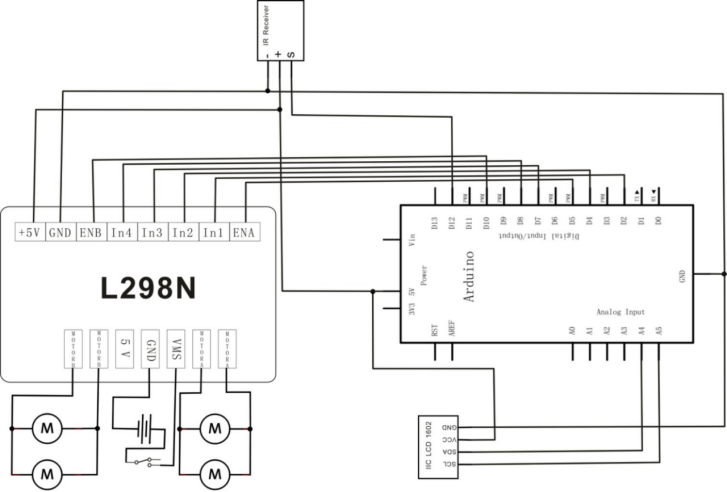
3.Schematic Diagram
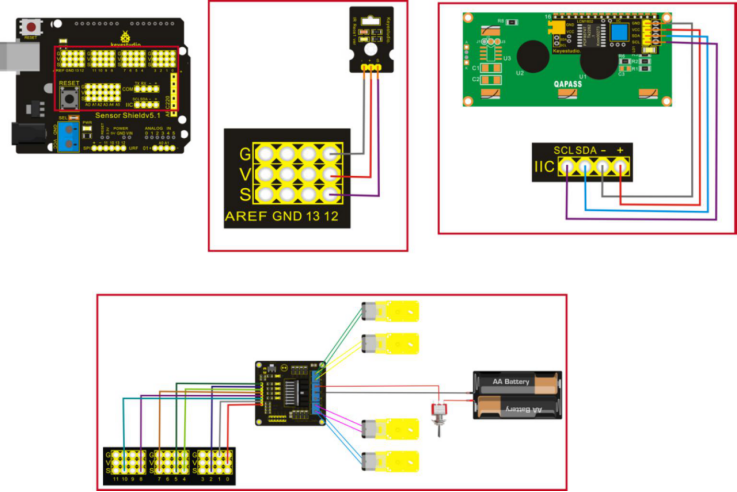
4.Connection Diagram
5.Sample Code
#include <LiquidCrystal_I2C.h>   //including libraries of I2C-LCD1602 liquid crystal
#include <Wire.h>                //including libraries of I2C
#include <IRremote.h>
int RECV_PIN = 12;
IRrecv irrecv(RECV_PIN);
decode_results results;
#define IR_Go      0x00ff629d
#define IR_Back    0x00ffa857
#define IR_Left    0x00ff22dd
#define IR_Right   0x00ffc23d
#define IR_Stop    0x00ff02fd
#define IR_ESC     0x00ff52ad
LiquidCrystal_I2C lcd(0x27,16,2);  //defining liquid crystal
#define Lpwm_pin  5     //adjusting speed
#define Rpwm_pin  10    //adjusting speed //
int pinLB=2;           // defining pin2 left rear
int pinLF=4;           // defining pin4 left front
int pinRB=7;           // defining pin7 right rear
int pinRF=8;           // defining pin8 right front
unsigned char Lpwm_val = 200;
unsigned char Rpwm_val = 200;
int Car_state=0;

void M_Control_IO_config(void)
{
  pinMode(pinLB,OUTPUT); // pin2
  pinMode(pinLF,OUTPUT); // pin4
  pinMode(pinRB,OUTPUT); // pin7
  pinMode(pinRF,OUTPUT); // pin8
  pinMode(Lpwm_pin,OUTPUT); // pin11 (PWM)
  pinMode(Rpwm_pin,OUTPUT); // pin10 (PWM)
}

void Set_Speed(unsigned char Left,unsigned char Right)
{
  analogWrite(Lpwm_pin,Left);
  analogWrite(Rpwm_pin,Right);
}

void advance()     // going forward
{
     digitalWrite(pinRB,LOW);  // making motor move towards right rear
     digitalWrite(pinRF,HIGH);
     digitalWrite(pinLB,LOW);  // making motor move towards left rear
     digitalWrite(pinLF,HIGH);
     Car_state = 1;
     show_state();
}

void turnR()        //turning right(dual wheel)
{
     digitalWrite(pinRB,LOW);  //making motor move towards right rear
     digitalWrite(pinRF,HIGH);
     digitalWrite(pinLB,HIGH);
     digitalWrite(pinLF,LOW);  //making motor move towards left front
     Car_state = 4;
     show_state();
}

void turnL()        //turning left(dual wheel)
{
     digitalWrite(pinRB,HIGH);
     digitalWrite(pinRF,LOW );   //making motor move towards right front
     digitalWrite(pinLB,LOW);   //making motor move towards left rear
     digitalWrite(pinLF,HIGH);
     Car_state = 3;
     show_state();
}

void stopp()         //stop
{
     digitalWrite(pinRB,HIGH);
     digitalWrite(pinRF,HIGH);
     digitalWrite(pinLB,HIGH);
     digitalWrite(pinLF,HIGH);
     Car_state = 5;
     show_state();
}

void back()          //back up
{
     digitalWrite(pinRB,HIGH);  //making motor move towards right rear
     digitalWrite(pinRF,LOW);
     digitalWrite(pinLB,HIGH);  //making motor move towards left rear
     digitalWrite(pinLF,LOW);
     Car_state = 2;
     show_state() ;
}

void show_state(void)
{
   lcd.setCursor(0, 1);
   switch(Car_state)
   {
     case 1:lcd.print(" Go  ");Serial.print("\n GO");
     break;
     case 2:lcd.print("Back ");Serial.print("\n Back");
     break;
     case 3:lcd.print("Left ");Serial.print("\n Left");
     break;
     case 4:lcd.print("Right");Serial.print("\n Right");
     break;
     case 5:lcd.print("Stop ");Serial.print("\n Stop");
     break;
     default:
     break;
   }
}

void LCD1602_init(void)            //function of initialization of liquid crystal
{
   lcd.init();  //invoking initialized function in LiquidCrystal_I2C.h
   delay(10);   //delaying for10 millisecond
   lcd.backlight(); //open backlight of LCD1602
   lcd.clear();     //clear screen
}

void IR_Control(void)
{
   unsigned long Key;
   lcd.setCursor(0,0);  //setting cursor in the first row and column
   lcd.print("IR_Ctr          ");
   while(Key!=IR_ESC)
   {
      if(irrecv.decode(&results)) //judging if serial port receives data
      {
      	 Key = results.value;
    	 switch(Key)
         {
           case IR_Go:advance();   //UP
           break;
           case IR_Back: back();   //back
           break;
           case IR_Left:turnL();   //Left
           break;
           case IR_Right:turnR(); //Righ
           break;
           case IR_Stop:stopp();   //stop
           break;
           default:
           break;
        }
        irrecv.resume(); // Receive the next value
      }
   }
   lcd.clear();
   lcd.setCursor(0, 0);  //setting cursor in the first row and column,
   lcd.print("  Wait  Signal  ");
   stopp();
}

void setup()
{
   LCD1602_init();
   M_Control_IO_config();
   Set_Speed(Lpwm_val,Rpwm_val);
   irrecv.enableIRIn(); // Start the receiver
   Serial.begin(9600);   //initializing serial port, Bluetooth used as serial port, setting baud ratio at 9600
   lcd.setCursor(0, 0);  //setting cursor at the first row and column
   lcd.print("  Wait  Signal  ");
   stopp();
}

void loop()
{
   if (irrecv.decode(&results))
   {
      if(results.value == IR_Stop )IR_Control();
      irrecv.resume(); // Receive the next value
   }
}