Project 11 Distance Detecting of Smart Car
1.Introduction
This project,regarding Arduino as main control, is to detect front obstacle by ultrasonic sensor and platform motor, and then send the feedback to Arduino. Arduino will analyze the feedback signal and then control the driver motor to adjust the car diversion. Finally the car is able to avoid obstacle automatically and to keep going.
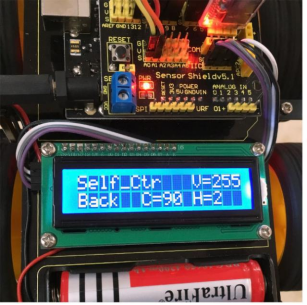
In addition, you can observe the state and speed of the car, the angle of motor and the distance between car and obstacle through keyestudio 1602 I2C Module.
2.Principle
Ultrasonic detecting distance: one port emits high level more than 10 US. Once it outputting level, open potentiometer to time. When the port becomes low level, read out current value. Use the time of detecting distance to calculate distance.
Use ultrasonic to detect the distance between obstacle and car, so that control the motion of the car according to the data.
If the distance between the car and obstacle is less than 35 cm, the car goes backward; if the distance is no less than 10 cm, the car goes forwards; if the distance is less than 60 cm, the motor turns to detect the distance between car and left obstacle or right obstacle; if the distance between car and left obstacle, the distance between car and right obstacle are less than 35 cm, the car goes backward; if the distance between car and left obstacle is larger, the car turns left; if the distance between car and left obstacle is less than or equal to the distance between car and right obstacle, the car turns right.
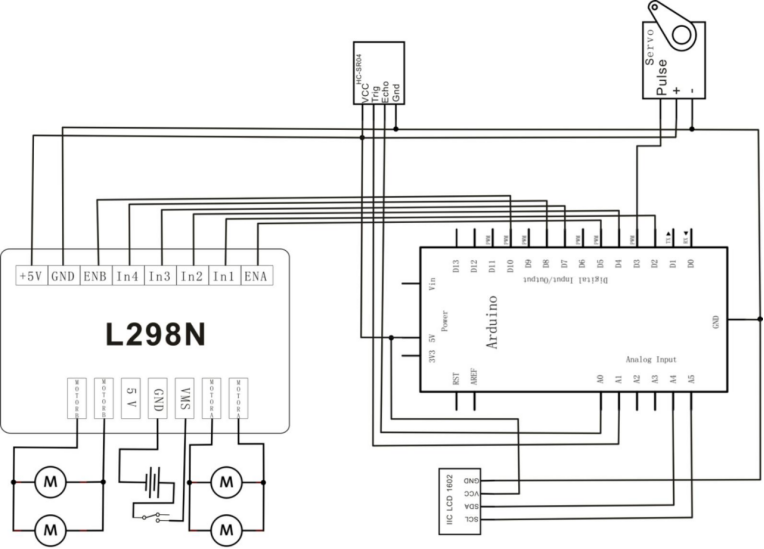
3.Schematic Diagram
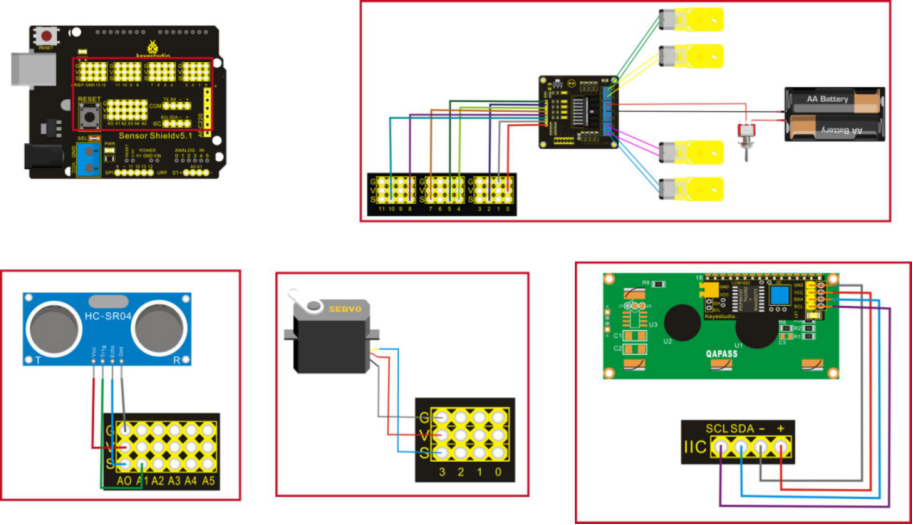
4.Connection Diagram
5.Sample Code
#include <LiquidCrystal_I2C.h>   //including libraries of I2C-LCD1602 liquid crystal
#include <Wire.h>              //including libraries of I2C
int inputPin=A0;  // ultrasonic module   ECHO to A0
int outputPin=A1;  // ultrasonic module  TRIG to A1
LiquidCrystal_I2C lcd(0x27,16,2);   //defining liquid crystal
#define Lpwm_pin  5     //pin of controlling speed---- ENA of motor driver board
#define Rpwm_pin  10    //pin of controlling speed---- ENB of motor driver board
int pinLB=2;             //pin of controlling turning---- IN1 of motor driver board
int pinLF=4;             //pin of controlling turning---- IN2 of motor driver board
int pinRB=7;            //pin of controlling turning---- IN3 of motor driver board
int pinRF=8;            //pin of controlling turning---- IN4 of motor driver board
unsigned char Lpwm_val = 250; //initialized left wheel speed at 250
unsigned char Rpwm_val = 250; //initialized right wheel speed at 250
int Car_state=0;             //the working state of car
int servopin=3;              //defining digital port pin 3, connecting to signal line of servo motor
int myangle;                //defining variable of angle
int pulsewidth;              //defining variable of pulse width
unsigned char DuoJiao=60;    //initialized angle of motor at 60°

void servopulse(int servopin,int myangle) //defining a function of pulse
{
    pulsewidth=(myangle*11)+500; //converting angle into pulse width value at 500-2480
    digitalWrite(servopin,HIGH); //increasing the level of motor interface to upmost
    delayMicroseconds(pulsewidth); //delaying microsecond of pulse width value
    digitalWrite(servopin,LOW); //decreasing the level of motor interface to the least
    delay(20-pulsewidth/1000);
}

void Set_servopulse(int set_val)
{
	for(int i=0;i<=10;i++)  //giving motor enough time to turn to assigning point
   		servopulse(servopin,set_val); //invokimg pulse function
}

void M_Control_IO_config(void)
{
    pinMode(pinLB,OUTPUT); // /pin 2
    pinMode(pinLF,OUTPUT); // pin 4
    pinMode(pinRB,OUTPUT); // pin 7
    pinMode(pinRF,OUTPUT);  // pin 8
    pinMode(Lpwm_pin,OUTPUT);  // pin 11 (PWM)
    pinMode(Rpwm_pin,OUTPUT);  // pin10(PWM)
}

void Set_Speed(unsigned char Left,unsigned char Right) //function of setting speed
{
    analogWrite(Lpwm_pin,Left);
    analogWrite(Rpwm_pin,Right);
}

void advance()    //  going forward
{
     digitalWrite(pinRB,LOW);  // making motor move towards right rear
     digitalWrite(pinRF,HIGH);
     digitalWrite(pinLB,LOW);  // making motor move towards left rear
     digitalWrite(pinLF,HIGH);
     Car_state = 1;
     show_state();
}

void turnR()        //turning right(dual wheel)
{
     digitalWrite(pinRB,LOW);  //making motor move towards right rear
     digitalWrite(pinRF,HIGH);
     digitalWrite(pinLB,HIGH);
     digitalWrite(pinLF,LOW);  //making motor move towards left front
     Car_state = 4;
     show_state();
}

void turnL()         //turning left(dual wheel)
{
     digitalWrite(pinRB,HIGH);
     digitalWrite(pinRF,LOW );   //making motor move towards right front
     digitalWrite(pinLB,LOW);   //making motor move towards left rear
     digitalWrite(pinLF,HIGH);
     Car_state = 3;
     show_state();
}

void stopp()        //stop
{
     digitalWrite(pinRB,HIGH);
     digitalWrite(pinRF,HIGH);
     digitalWrite(pinLB,HIGH);
     digitalWrite(pinLF,HIGH);
     Car_state = 5;
     show_state();
}

void back()         //back up
{
     digitalWrite(pinRB,HIGH);  //making motor move towards right rear
     digitalWrite(pinRF,LOW);
     digitalWrite(pinLB,HIGH);  //making motor move towards left rear
     digitalWrite(pinLF,LOW);
     Car_state = 2;
     show_state() ;
}

void show_state(void)
{
  lcd.setCursor(0, 1);
   switch(Car_state)
   {
     case 1:lcd.print(" Go  ");Serial.print(" \r\n GO");
     break;
     case 2:lcd.print("Back ");Serial.print(" \r\n Back");
     break;
     case 3:lcd.print("Left ");Serial.print(" \r\n Left");
     break;
     case 4:lcd.print("Right");Serial.print(" \r\n Right");
     break;
     case 5:lcd.print("Stop ");Serial.print(" \r\n Stop");
     break;
     default:
     break;
   }
}
void LCD1602_init(void)            //including initialized function of liquid crystal
{
   lcd.init();  //invoking initialized function of LCD in LiquidCrystal_I2C.h
   delay(10);  //delaying for 10 millisecond
   lcd.backlight(); //open backlight of LCD1602
   lcd.clear();    //clear screen
}

void Show_V(unsigned char V)
{
    lcd.setCursor(11, 0);
    lcd.print("V=    ");
    lcd.setCursor(13, 0);
    lcd.print(V,DEC);
    Serial.print("\n Speed = ");
    Serial.print(V,DEC);
}

void Show_DuoJiao(unsigned char Jiao)
{
     lcd.setCursor(6,1);
     lcd.print("C=    ");
     lcd.setCursor(8, 1);
     lcd.print(Jiao,DEC);
     Serial.print("\n JiaoDu = ");
     Serial.print(Jiao,DEC);
}

void Self_Control(void)//self-going, ultrasonic obstacle avoidance
{
    int H;
    lcd.setCursor(0, 0);  //setting cursor in the first row and column
    lcd.print("Self_Ctr        ");
    Show_V(Lpwm_val);
    Set_servopulse(DuoJiao);
    Show_DuoJiao(DuoJiao);
    H = Ultrasonic_Ranging(1);
    delay(300);
    if(Ultrasonic_Ranging(1) < 35)
    {
       stopp();
       delay(100);
       back();
       delay(50);
    }
    if(Ultrasonic_Ranging(1) < 60)
    {
        stopp();
        delay(100);
        Set_servopulse(5);
        Show_DuoJiao(5);
        int L = ask_pin_L(2);
        delay(300);
        Set_servopulse(177);
        Show_DuoJiao(177);
        int R = ask_pin_R(3);
        delay(300);
        if(ask_pin_L(2) > ask_pin_R(3))
        {
           back();
           delay(100);
           turnL();
           delay(400);
           stopp();
           delay(50);
           Set_servopulse(DuoJiao);
           Show_DuoJiao(DuoJiao);
           H = Ultrasonic_Ranging(1);
           delay(500);
        }
        if(ask_pin_L(2)  <= ask_pin_R(3))
        {
           back();
           delay(100);
           turnR();
           delay(400);
           stopp();
           delay(50);
           Set_servopulse(DuoJiao);
           Show_DuoJiao(DuoJiao);
           H = Ultrasonic_Ranging(1);
           delay(300);
        }
        if (ask_pin_L(2)  < 35 && ask_pin_R(3)< 35)
        {
           stopp();
           delay(50);
           back();
           delay(50);
        }
     }
     else
     {
     	advance();
     }
}

int Ultrasonic_Ranging(unsigned char Mode)//function of ultrasonic distance detecting ,MODE=1,displaying,no displaying under other situation
{
  int old_distance;
  digitalWrite(outputPin, LOW);
  delayMicroseconds(2);
  digitalWrite(outputPin, HIGH);
  delayMicroseconds(10);
  digitalWrite(outputPin, LOW);
  int distance = pulseIn(inputPin, HIGH);  // reading the duration of high level
  distance= distance/58;   // Transform pulse time to distance
  if(Mode==1)
  {
      lcd.setCursor(11, 1);
      lcd.print("H=    ");
      lcd.setCursor(13, 1);
      lcd.print(distance,DEC);
      Serial.print("\n H = ");
      Serial.print(distance,DEC);
      return distance;
  }
  else  return distance;
}

int ask_pin_L(unsigned char Mode)
{
  int old_Ldistance;
  digitalWrite(outputPin, LOW);
  delayMicroseconds(2);
  digitalWrite(outputPin, HIGH);
  delayMicroseconds(10);
  digitalWrite(outputPin, LOW);
  int Ldistance = pulseIn(inputPin, HIGH);
  Ldistance= Ldistance/58;   // Transform pulse time to distance
  if(Mode==2)
  {
      lcd.setCursor(11, 1);
      lcd.print("L=    ");
      lcd.setCursor(13, 1);
      lcd.print(Ldistance,DEC);
      Serial.print("\n L = ");
      Serial.print(Ldistance,DEC);
      return Ldistance;
  }
  else  return Ldistance;
}

int ask_pin_R(unsigned char Mode)
{
  int old_Rdistance;
  digitalWrite(outputPin, LOW);
  delayMicroseconds(2);
  digitalWrite(outputPin, HIGH); //
  delayMicroseconds(10);
  digitalWrite(outputPin, LOW);
  int Rdistance = pulseIn(inputPin, HIGH);
  Rdistance= Rdistance/58;   // Transform pulse time to distance
  if(Mode==3)
  {
      lcd.setCursor(11, 1);
      lcd.print("R=    ");
      lcd.setCursor(13, 1);
      lcd.print(Rdistance,DEC);
      Serial.print("\n R = ");
      Serial.print(Rdistance,DEC);
      return Rdistance;
  }
  else
      return Rdistance;
}

void setup()
{
   pinMode(servopin,OUTPUT);  //setting motor interface as output
   LCD1602_init();            //initializing 1602
   M_Control_IO_config();     //motor controlling the initialization of IO
   Set_Speed(Lpwm_val,Rpwm_val);  //setting initialized speed
   Set_servopulse(DuoJiao);       //setting initialized motor angle
   pinMode(inputPin, INPUT);      //starting receiving IR remote control signal
   pinMode(outputPin, OUTPUT);    //IO of ultrasonic module
   Serial.begin(9600);            //initialized serial port , using Bluetooth as serial port, setting baud
   lcd.setCursor(0, 0);           //setting cursor at 0.0
   lcd.print("  Wait  Signal  ");  //LCD printing character string
   stopp();                       //stop
}

void loop()
{
   Self_Control();
}